Say Ron Paul Won…Which US Allies would get Retrenched? (2) Japan?

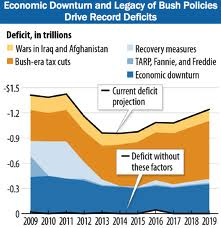
retrenchment graph

This post series is getting so much traffic, here is a part three on likelihood of retrenchment. Here is part one where argued that America’s 8 most important allies are, in order: Canada, Mexico, Saudi Arabia, Taiwan, India, Indonesia, Israel, and South Korea.

I argued for 3 quick-and-dirty reasons for that ranking, but I got some criticism on these in the first post, so here is some elaboration :

1. National Security: Some places, like SA and Mexico, may not appeal much to Americans, but they are so obviously important, that abandonment would be hugely risky. So yes, SA is a nasty, reactionary ‘frenemy,’ not really an ally at all, but we’re stuck with it. A Saudi collapse would set off both huge economic and Islamic religious turmoil; all the more reason to slowly exit the Middle East and pursue green energy. But until then, I think we have to be honest and say that we can’t really leave the Gulf. But the bar of this criterion should be awfully high. With some frenemies, like Afghanistan and Pakistan, we don’t really need to pretend to be allies actually. We can just get out if have to.

2. Need: In some places, the US can get a lot more bang for its commitment buck, because without us, our ally would likely collapse/lose/fail. Taiwan is the most obvious example. Conversely, other places, like Germany, pretend to need us, because they don’t want to shell out the cash (and we’re so bewitched of our God-given, history-ending, last-best-hope-for-mankind, bound-to-lead neocon unipolar awesome-ness that we let ourselves get taken for a ride).Between Taiwan and Germany, I would place Israel and SK.

3. Values/Symbolism: I don’t like this criterion much, because it reminds me a lot of McNamara, ‘credibility,’ Vietnam, the Munich analogy and all that. But still, there are a few places where the American commitment has taken on an almost ‘metaphysical,’ good-guys-vs-bad-guys dimension. The whole world is watching, and a departure would be seen as a huge retreat from critical values that would bolster dictators everywhere, especially in China and Russia. SK is the most obvious example. NK is so bizarre, frightening, and horrific that while the US commitment isn’t really that necessary anymore, it’s taken on a symbolism wholly out of proportion to events on the peninsula. Taiwan also comes to mind, as does cold war West Germany. Avoiding another such perpetual commitment was one of the important reasons to get out of Iraq. If we’d stayed, we might have have gotten chain-ganged into never leaving our symbol of GWoT ‘success.’ We really don’t need more of that sort thing

So back to the list. Now come the ones that can more easily be retrenched, because either they are wealthy enough to defend themselves, or their value to the US has fallen:

Continue reading

Would Ron Paul Retrench the US from Korea?

retrenchment

Here is part two, and then a third, given just how much traffic this post has received (h/t to Stephen Walt and Andrew Sullivan).

Here is Steve Walt saying nice things about Ron Paul, and Layne has a nice recent piece in the National Interest, and another at ISQ, about looming US retrenchment.  Earlier I argued that I think lots of people in IR now both expect and want some measure of US pullback. The argument is pretty well-known by now – empirically, the US is doing more than it can afford, like the Iraq war (trillion dollar deficits and ‘overstretch’); normatively, we are violating far too many of our liberal values against a comparatively minor terrorist threat (torture, indefinite detention, unoverseen drone strikes). But I don’t see too much on what specifically could be cut if absolutely necessary. The British retrenchment east of Suez in the 70s is probably our best model, but of course, the Brits had different sets of commitments, so it’s not a great blueprint.

So I try below to compile a list of who would/could/should get the axe and who not. Just like the intense competition over the periodic BRACs, one could imagine US allies making their case for a retention of US bases, troops, aid, etc. In one of his speeches, I heard Ron Paul argue that we have 900 overseas bases, so the field of choice is very wide.

I can think of 3 basic criteria for judgment of whom should be cut loose and who not:

Continue reading

China’s Counter to the Asian ‘Pivot’ (2): ‘Swarms’ in the Pacific

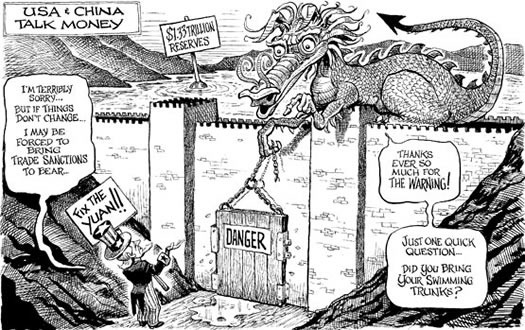
china-us-economic-warfare

Part one is here, where I noted China’s growing fear of encirclement (I get Chinese students a lot who talk about this). So, in the role of China, I argued for an Indian charm offensive to prevent encirclement, and how China might buy off Korea from the US camp by abandoning North Korea. Here are some more ‘B-Team’ style ideas for pushing back on US local dominance, including swarming the US navy in the western Pacific with cheap drones and missiles:

Continue reading

China’s Counter to the Asian ‘Pivot’ (1): Korea, India

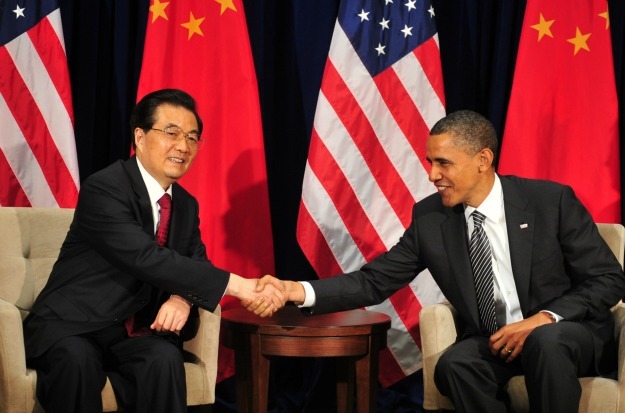
obamahu132628592pk

So the US is supposedly going to pivot to Asia and start worrying more about China. This makes sense (which is probably why we won’t do it). The Middle East has become a pretty terrible sinkhole of American power. Increasingly the verdict on the war on terrorism is negative, and we should probably retrench from the Middle East (but we won’t because of the religious right’s interest in the region). Mearsheimer argued that if it weren’t for 9/11 we probably would have focused on China a lot earlier. Kaplan sketched how the US would defeat China in a war. I argued a few years ago, at the height of the ‘China-has-changed-into-a-scary-revisionist’ hype of 2009-11, that containment of China was likely (maybe even desirable Sad smile). And clearly China’s behavior over the last few years has raised the likelihood of at least soft containment; even the Vietnamese and the Filipinos are asking for US agreements now.
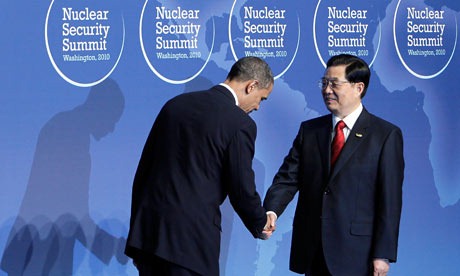

But I don’t see much Western discussion of how China would/should respond. So in the tradition of those old CIA A team/B team exercises, here are five ideas for how China should/could respond to its incipient encirclement:

Continue reading

The US will not ‘Pivot’ much to Asia (3): We can’t afford it

Pesident-Obama-China-001

Please read parts one and two first, where I argued that there is no constituency in the US for the pivot, and that Asia is so culturally distant from the US, that Americans are unlikely to care enough to sustain the pivot. But we also don’t really need to pivot, nor do we have the money for it:

3. The Middle East is characterized by so many nondemocracies that the US must be heavily invested (at least to meet current US goals – oil, Israel, counterterrorism). Katzenstein noted this; America has no strong subordinate anchor-state in the region (like Germany in Europe and Japan in Asia). This is why the GOP particularly emphasizes an enduring, semi-imperial presence in the Gulf. Besides tiny Israel, we don’t have the friends necessary for things like the dual containment (Iran and Iraq) of the 90s, and or the Iraq war of the 2000s. So we have to do it all ourselves.

By contrast in Asia, we have lots of allies and semi-friends who are strong and functional – Japan, Australia, Korea, and Taiwan most obviously – with improving relations with India and Vietnam too. Now, if we are smart – or maybe just because we are broke – we can push a lot of the costs of our goals onto them. Specifically, much of the pivot has been assumed to be targeted at China. But why should we encircle, contain, or otherwise provoke China, when the frontline states should be it doing it first? In other words, we don’t have to pivot toward Asia unless China threatens to invade everybody, because places like India, Korea, and Japan will work hard to build and maintain a multipolar equilibrium. They don’t want to be dominated by China, and they will suffer a lot more than we will if China becomes the regional hegemon. So we can hover in the background, offshore, over the horizon, as we always have. Given the strength of liberal democracy in Asia (unlike the ME), there is no need for us to be there in strength.

Continue reading

The US will not ‘Pivot’ much to Asia (2): We don’t really care @ Asia

4478141208_8caeba59d9

That is my Asian pivot.

Here is part one, where I argued that there is no constituency in the US to support an Asian pivot besides the some business people.

2. Connected to the first point is that Americans don’t know much about Asia. Of course, it’s true Americans don’t know a lot about the world generally. We are a superpower, so we don’t have to know about others; others have to know about us. That’s why ‘they’ learn English, and we think Urdu is a country in the Sahara. We are geographically far away, so touring Europe or Asia is very expensive. We don’t (need to) speak foreign languages. But beyond that general ‘ugly American’ stuff, I think Americans are particularly ignorant about Asia. Asia is the most culturally different social space in the world from the US I can think of, with the possible exception of central Africa. Latin America, Europe, Oceania, and Russia are all in, or close enough to, Western Civilization that what we learned in high school civics classes can apply. They look like us (kind of); they eat like us, their languages are fairly similar (Indo-European roots); they dress like us; they worship like us. The tribal cultural gap (how others eat, dress, talk, worship, look, write, etc.) is not that wide .

Continue reading

The US will not ‘Pivot’ much to Asia (1): We don’t really Want to

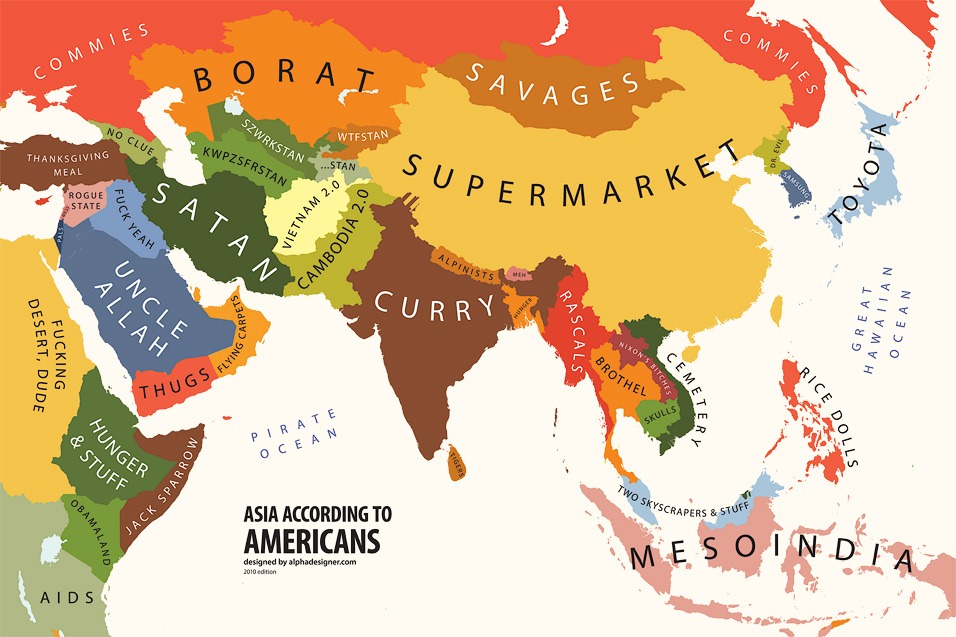
Asia According to USA

I pulled this image from here.

So the US pivot toward Asia is all the rage in foreign policy  now. Obama and Secretary Clinton genuinely seem to believe in this, and there good reasons for it. Briefly put, Asia has the money, people, and guns to dramatically impact world politics in a way that no other region can now. But I think the US Asian pivot won’t happen much nonetheless, because: 1) Americans, especially Republicans, don’t care about Asia, but they really care about the Middle East (a point the GOP presidential debates made really obvious); 2) Americans know less about Asia than any part of the world, bar Africa perhaps; 3) intra-Asian soft balancing (i.e., almost everyone lining up informally against China) means we don’t really need to be that involved, because our local allies will do most of the work; 4) we’re too broke to replicate in Asia the sort of overwhelming presence we built in the Middle East in the last decades.

Continue reading

Some IR Thoughts on the GOP Debate Marathon

I guess if you speak a foreign language, you’re a traitor

Here were my first, domestic politics thoughts on the GOP debate-run, particularly the competitive, extreme position-taking forced onto the candidates by the audience reactions. But I thought the debates actually taught us very little directly on foreign policy (beyond bombast, or just watch the vid above you francophile, cheese-eating traitor to the heartland). Instead, most of my cues were indirect, such as audience reaction:

4. We (and the world) learned a lot from the audience behavior. I don’t think anyone anticipated this, but the GOP audience demographic (aging white evangelicals), plus its hoots and hollers (for torture, against the Palestinians, for executions, for war with Iran) communicated a lot of information in itself. It showed just how captured the GOP is now by a hard right Christianist ideology that comes off as more than just angry, but downright belligerent, if not scary. And for IR, this is important too. Foreigners will see this stuff and hardly believe that American hegemony is ‘benevolent’ or ‘benign.’ I’ve said this before, but this Tea Party radicalism is washing downstream to the rest of the world; a few years ago, my students here were asking me in amazement why Americans were comparing Obamacare to the Nazis, and I just ran out of lame excuses. Foreigners do pick up on this stuff, Fox News execs. You can’t talk like this and be a superpower at the same time. Foreigners do think we are fairly bonkers, and don’t even start with that ‘bound to lead’ schtick (more like unfit), when so many Americans muse that Obama might be the Antichrist or a Muslim non-citizen.

Continue reading

GOP SotU Response Better than SotU (2)

images 234

Part one of my response to Obama’s 2012 State of the Union is here.

3. The foreign policy section was weaker and more militaristic than usual. The opening bit about the Iraq war making us ‘safer and more respected around the world’ was jaw-dropping. I guess this really is a campaign speech outreach to the right, because I can’t believe any of the president’s 2008 voters actually buy that line. Does anyone really believe that anymore, except for the right-wing think-tank set or something (ok, I’ll admit I did until a few years ago, but not now)? Wow. Didn’t people vote for Obama because of exactly the kind of Bushian American hubris that can read an unjustified, unprovoked, unilateral assault on another state (which would have provoked howls of rejection by Americans if done by any other country in the world) as a great American victory? Veterans too got a pander wishlist – even though even Michelle Bachmann (!) has come to realize that VA benefits will have to be included in any budget deal.

Continue reading

Competing Maps of Eurasia: Mackinder vs Barnett & the US Asian ‘Shift’

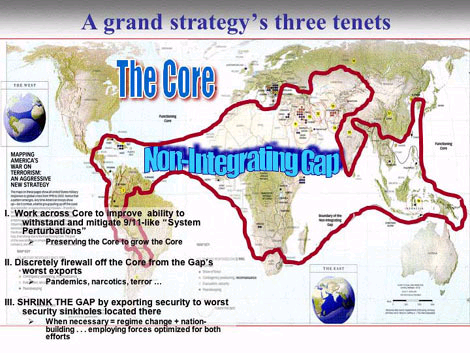
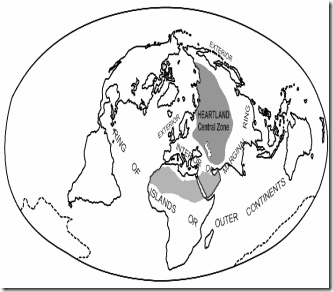
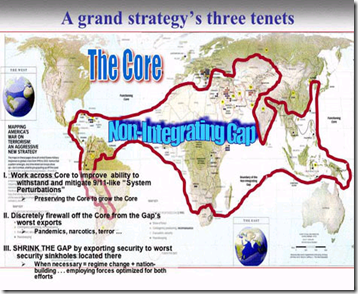
mackindersworldCore Gap

Mackinder’s famous map is on the left; Barnett’s is on the right. Here is Mackinder’s famous article; here is Barnett’s book.

It is a slow fall for Asian stuff. China is behaving better; Japan and SK are quiet; NK always seems like its building a new military installation somewhere, but it’s fairly quiet too. If you missed KJI’s birthday though, click here. The big recent new is the US decision to ‘shift’ toward Asia and the placement of US forces in Australia. Last year, I predicted that the US would lead a containment ring around China (yes, I realize that that is not a very gutsy ‘prediction’ at this point in the game). I see this as the first step. So here are some big geopolitics thoughts on the US shift, because I was re-reading Mackinder for work.

Halford Mackinder practically founded the field of geopolitics single-handedly with his famous article and the above map. It became the informal basis of US strategy in WWII and to certain extent, justified Cold War containment: keeping the Soviets penned into Northeast Eurasia. So it’s easy to roll this over to China. Mackinder’s map privileges land power. Mackinder thought the center of Eurasia constituted the ‘heartland’ that would be the pivot of global dominance. (China could arguably be a part of that, as it is far more populous than Siberia.) His famous quote was: Who rules East Europe commands the Heartland; Who rules the Heartland commands the World Island; Who rules the World Island commands the World.” Generations of German, Russian/Soviet, and (to a much lesser extent) American cold war strategists, took this as established wisdom. And indeed, I argue similarly in my Geopolitics article. The US is safe behind two big oceans, so long as no one controls all of Eurasia. If Napoleon, Hitler or Stalin had managed to control that whole stretch though, then a transoceanic invasion of the US might actually be possible. (Inter alia, it was Mackinder who coined that term ‘Eurasia.’) Probably the most famous exposition of the heartland theory’s importance for the US was from Frank Capra (yes, the guy who made It’s a Wonderful Life.)

Barnett comes more from the traditional American school privileging seapower, best known from the work of A T Mahan. Mahan thought (and Teddy Roosevelt agreed) that a powerful US navy was a the shield of the nation against the chaos of Eurasia. There is no need to get into long wars about the heartland; off-shore balancing is possible. The long US naval tradition is why the heartland school was never as dominant in the US as in Eurasia. Even though the US invented the nuke and has fought a land war in Asia for a decade now, the US is still firstly a naval power. I also think Barnett’s map reflects the American infatuation with technology and capitalism. Mackinder’s image is very traditional or realist: big states with big industries build big armies to conquer big spaces. This is a recipe every land strategist from Sun Tzu to Clausewitz could love. Barnett goes around all that to re-write geopolitics politically not militarily. In post-industrial economies, the control of land isn’t so important anymore (people’s brains are a lot more important than their manual labor in the fields of Ukraine). The critical divide is then between those states that function and those that do not. The functioning ones join globalization, get rich in the process, and then can use their wealth to set the rules. The nonfunctioning ones can’t grasp the benefits of globalization, generate all sorts of asymmetric problems, and are therefore the locus of military conflict. Policing failing states as spaces is more important the conquest of strategic territory. In Barnett’s world, Iraq, Somalia, Afghanistan, etc. are the threats of the future; in Mackinder’s China should start bullying central Asia and maybe Russia soon.

Has Barnett’s vision of Eurasia divided into functioning and failed states replaced Mackinder’s land-power realism? It seems to me that this is a good test of whether or not globalization is really changing a lot. If China and Russia become status quo powers, then yes.  Then the only big issues will be integrating the periphery and rogues into the world economy. In this environment, salafism and other ‘remnants of war’ becomes the biggest challenger (headache really) to the US. But Russia, and especially China, pursue major changes in the land order in Asia, then score one for the realists. And America’s decision to base in Australia now too says Obama is leaning against Barnett-Mahan offshore balancing, toward forward deterrence of Asia domination.

I would add to other factors to this macro-musing:

1. A strong test of these competing maps is Chinese and Russian behavior if US power weakens. Radical Islamists, driven by the fear of God, will assault the West regardless of the chances of victory. So in that sense, Barnett will always be correct. But Russia and China are more rational. If US unipolarity holds, they are not likely to challenge the US, so then we’ll never know if the Russians and Chinese have changed because of globalization or were just deterred. But if the US declines, if military power genuinely disperses, and multipolarity emerges, then look for a challenge. As Beinart notes, “Offshore balancing, by contrast, reemerges when the money and bravado have run out.”

2. Global warming will raise the importance of the Heartland. In 1943, Mackinder noted the importance of the river basins in the Heartland. Fortunately for the West, those that flowed into the Arctic were blocked mostly be ice. Russian/Soviet naval power was forced to the fringes – Vladivostok, Leningrad, Odessa. If the Arctic truly meets permanently, perennial land power Russia will immediately become a sea power too. This would be an unprecedented shift, as geographic obstacles like the Arctic ice pack have generally been understood to be permanent, immovable features of geopolitics.