My Lowy Post: Relax (again), Japan is Not ‘Re-Militarizing’

images

If there is any one trope in Korean and Chinese international relations writing I don’t like, it is the causal, constant, angry insistence on reading Japan as always ‘remilitarizing.’ In just about everything I read by Korean and Chinese authors on northeast Asia this is repeated relentlessly, as a truism, and usually in the worst possible normative light: not only is Japan ‘remilitarizing,’ it also apparently has neo-imperial designs on Asia.

Sorry, Koreans and Chinese, but this is just not true, not at all really. Note for example, that Japan always seems to be in the process of re-militarizing in this manner of writing. It is never actually done doing so; it’s constant and insidious. No matter what Japan does on national security, it always is described as re-militarizing. Apparently Japanese remilitarization has been going on for decades; which is another way of saying it isn’t really happening at all. Note too, that no one ever seems to remark on Japan’s paltry defense spending or systemic dependence on the US military. So this is just silly boilerplate; it’s far more about Korean and Chinese nationalist dislike for Japan than any real empirical trend. But since it gets repeated so often, and seems to be taken for granted by just about everyone in Korea and China, it is worth laying out in some detail why is is bunk.

The essay below the jump is re-post of this essay for the Lowy Institute in Australia.

Continue reading

My Lowy Post on Japan’s Pointless, Self-Indulgent WTH? Review of the Kono Statement

This is a re-print of a post for the Lowy Institute on the recent Japanese review of the Kono statement on Imperial military sexual service during the war. (That’s Kono in the picture.)

What the point of the ‘review’ was, I can’t figure out. The GOJ ran the review, predictably found the answer Abe wanted – that Koreans pushed Japan into historical concessions in the 1993 debate – but then Abe said he won’t change the statement anyway.

Wait, what? Why run the review if it serves no purpose? What was the point? Just to prove to us all once again that Japanese conservatives can’t give-up their creepy fascination with the war? That the Japanese old guard still looks at Korea as ‘lucky’ to have been modernized by Japan? Why the hell run the Kono review if you aren’t going to change the statement? It was a total nationalist self-indulgence. Bleh. I like Abe some of the time, especially when he talks about China and economics; but when it comes to the war, he sound like David Irving. Yikes.

Here’s that essay:

“The Korea-Japan dispute over history is back, yet again. The Japanese government this week released a ‘review’ of the drafting of the ‘Kono Statement.’ That statement is the 1993 Japanese admission, by Chief Cabinet Secretary Yohei Kono, that the Imperial military during the Pacific War organized military brothels in which Korean women were often forced to serve. The Japanese euphemisms for this are ‘comfort women’ and ‘comfort stations’; in reality, this was enforced prostitution that inevitably included beatings and other abuse. As the Japanese empire expanded, the practice spread across Asia, including women in Japan’s southeast Asian holdings as well.

Continue reading

My Lowy Post on Obama’s Asia Trip – Watch Every Interest Group Instrumentalize it for its Own Purposes

PHOTO: Barack Obama waves as he walks down the stairs from Air Force One at Fiumicino Airport on March 28, 2014 in Rome, Italy.

So Obama is off to Asia this week for a quick trip that is inevitably being over-hyped by every Asia analyst on the planet as some major turning point in the US relationship with Asia. It’s not: below is re-printed my original, ‘watch-elites-manipulate-the-Obama-trip’ comment for the Lowy Institute. The spin will be over-the-top as every Asia pundit races for media exposure. Presidential trips are a great opportunity for the analyst community to posture and hyperventilate about how Obama ‘must’ do this, ‘has’ to do that.

Yawn.

Most of that is bunk. A lot of that is 1) analysts trying to demonstrate their own relevance and self-importance – is it surprising that Asia hands defend the Asia pivot so vociferously? But there is also 2), the unwillingness of a lot of Asia hands and hawks to admit that the US does not actually ‘have’ to do anything in Asia. America has huge freedom to move here, and Asian states – both allies and China – need the US way more than we need them. Where would Asian economies be without the US consumer? And even China might be nervous about a US forces withdrawal given the open balancing behavior that would likely spark in Japan, India, Vietnam, and the Philippines. So ignore all the commentary that the US ‘needs’ Asia; the real story is the opposite and that space which that gives the US to play hard-ball on things like Asian mercantilism and North Korea.

Continue reading

My Diplomat Essay for April: Unintended Consequences of US Alliances in Asia

UC

So this month for the Diplomat I wrote a speculative essay on US alliances in Asia – reposted below, original here. I think some people over-read it to mean that the US should leave Asia or that I endorse Chinese regional hegemony or whatever. I don’t. As I say in the piece, I still think the US presence is balance-positive, especially as China is moving from the ‘peaceful rise’ to capacious maritime claims off its east coast. Instead this was to be a thought experiment – an effort to tease out whether US regional alliances have negative impacts, given that almost all the discussion rather blithely assumes the opposite. I think the first possible downside suggested below – that China won’t cut North Korea loose until the US leaves Korea – is particularly strong and unsettling to the conventional wisdom. Ideally, this analysis would encourage thinking on mitigating these unintended side-effects.

Here is that essay. If you follow CSIS’ ‘PacNet’ series (which you should btw), a variant of this will come out there shortly:

“The conventional wisdom on US alliances in Asia, at least in the West, Japan, and Taiwan (but not necessarily in South Korea), is that they are broadly a good thing. One hears this pretty regularly from US officials and the vast network of US think-tanks and foundations like CSIS or AEI and their many doubles in Asia. US alliances, we are told, provide stability. They keep China from dominating the region. They hem in North Korea and defend the powerfully symbolic South Korean experiment in liberal democracy and capitalism. They prevent the nuclearization of South Korea and Japan and a spiraling regional arms race. In short, they re-assure.

Continue reading

My March Essay for the Diplomat: 3 Hypotheses for Korea’s ‘Japanobia’ – 1. Genuine; 2. Post-Colonial Score-Settling; 3. RoK Legitimating Ideology

This, I hope, is my last piece on Japan-Korea relations for awhile. I think everyone is getting burned out by this topic. And I am sick of the hate-mail. But at least Obama got Abe and Park into the same room last week. Park look pretty furious, but at least the meeting was progress.

This essay goes into what purpose or function Korea’s resentment of Japan fulfills. Koreans get a little upset when I phrase it this way, but the extreme nature of Korean resentment of Japan tells me there is more going on than just memory and the war. That picture, from here, is a good illustration of just how instrumentalized ‘anti-Japan-ism’ has become for South Korean political identity.

This essay was originally written for the Diplomat this month. As always, when I write on this topic, I just don’t read the comments there anymore, because the hostility is so over-the-top. So if you’re here to tell me I am traitor to your favored cause, don’t worry. I know already. Thanks. Save your vitriol and try to stick to the social science research question I sketch in this essay. The essay follows the jump:

My Expanded Lowy Post on Moral Hazard in US Alliances: Explaining Japan-Korea (and Greece-Turkey?)

domhSo this post is a bleg to those of you who know more about alliances than me. I am considering writing up this for an article, so I thought I would ‘crowd-source’ early comments on this. I also wonder if someone elsewhere has already suggested this idea in the vast alliance literature, so please let me know. The motivation is inductive – the deepening tension between Japan and Korea has suggested the addendum to alliance theory I am proposing here. But I wonder if others have said this before.

Put briefly, I don’t think entrapment or abandonment captures the US position between allies in dispute, like Japan and Korea, or Greece and Turkey (perhaps – I know that latter case less well). Instead, each seems to use the US alliance patron to: a) compete with each other, because b) the US alliance relieves external pressures (China and North Korea, and the USSR and chaos in the Balkans and Middle East, respectively) that would otherwise incentivize a rapprochement. These four states are not trying to ‘entrap’ the US so much as leverage it for an intra-alliance squabble, with the shared patron as referee. I’ve not read this theorized elsewhere, so here is an effort to do so.

Continue reading

My First Post at the Lowy Institute: 3 Non-Predictions for 2014

logo

So this year, I am writing twice a month for the Lowy Institute – a foreign policy and international relations think-tank in Australia. My work will go on their blog-line, called the Interpreter. My author page with them is here. I’ve had Lowy in my own blog-roll (on the right side of this page) for awhile. It is a good site, particularly if you are interested in Australia. Now Lowy is seeking to break out into East Asian politics more generally. I am happy to participate in that, and I would like to thank the Interpreter editor, Sam Roggeveen, for recruiting me. My first post with them, here, was about two weeks ago. Sam had the clever idea to invert the usual ‘predications for the coming year’ pieces that fill January with predictions of things that won’t happen. My own record of predictions on this site (2010, 2010, 2011) are pretty spotty, so this was a nice challenge.

So here are three things that you think might happen in Eat Asia this year, but won’t:

1. There will be no Sino-Japanese war. Any scuffles will be contained.This was would be so destructive, there’s no way the CCP will let the PLA pursue real escalation.

2. North Korea will not change. That might sound like the safest prediction ever, but actually political science and Korea studies have a long history of arguing that NK is about to collapse. But it won’t.

3. ASEAN will stay useless and over-rated. Western liberals and international organization majors really, REALLY need to stop hyping ASEAN. It’s a joke, and it will stay one. The real story in Asia is its refusal to regionalize/organize, not the incipient regionalization westerners are so desperate to find in every meeting of Asian leaders. And don’t even talk to me about ASEM. These are all talk-shops. East Asia is the land of Hegelian nation-state. Get used to it.

Here’s that full essay:

Continue reading

My January Diplomat Essay: Top 5 Northeast Asian Security Stories in 2013

20120818_ASM985

I know these exercises in end-of-year top 5s or top 10s can be silly or fanciful. But there is some value to trying prioritization. Part of social science is determining causal weights – which causes are most important among many possibilities. And that is the logic implicitly behind these sorts of turn-of-the-year lists. It’s also fun to try after a long year. So here is mine; I imagine these will seem pretty predictable though.

“It’s that time of year when analysts everywhere throw out predictions of the year to come and retrospectives of the past year. It’s practically impossible to build a fair metric for these things, but it is fun to try. Here I define consequentiality as those events likely to shape future events on large geopolitical questions in northeast Asia, specifically commerce and conflict. Here is one such list from the Financial Times on Asia. Here is mine:

1. The expansion of the Chinese Air Defense Identification Zone (ADIZ)

This strikes me as the most important regional geopolitical event of the year, because it effectively ratifies what many analysts have suspected of coming for a long time – a Sino-Japanese competition over Asia, with the US hovering in the background, tilting toward Japan. This will be the defining competition of Asia for the next several decades, and the trend-lines broadly favor China – Japan and the US are in decline relative to China.

Continue reading

My December Newsweek Japan Essay: Japan as a Unique Bulwark to Chinese Hegemony in Asia

5766_p

I recently joined Newsweek Japan in a more official capacity as a regular contributor. I am pleased to do so, as I increasingly think that Japan is the primary bulwark to Chinese hegemony in Asia. So more and more, my research interest is drifting toward the Sino-Japanese competition as weightier than the inter-Korean competition.

In that vein, I wrote the following story for the current volume of Newsweek Japan. In brief, I argue that only Japan has the strength to really block China’s rise to hegemony in east Asia. Russia is too weak, especially out here. India just can’t seem to get its act together (I used to push India really hard as an obstacle, but it just doesn’t seem up to it.) I am a skeptic of the US pivot, and sheer distance alone means the US need not confront China unless it wants to. The US will never be under a Chinese ‘Monroe Doctrine’ as Asia might be in the future. That leaves Japan as a unique bulwark – a front-line state with the wealth and state/bureaucratic capacity to give China a real run for its money. Indeed, one way to see the current tension is as another round of Sino-Japanese competition for Asian leadership going back to the mid-19th century. (As always, I’d love to hear from the Japan mil-tech guys on all this.)

Elsewhere I have argued that China’s rise to hegemony is unlikely, in part because I think Japan will vigorously balance China. (Indeed, it probably is already.) So this essay is an expansion of that previous argument. The essay follows the jump.

Continue reading

My December Diplomat Essay: US Alliance with Japan Sparks a Korean Grand Strategy Debate

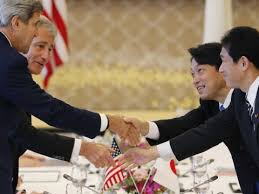
hagel japan

This is a re-up of my most recent monthly essay for the Diplomat. The original is here.

The idea here is to explore why Korea is not simply going to line up with the US and Japan against China. A lot of Americans, understandably focused on China in Asia, assume Korea will just join up. I really doubt that. I have been arguing this point for awhile on this site (start here), but Korea is way more alienated from Japan, for all sorts of reasons, than a lot of westerners realize. And it simply does not worry that much about China (no, I don’t understand that either). When I go to the conferences, Americans worry about China, the Japanese really worry…but the Koreans are like, ‘meh…whatever,’ but they get really activated over Dokdo. That dichotomy in response drives just about every American analyst I know up the wall, but it is the way it is. We need to realize that instead of trying to force Korea into the kind of black-and-white, good-guys-vs-bad-guys cold war frame Americans usually insist on in world politics. The essay follows the jump.

Continue reading