My Top 5 List for 2104: 5 Biggest Foreign Policy Events in Korea

clip_image001

This is a follow-up to my previous post – a top 5 list of events for US power in Asia in 2014.

South Korea had a good year. President Park’s cozying up to Beijing is starting to pay off. China-North Korea relations are frosty, which is important progress. Seoul also got OPCON delayed indefinitely, which is great for Southern security, as well as its defense budget (but not so great for the US). And the UN report on North Korea human rights has gotten a lot of traction – way more than I thought – and looks increasingly likely to show-up China and Russia for what they really are out here – shameless, cold-blooded supporters of the worst regime on earth. The more that point is made in public and Moscow and Beijing suffer the embarrassment costs of that support, the better.

The full post comes after the jump; it was originally written for the Lowy Institute:

Continue reading

My Top 5 List for 2014: 5 Biggest Foreign Policy Events for the US in Asia

empire-in-asia-e1377199333368

I love these hoky, end-of-the-year lists. But I don’t know much about genuinely interesting or cool stuff, like the top 5 classical music pieces or architectural masterpieces of the year. So before you read another list about the Kardashians’ top 5 lip glosses, or the 5 most repetitive comic movies of the year, here is an uber-wonky one that’s basically about the sustainability of the pivot.

I am constantly wondering whether the US can carry through on the ‘rebalance,’ whether we can actually shift out of the Middle East and Europe and pay more attention to the Asia-Pacific. I am skeptical, in part because I tend to see US commitments as opportunity costs of one another. In other words, if we are tangling with Putin or ISIS, then we don’t have much time for China or Maduro. But if you’re a neocon, then the pivot is no trouble. Getting involved in Asia doesn’t mean lessening commitments elsewhere, because the US should be globocop anyway, and US domestic expenses should be cut to fund to all this intervention.

The following post was originally put up at the Diplomat:

The “Interview” Fits a Long Tradition of Really Stupid US Portrayals of North Korea (but SK Film is much Better)

9inter

If you are looking to watch The Interview immediately, you can buy it on YouTube here. But the reviews on Rotten Tomatoes have been weak so far.

I am not quite sure what to make of all the hacking controversy yet, but in the run-up to the film, I wrote this quick comparison of North Korea in South Korean and US film. Not surprisingly, South Korea handles NK far more intelligently, whereas the US seems to have a weird, somewhat creepy obsession with North Korea invading America. Yes, really; read the review below: the US will have four ‘NK invades the US’ movies or video games in five years. I am still trying to figure out what that means.

Anyway, this was first written for Lowy Institute; the essay follows the jump.

My 2014 Hate-Mail of the Year: ‘Kelly, You’re Wrong; North Korea’s Awesome!’

North Korea 2012 279-Kelly-Viao

For my 2013 hate-mail of the year award, go here.

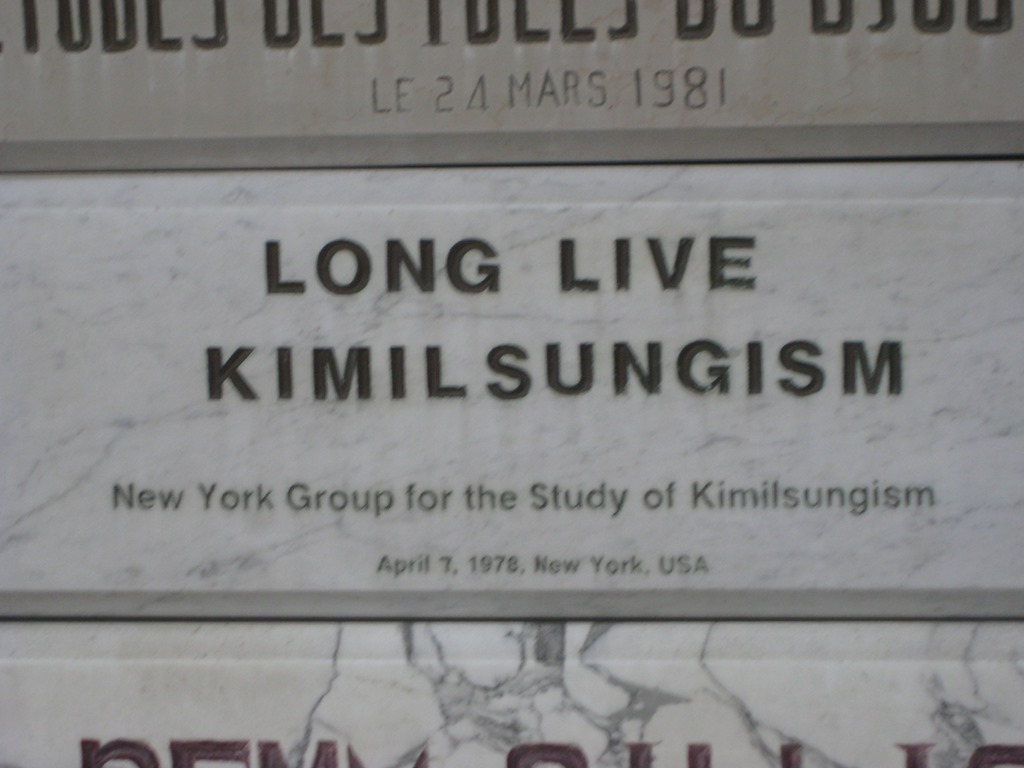
So I get a lot of weird email and comments because of my blog, or in the comment sections of my op-eds for the Diplomat. A lot of it is fairly ridiculous (‘you want the terrorists to win!’) or ad hominem (‘you’re a tool of the IMF; you’re a Muslim’), but occasionally I get pretty unique stuff like this letter below. (The image above is a personal picture of a plaque on the Juche Tower in Pyongyang. Perhaps the correspondent comes from this study group.)


“Dear Robert Kelly,

I read your column in The Korea Times with great interest and would like to share my thoughts with you.

You may think that my opinion is weird and crazy from a point of American.

Most Americans think that North. Korea is vitally harmful, threatening the world peace by shooting the missile toward America.

America had fought with North. Korea at 1950 and kept a hostile relations with it since then.

I think North. Korea is a great country, because it has shown sophisticated diplomacy against a big country.

I claim that North. Korea is less westernized and less materialized. It keeps a strong defense for people.

I also argue that North. Korea has not tarnish tradition and nature unlike South. Korea.

I wonder that you can say that all the people in South. Korea and U.S. are happy, just because they live in a democratic and capitalistic society.

I also ask you that most people in North.Korea is unhappy, because their government infringes on its citizen’s individual freedom severely.

I am sure some people may have been successful in adapting to a totalitarian society and they may have made a fortune and achieved a solid social position.

If the U.S. is a perfect society for living, I wonder why so many American came to Korea to get a job.

I have met many Americans who blamed their country and they don’t want to go back to their country.

Some American has settled down in Korea, marrying a Korean woman.

Deciding which government is better is subjective.

In a nutshell, North. Korea never collapses.

Best regards,

———“

My Lowy Essay: “OPCON Reversion is Dead – the 10-Year Soap Opera is Finally Over”

untitled

This is a reprint of an essay first published by the Lowy Institute a week ago.

The reversion of OPCON – operational wartime control of the South Korean military – to South Korea is finally over. After 10 years of endless meetings, papers, op-eds, and power-points, everyone seems to have realized it was a basically a huge mistake (which it was). The US and Korea recently agreed to push it off the 2020s, which is another way of saying it will probably never happen.

The irony is that almost as soon as reversion was agreed to last decade, the South Koreans got cold feet and tried to have it changed back. No one seems to have thought that closing down the Combined Forces Command would mean that Korea would have to do a lot more for its own defense and stop free-riding so much. Once that reality hit by the end of President Roh’s term, ‘US imperialism’ didn’t look so bad after all: it meant Seoul could continue to woefully under-invest in defense. So here we are at last, back to where we started from. And honestly, it is all for the best – if the US is going to stay here.

The essay follows the jump.

My National Interest Essay on the Ridiculous Media Hysteria over Kim Jong Un’s Disappearance

untitled

Admit it,  you miss the wild speculation about Kim Jong Un’s disappearance last month. It was lunatic fun, right? Was he dead? Was his sister in charge? WAS HE REPLACED BY ALIENS?!! Run for the hills!

To me, in retrospect, the big story was not KJU’s disappearance, but the wild, almost lunatic conspiracy-theorizing it unleashed in the West.

North Korea is a running punch-line in the West. Kim Jong Il was the villain in Team America. The story that the Norks found a unicorn a few years ago got play for weeks in the US for its sheer laugh value. So this essay was an effort to get a handle on this – why do Western media feel license to make any wild, preposterous claim they want about North Korea? Where does this bizarre obsession come from? There’s probably a good MA thesis in here actually if you were serious about it.

The following essay was first published by the Lowy Institute, and then picked up by The National Interest. This was the first time I was published by TNI, so that was pretty cool. My thanks to the TNI editor, my friend, Harry Kazianis.

My Lowy Debate on whether the US should Retrench from South Korea, part 2: No

North Korea 2012 131

This is a re-up of the second part of a couplet I wrote for the Lowy Institute on whether the US should retrench from South Korea. Part one is here; the original Lowy version of part 2 is here. And that pic is me doing what I really went to North Korea for…

My friend Dave Maxwell responded to part one by suggesting that I am not really laying out core US realist or national interests in Korea. Instead I got sidetracked going after liberal internationalists and neocons over the alliance and interventionism. Here is his reply. He says I come down on the side of retrenchment. Hmmm…

First, if you don’t know Dave’s work on Korea, you should. Go follow his blog. He’s way better on Korean security than I am. For example, his piece on a possible insurgency in post-unification north Korea is really valuable. I can’t think of anything else on that topic. Until I had read it, I must admit that I hadn’t really even thought of that scenario.

In response, I guess I would say that I am not sure what direct national interest the US has in ROK security today. I get it that South Korea is a liberal democracy facing off against the worst tyranny ever. But that’s a liberal argument, not a realist one. And I get it that North Korea is horrible, worse-than-1984 state which we should push into the dustbin of history as soon as possible. But that’s also a liberal/humanitarian argument.

I also get it that South Korea is important for the US position in Asia and dealing with/hedging/containing (or whatever it is we’re doing with) China. But that’s more a neocon argument in which US hegemony, instantiated in our global basing network, is an end itself. But if hegemony means allied free-riding (see: NATO) and getting chain-ganged into conflicts with states like North Korea or China, then realists would say hegemony should be scaled back, because it is not serving the national interest. American hegemony is only valuable if it serves the national interest; it is not an end in itself. (Daniel Larison makes this argument a lot.)

Finally, I get it too that a North Korean destruction of South Korea would be a horrible tragedy, a humanitarian nightmare, a boon to autocrats and tyrants everywhere, give new life to the worst regime on earth, and so on. But those reasons are so big and ‘metaphysical’ that they violate the realist demand that the national interest be something direct, tangible, immediate, and so on. It cannot credibly be the purpose of US foreign policy to stop tyranny or humanitarian catastrophes everywhere in the world. However morally attractive, that’s a sisyphean task that means perpetual war by the US all over the planet. This was thrust of Bush’s soaring second inaugural – which just about everyone derided immediately as an impossible flight of crusading fancy.

So, what, exactly, are the US national interests in South Korean security? North Korea is not going to invade the US. The Cold War is over, so South Korea is not a domino about to fall as communism chews its way through the Free World. South Korea doesn’t export anything that the US absolutely has to have, like oil which keeps the US tied to the Persian Gulf no matter how much we want to get out. There’s no anti-American terrorism problem out here.

And I don’t say all this to be testy or contrarian. My own gut-feeling is to keep the US in Korea – probably because I think North Korea is just about the worst place on earth. I am open to being convinced on this, and I kinda want to be. I imagine a lot of people instinctually feel the same way. But that’s not a replacement for clear, obvious need for us to be here. As I said in part one, this is the big hole in the conversation. We’re in the Middle East because of oil and terrorism. We’re in the Caribbean littoral states, because they’re our neighbors, and their problems become our problems. We’re in Japan, because China is a genuine emergent hegemonic challenger to the US. But Korea? I’m not sure. Even the reasons given in this post below are kinda vague, nothing is as crystalline as, say, helping Mexico defeat its super-violent drug cartels so that they don’t penetrate the US.

So give me your best shot. I’m open to it.

The essay follows the jump:

My Lowy Debate on whether US should Retrench from South Korea, part 1: Yes

North Korea 2012 113

This is a re-up of a debate couplet on the US position in South Korea, which I wrote for the Lowy Institute. Part one, the reasons for US retrenchment, is here (and below); part 2, the arguments against a US departure, is here. And that pic is me and my North Korean minder at the North Korea side of the DMZ. Note the KWP pin above his breast pocket.

Whether the US should stay or go is a perennial issue, that surprisingly, doesn’t get discussed much. This is probably because if you really supported a US withdrawal, you would not be taken seriously in much of US or Korean foreign policy establishments. US foreign policy is dominated by a hawkish, interventionist consensus of neocons and liberal internationalists for whom the US positions in Japan and Korea have become ends in themselves as symbols of US hegemony (in neocon-speak, that’s read as: ‘global basing means we’re f****** awesome!’). In tandem, the Korean discussion, for all its lazy anti-Americanism, assumes a permanent American presence to the point of irresponsibility. But all this misses the real hole at the center – the end of the Cold War and the collapse of the North Korean conventional threat (and before you say, ‘heh wait, they could blow up Seoul,’ recall that South Korea easily has the resources to ramp up in a big way; it just doesn’t do it).

The essay starts after the jump:

Continue reading

My Op-Ed for the Korea Times on US-North Korea Relations: in short, They’re Awful

524344_10151049939842362_890600132_n

That picture would be me and the “Great Chosun Leader, Comrade Kim Il Sung” (“위대한 조선 수령 김일성 동지,” as they told us to call him) in the Pyongyang subway. You’ll notice that the gold stature is nicer than the passing metro car (right) from the 1960s. That pretty much tells you what, and how awful, North Korea’s priorities are.

The Korea Times asked me to comment on North Korea’s relationship with the US as a part of its review of North Korea’s foreign relations. The original is here and re-printed below. My main theme is that most Americans are unwilling to accept the legitimacy of North Korea as a real, independent country like any other. Not only is it run as a orwellian gangster fiefdom which the world would loathe anyway, it should also be a part of a Southern-led, unified Korea.

Naturally, this worries the NK elite who in turn are hostile back to us. I suppose we could accept and recognize the permanent existence of North Korea, as the South Korean left would have us do, but I must admit I find normalization intolerable. The idea of coexisting with North Korea strikes me as deeply immoral, even if the cost of that attitude is near-permanent tension. I suppose North Korea is one of few global problems about which I am still a real hawk, but North Korea’s human rights record is so stupendously awful – the recent UN report on human rights in North Korea likened the place to the Nazi Germany for christ’s sake – that I just can’t take that leftist route of recognition.

Here’s that op-ed:

Continue reading

My Diplomat on Essay on Xi’s Trip to Korea: SK as a Hole in the Pivot in Exchange for Help w/ NK

This is a re-post of an essay I wrote last week at the Diplomat. I guess South Korea-China relations is a hot topic, because I got a bunch of emails over this – note to grad students.

The quick version is that South Korea really needs China now to get any kind of movement on North Korea, so it kinda has to suck up to Xi. I am of the school that says that North Korea is sliding into an economic colony of China, regardless of how they bluster and blow off nukes. In fact, the reason Pyongyang probably has the nuclear and missile programs is not just to deter the US, but to prevent China’s economic domination from turning into political domination too. So Park will be practically begging Xi to rein in Pyongyang. She has to – which sucks, btw, and shows just how cynically China manipulates the human rights catastrophe that is North Korea to its own callous advantage. Awful.

But Park can offer to restrain/impede the US pivot/containment of China as a quid pro quo for North Korea help. China really needs South Korea in order to prevent the US pivot from becoming full-blown encirclement of China. Because South Korea is so virulently anti-Japanese, it is an important hole in the tightening containment line around China that runs from Japan through Southeast Asia to India. The Koreans don’t want to line up against China, and they really don’t want to line up with Japan. If China is smart, they’ll exploit that. So China is unlikely to really bully South Korea as it has in the South China Sea.

Here’s that essay:

Continue reading