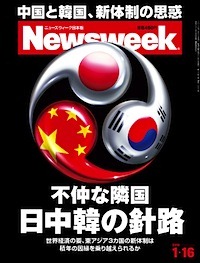
My ‘Newsweek Japan’ Story on Korea’s Regional Foreign Policy: Being an Encircled Middle Power Sucks

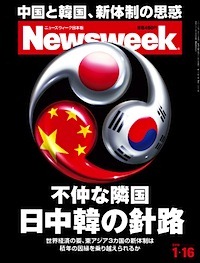
Newsweek 3rd coverNewsweek Japan asked me to contribute an essay on Korean foreign policy for a special issue on current Northeast Asian tension. I also wrote the introductory essay for this special issue. There is one essay each on Japan, China, and Korea; mine is the Korean one. So this is a nice laymen’s review without too much fatiguing jargon. This was originally published in January, so this translation is late, but the points still hold.

In brief I argue that Korea’s foreign policy is driven by its geography. Korea is a middle power surrounded by three great powers, plus the most orwellian state in history. That position really, really sucks. The US alliance helps buttress Korea sovereignty in that tight neighborhood, but China’s rise is unbalancing everything, especially calculations for unification. Once again, there are no hyperlinks, because it was intended for print. Here we go:

“On December 19, Korea elected a new president, Park Geun-Hye. Park comes from the conservative New Frontier Party. The current president, Lee Myung-Bak, is also a conservative. Park will be inaugurated in late February. Her campaign presented her as more ‘dovish’ on foreign policy than Lee, but she represents greater continuity than her opponent, particularly regarding North Korea.

Korea’s foreign policy is heavily-driven by its geography. It is an encircled middle power that has frequently struggled to defend its autonomy against its much larger neighbors. And since World War II, it has faced the most orwellian country in history in a harsh stand-off that dominates Korean foreign policy. An opening of North Korea, leading to eventual reunification, is the central policy issue of every Korean administration. Beyond that, Korea’s central relations are with the United States, China, and Japan. All three structure Korea’s neighborhood and will significantly influence unification.
Continue reading

My ‘Newsweek Japan’ Cover Story on the post-1979 ‘Asian Peace’ & Economic Miracle

Newsweek 3rd coverNewsweek Japan asked me to write an introductory essay for its January 16 special issue on tension in Northeast Asia (cover story to the left). I should have put this up 4 months ago, but I forgot and the arguments are still valid. Anyway, here is the link in Japanese, but I thought it would be useful to publish the original, untranslated version as well. (If you actually want the Japanese language version, email me for it please.)

The essay argues that Northeast Asia has benefited enormously from an ‘Asian peace’ in the last 35 years. All the remarkable growth in China and South Korea (as well as India and Southeast Asia) would not have happened without it. So fighting over some empty rocks (Liancourt Rocks, Pinnacle Islands) is a terrible idea. And for political scientists, the current Sino-Japanese tension is a good test of the hypothesis that economic interdependence brings peace. It’s fascinating to watch China especially try to figure out just how much economic gain to forego in pushing Japan over the Pinnacle Islands.

This was intended for their print edition, so there are no hyperlinks included in the text. Here we go:

“1979 was an important year in modern East Asia. It captures two of the region’s most important trends. It was the year of both the last serious military conflict between two East Asian countries – a Sino-Vietnamese border war – and the start of China’s capitalist modernization under Deng Xiaoping. These moments usefully frame the following thirty-four years: much of Asia has gotten substantially wealthier, and no major conflicts have broken out to upset that upward economic swing. This magnificent regional achievement has catapulted Asia, particularly East Asia, into the center of world politics.

Continue reading

My ‘Newsweek Japan’ Cover Story on the Agenda for Korea’s Next Prez

Newsweek cover 2

Newsweek Japan asked me for a long-form essay on the challenges facing the new Korean president-elect for its December 26, 2012 issue (cover story to the left). Here is the link in Japanese, but I thought it would be useful to publish the original, untranslated version as well. (If you actually want the Japanese language version, email me for it please.)

The essay was actually written up before the outcome (a Park Geun-Hye victory) was known, but the argument still applies. In brief, I argue that Korea is drifting leftward. The young in Korea want chaebol reform and less political elitism at home, and abroad they want a foreign policy both less hawkish on North Korea and less influenced by the United States. In fact, if Korea weren’t aging so extremely fast, this agenda would have won. But Korea’s demography is now so skewed that ‘missing’ youth voters due to Korea’s super-low birthrate probably cost Moon Jae-In the election. (Not surprisingly, the Korean news is already reporting on youth action against against free bus fair for the elderly, because they ‘stole’ the election.) Nevertheless, the generational split is real, and the right would be foolish to govern against future voters’ wishes in the name of aging voters who will naturally pass away. Hence my prediction that Park will govern as a centrist not a conservative.

Regular readers of this blog will see themes I have emphasized before. This was intended for their print edition, so there are no hyperlinks included in the text. Here we go:

“On December 19, South Korea will have its sixth democratic election since the end of military rule in 1987. The main candidates are Park Geun-Hye of the conservative New Frontier Party and Moon Jae-In of the liberal Democratic United Party. Park is expected to win, as Moon has run a poorly organized campaign and the Korean left has split. Ahn Chul-Soo, a popular reformist liberal candidate, dropped out late in the race and only weakly endorsed Moon, while a far-left party, the Unified Progressives, has stayed in the race. All this will fragment the left’s vote, likely throwing the election to Park.

Continue reading

My ‘Newsweek Japan’ Cover Story on Korea’s Economy: De-Concentration Needed

NewsweekNewsweek Japan asked me for a long-form essay on Korea’s economy for its December 5, 2012 issue (cover story to the left). Here is the link in Japanese, but I thought it would be useful to publish the original, untranslated version as well. (If you actually want the Japanese language version, email me for it please.)

The essay broadly argues that Korea needs to move beyond ‘developmentalism’ toward economic liberalism, as a lot of Asia does in my opinion. Regular readers of this blog will see themes I have emphasized before. This was intended for their print edition, so there are no hyperlinks included in the text. Here we go:

“As Korea’s presidential election moves into the home stretch, the local economic discussion is sharpening. Inequality, demographic collapse, massive concentration of economic weight in a few mega-conglomerates, weak consumer purchasing power, growing trade friction over intellectual property rights, and a chronically under-powered small- and medium-enterprise sector (SME) are among the major problems this outwardly very successful economy must confront. Unfortunately, none of the major candidates are pushing the deep reform needed to fix these underlying issues. As with China’s leadership transition, things seem so good at the moment that elites are wary of rocking the boat; as with the recent American election, tough choices will likely once again be kicked down the road. In Korea’s case, that means moving away from its ‘developmentalist’ growth model before encountering troubles similar to Japan’s.

Continue reading