USC-CSIS Conference on Korean Unification (2): ‘One Country, Two Systems’ will not happen

CSIS Korea ProjectHere is part one of this post. The following will make more sense if you start there.

I noted that I am participating, today in Seoul (attend if you can), in a USC-CSIS project on Korean unification. This is the final ‘phase’ of their Korea Project on unification.

I thought I would post my thoughts on the USC-CSIS Phase II report (available here) which provided all sorts of suggestions for reconstruction. It’s required reading if your area is Korea and NK, but I actually disagree with a fair number of the analogies to Iraq and Afghanistan. I think Germany is a better model for what will happen here, and I think a ‘one country, two systems’ arrangement like in greater China is nearly impossible given the extraordinary deep ideological divide, which is also existentially necessary for NK to demonstrate why it must be a seperate, poorer Korean state. So it’s either implosion or stalemate.

Anyway, the rest of my thoughts are after the jump. Having read the CSIS report is not a prerequisite to understanding my arguments, but it would help.

Continue reading

USC/CSIS Conference on Korean Unification (1): it will cost WAY more than people think

Cha_Challenges__110The University of Southern California Korean Studies Institute and the Center for Strategic and International Studies are running a joint Korea Project: Planning for the Long Term (pic to the left). CSIS will hold the last of three conferences in this project at the Asan Institute on January 21st next week. If you are in Seoul, you should go. The agenda looks pretty good. (Contact the Asan Institute.) I’d like to thank USC and CSIS for soliciting my participation..

The January 21 conference is actually the last meeting of the Project. The first meeting asked Korea area experts to look at unification; the second meeting asked functional experts to do the same. This upcoming third meeting will look at regional impacts from unification. I will comment on papers from Russia and Japan. I will put up my thoughts on those papers after the Phase III conference, but for now, I thought I would post my comments on the Phase II conference (by the functional experts).

Basically I argue that  Germany is a better model for what will happen here than either the occupations of Iraq or Afghanistan, or LDCs in transition. Also I don’t buy for one second that NK will enter into a meaningful ‘one country, two systems’ arrangement like in greater China. DPRK change meaningful enough to permit a federation would be so far-reaching, that it would inevitably raise the question why the DPRK  exists at all. Ideological change is an existential threat to the regime: why be a poorer version of SK if you’re in a federation with SK? why not just join up? This is the logic that undid the GDR. So it’s either implosion or stalemate IMO.

Here is the final CSIS report on Phase II (a must-read if you want to research unification); my gloss on that follows the jump. (Here is the much shorter Phase I report.)

Continue reading

The International Relations Discipline and the Rise of Asia

Buddha

A few months ago, I was commissioned by the International Relations and Security Network of the Swiss Federal Institute of Technology to provide a brief write-up on how Asia’s rise will impact the formal discipline of international relations (IR) within political science. I didn’t get a chance to put it up earlier, and inevitably, the brief means sweeping judgments in just a few pages, but I think it’s a reasonable effort. Here is the version on their website; below it is reprinted:

“It is widely understood that international relations (IR) relies on modern (post-Columbus) and North Atlantic cases as the research base for its general theory. Our graduate students are well-versed in a heavily researched set of cases such as the Napoleonic Wars, World War I, or the Cuban Missile Crisis. While this is arguably ‘eurocentric’ training – white, western practitioners feigning to build ‘universal’ theory from just the cases and languages they know best from their own civilizational background – it might be also reasonably explained by Western dominance of world politics for so many centuries. So long as the West (including the USSR as a basically Western leftist project) so overawed the planet’s politics, then a modern and Atlantic prejudice was perhaps less narrow than it seems. Whatever the cause, this will likely change in the coming decades.

Continue reading

Some Recent Media

I was going to write on the Biden-Ryan debate, but it wasn’t that interesting. Biden came off like that aggressive uncle at Thanksgiving family dinner who takes over the conversation, and Ryan seemed pretty out of his depth on foreign policy. I’d say Biden won, but not by as much as Romney won last week.

So this is just a bits & pieces post instead about the first time I ever spoke on TV (yikes!).

This is the first time I ever spoke on TV. Unnerving…

In July, when Vice Marshal Ri Young Ho of the DPRK was sacked, BBC news asked me to speak. I didn’t realize until about 20 minutes beforehand that it would be on TV, and it was 2 am EST. Good grief. So I’m not even wearing a tie, and I sat in my parent’s living room Smile. Good thing they didn’t see the bar behind me!

On September 10, I did a full hour radio interview on my trip to North Korea. Go to recording 169 here. For my write-up of my NK trip impressions, go here.

On August 27, I published an op-ed in Korea’s main and centrist newspaper, the JoongAng Daily. I am happy to say that Real Clear World picked it up too. The long version is here (one) and here (two). Basically I argue that even though America is broke, foreigners are so desperate to hold dollars, that we can still fight long, unnecessary wars and borrow incessantly without a financial crisis. To paraphrase Mel Brooks (sarcastically), ‘it’s good to be the hegemon – you can do whatever the hell you want.’

Continue reading

Guest Post: Dave Kang – “Confucian North Korea”

I am on break for the summer, but I am happy to open this space to a good friend and excellent scholar on international relations theory and Asia – David C. Kang, a professor of international relations and business at the University of Southern California and director of its Korean Studies Institute. Regular readers will know that I cite Dave’s stuff a lot. If you aren’t reading him, you should be: here is his Amazon page.

Confucian North Korea

clip_image002

Figure 1. Korean Worker’s Party symbol

It is easy to caricature North Korea as a “bizarre” “land of no smiles” full of brainwashed robots. In the past few years, North Korea has become somewhat prominent in popular culture either as a salacious joke or a freak show of a country. (And yes, I refuse to give you too many links to articles I think are misinformed caricatures). The trope of North Korea as a nation of automatons, grimly marching through each day is very powerful.

It is absolutely true that the regime itself is horrific and reprehensible, and engages in systematic human rights abuses. Indeed, the people of North Korea are the most direct victims of the ruling regime. I am totally for regime change, or a regime that modifies its ways and introduces economic and social reforms that improve the lives of its people. However, wishful thinking has gotten us nowhere, and rather than simply sit back and laugh at North Korea or call it names, perhaps we might explore why the regime has survived as long as it has.

In addition to extensive repression and selective bribery, what is widely overlooked is that the North Korean dictatorship is built on deeply traditional Korean cultural and Confucian roots. In fact, the best way to understand both the regime and its people is to remember that North Koreans are Koreans more than anything else. Far more insightful than any other description such as “communist monarchy,” North Korea is identifiably Korean, and there is a coherent internal logic in much of its way of life. As a result, the regime is more stable and enduring than commonly thought. (The arguments I make here have been made much more cogently by Bruce Cumings and Suk-Young Kim, among others).

Take a look at picture at the top of this page, which is a photo of the official emblem of the Korean Worker’s Party. Although the hammer and sickle are easily recognizable as signs of all Communist Parties from the Soviets to the Chinese Communist Party and others (Figure 2),

Figure 2. Flag of the Chinese Communist Party

clip_image004

North Korea is unique in that there are actually three symbols. What is that middle symbol in Figure 1?

1. Candle?

No. Wrong. C-

2. Paintbrush?

Warmer. What kind of paintbrush?

3. A calligraphy brush they used in olden times to write Chinese characters?

Yes!

It is a Confucian scholar’s brush – perhaps the most direct and vivid symbol of traditional learning, culture, and scholar-elite rule in Korea since the 9th century Silla dynasty first introduced an examination system for selecting government officials.

This is pretty remarkable. The Communist Party everywhere has stood for an utter rejection of the past and tradition as feudal and oppressive, and the basic message from Stalin to Mao has been to destroy the past and totally rebuild society. Yet the North Korean regime, rather than attempting to erase the past, has grafted itself onto traditional Korean traits, and reached back to some of the most traditional iconography possible: a hierarchic and elitist symbol of education, with all the other Confucian connotations that go with it: a ruler who embodies both the country and the “mandate of heaven,” an emphasis on centralized political control, and a clear set of hierarchical relationships that create harmony.

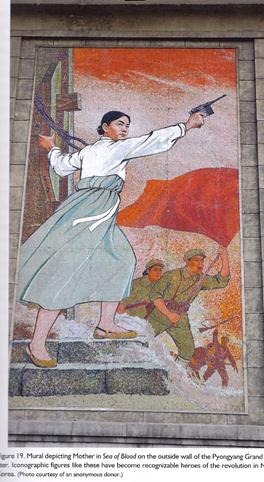
What about the role of women? Figure 3 is prominently displayed in Pyongyang, and depicts a generic and heroic “Mother,” fighting against the Japanese.

Figure 3. “Mother” in Sea of Blood

clip_image006

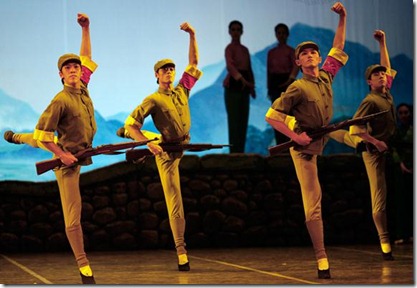
What is interesting about that painting? As with the KWP symbol, it might strike the viewer as somewhat odd that she is wearing traditional Korean women’s dress (“hanbok,”or “choseonot as they call it in North Korea). Compare this with the standard depictions of revolutionary Communist women from China or the Soviet Union – they are all in drab “Mao jackets” that reject and depart from any traditional and feudalistic tendencies (Figure 4).

Figure 4. Chinese revolutionary women
clip_image008

But in North Korea women have been presented with an image that emphasizes their Koreanness – a traditional dress that is far more common in Pyongyang and North Korea than in South Korea. The regime explicitly is telling North Korean women that they are a link to a way of life that is Korean, and the way they dress is the most obvious manifestation of that link.

What about the “cult of personality” and the rise of the grandson? Surely that’s bizarre, right? Not really, in a traditional Korean context. The Confucian emphasis on family places the father as the head of the family. Kim Il-Sung simply placed himself as father of the country, and grafted an authoritarian state onto the existing social and cultural roots. Leadership by a powerful family makes sense in a Korean context. Korea is a clannish country, and the family is the basic building block of social, political, and economic life.

The best way to understand the role of families is by comparison with contemporary South Korea. The foundation of Korean life in both North and South is the clan. For example, most major business conglomerates are family-run, and often the grandson of the founder is now in charge. This is the case even of the biggest companies in Korea. In addition, it may appear to outsiders that Korea is a country with only three last names (Kim, Park, and Lee, hahaha). But all those Kims are actually divided up into dozens of different clans, each connected to a hometown, each with extensive family lineage records, and each vividly distinctive to other Koreans. Thus, there is Kimhae Kim, Seoul Kim, Kyongju Kim, etc. So powerful was the clannish nature of Korea that until 1998, members of the same clan could not legally marry, even if they were separated by tens of generations. Similarly, Kathy Moon has recently argued that the blather over Kim Jong-un’s marriage is mostly misguided: “For Koreans on both sides of the 38th parallel…Unless one is married (and with children), one is not fully an adult. In both Koreas and in dynastic cultures, those pieces are supposed to come in the same box, to be pieced together into a coherent puzzle.” Thus, within a Korean cultural context, multigenerational leadership in North Korea and family as the building block of society is common sense.

Why does this matter? Because the story the North Korean regime tells itself and its people is aimed at domestic audiences, not at international audiences. They are telling a story that — however warped and corrupted — resonates deeply and instinctively with Koreans: North Korean are the true Koreans, and are the only ones remaining true to the essence of being Korean. South Koreans have been corrupted and forgotten who they are. The Kim family is leading the fight against external oppressors such as Japan and America. If the people must endure some hardship in order to maintain a Korean way of life, that’s a small price to pay.

This is one reason I tend to think an Arab Spring or uprising is not likely. Questions of imminent demise overlook the fact that North Korean dictatorship has grafted itself onto deeply traditional Korean culture roots. As a result, the regime is much more stable than some may think. For some people of North Korea, conditions may become so horrific that they choose to try and leave. But far more remain, and they remain not because they are brainwashed and not only because of repression. Many stay because North Korea is their home, where they grew up, where their family and friends live, and it is what makes sense to them.

Going to IQMR – Some Summer Asian Security Reading – Back in August

CQRM

I am off to the Institute for Qualitative and and Multi-Method Research for their summer training at Syracuse University. Take a look at the syllabus. Whoa. ‘Can you spell ‘Bayesian hermeneutics’ correctly, little Johnny? No? Me neither!’ But the preparation looks great for qualitative-types like me. I must thank Colin Elman and Andrew Bennett for taking me. The people in that pic look so much more lucid and intelligent than me, that I think they must have read the wrong file or something. I hope they don’t bust me playing ‘Halo’ in the back there…

If debating multicollinearity doesn’t sound like fun (yeah, I don’t really know what it means either, but I think it’s bad), then here is my regular list of good reads from the last few months before I go on break:

Continue reading

What Exactly is the Social Science Citation Index Anyway? or, which Korean IR Journals should You Read?

jcr_medbner_availnow

Yeah, I don’t really know either. I always hear the expression ‘SSCI’ thrown around as the gold standard for social science work. Administrators seem to love it, but where it comes from and how it gets compiled I don’t really understand. Given that we all seem to use this language and worry about impact factor all the time, I thought I would simply post the list of journals for IR ranked by impact factor (after the break).

I don’t think I ever actually saw this list before all laid out completely. In grad school, I just had a vague idea that I was supposed to send my stuff to the same journals whose articles I was reading in class. But given that I haven’t found this list posted on the internet anywhere, here it is. I don’t know if that means it is gated or something, or if my school has a subscription, or whatever. Anyway, I thought posting the whole IR list would be helpful for this site’s readership.

Note that a bunch of them are published in Asia, and 3 alone are about Korea (Korean Journal of Defense Analysis, Korean Observer, and NK Review) – so get to work!

But I have a few questions. First, why does Thomson-Reuters create this? Why don’t we do it? Does anyone actually know what they do that qualifies them for this ? And don’t say ‘consulting’ or ‘knowledge services’ or that sort of MBA-speak. The picture above includes some modernist, high-tech skyscraper, presumably to suggest that lots of brilliant, hi-tech theorists are in there crunching away big numbers (but the flower tells you they have a soft side too – ahh), but I don’t buy it. Are these guys former academics who know what we read? Who are they? Does anyone know? The T-R website tells you nothing beyond buzzwords like ‘the knowledge effect’ and ‘synergy.’ I am genuinely curious how T-R got this gig and why we listen to them. Why don’t we make our own list?

Next, I am not sure if the SSCI and the Journal Citation Reports from T-R are different or not or what. Click here to see the SSCI list; and here is the JCR link, which is probably gated, but ask your administration; they probably have access. There are 3038 journals in the whole SSCI list (!), 107 listed under political science, and 82 under IR. There is some overlap between the last two, but the PS list does not completely subsume the IR list, as I think most of us would think it should. For example, IS is listed only under IR, not political science, but ISQ is listed under both, even though I think most people would say IS is a better journal than ISQ. Also, there is no identifiable list for the other 3 subfields of political science. I find that very unhelpful. More generally, I would like to know how T-R chooses which journals are on the SSCI and which not. It doesn’t take much effort to see that they’re almost all published in English…

Next, I thought the SSCI was only peer-reviewed, but Foreign Affairs and the Washington Quarterly (which I understand to be solicited, not actually peer-reviewed – correct me if I am wrong) are listed on the IR list, and even Commentary and the Nation magazine are on the PS list. Wow – your neocon ideological ravings can actually count as scholarship. Obviously FA should be ranked for impact factor; it’s hugely influential. But does it belong on the SSCI? Note also that ISR is listed on the IR roster, as is its old incarnation, the Mershon ISR. Hasn’t that been gone now for more than a decade? Also when you access the impact factors (after the jump),T-R provides an IR list with its ‘Journal Citation Reports’ that has only 78 journals listed for IR, not 82. So the SSCI for IR (82) does not quite equal the JCR for IR (78). Is that just a clerical error? If so, does that mean the super-geniuses in the futuristic skyscraper are spending too much time looking out the windows at the flowers? I guess if you double-count M/ISR, you get 79, which is pretty close to 82, but given how definitive this list is supposed to be, it seems like there are problems and confusions.

Anyway, I don’t really know, so I just thought I’d throw it out there. Check the IR rankings on the next page.

Continue reading

7 things I don’t like @ being an Academic

dork

It’s grad school acceptance season, so here are a few thoughts if you are considering the PhD plunge. Try this genre also on the Duck of Minerva, where I also write. Enjoy your last summer to read as you choose, without following a peer reviewer or a syllabus. Such lost bliss… 

Generally speaking, yes, I like being an academic. I like ideas and reading. I like bloviating at length. The sun is my enemy, and exercise bores me. I would really like to be a good writer/researcher. Including grad school, I’ve been doing this now for 15 years, so clearly I could have switched. I am committed. But there are at least 7 things I didn’t see back in my 20s when I had romantic ideas that if I got a PhD, I’d be like Aristotle or John Stuart Mill – some great intellectual with real influence on, what a Straussnik once called to me, ‘the Conversation,’ which I took in my heady, pre-game theoretic youth to be this (swoon).

1. It’s lonely.

I didn’t really think about this one at all before going to grad school. In undergraduate and graduate coursework, you are always very busy and meeting lots of people. You live in a dorm or fun, near-campus housing, you have lots of classes, you hit the bars on the weekends, you go to department functions. Girlfriends/boyfriends come and go. So even if you didn’t like 9 of the 10 people you met, you were meeting so many, that you eventually carved out a circle and did fun stuff that kinda looked like the 20-something comedies you see on TV. But once you hit the dissertation, you are suddenly thrown back on your own, and you really re-connect, or try, with your family, because they’re the only ones who’ll put up with your stress. You spend way too much time at home, alone, in a room, staring hopelessly at a computer screen. You don’t really know what you’re doing, and your committee, while filled with good, smart people who are almost certainly your friends, can’t really do this for you, even though you try to push it off on them.

Continue reading

Why don’t Korea & Japan Align?

Flag-Pins-Japan-South-Korea

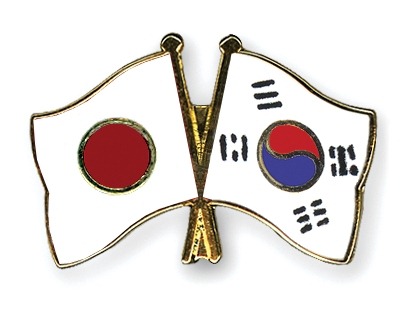
For awhile I was collecting links and such to make an argument about Korea and Japan working together on big issues like China and NK, or finally clinching the much-discussed but little worked-on FTA. Both the realist and the liberal in me wanted to see two liberal democracies working together in a tough environment with similar structural threats. Initially I had written: “This may be the biggest news of the year if it actualizes: Japan is apparently considering real defense cooperation with SK. If you follow East Asian security, this is a revolution. Try here, here and here.” But this is sorta cheating on social science, right? Looking around for any scrap of data to support an outcome we like, even though it isn’t really happening?

Well, I give up. Instead of more normative, but ultimately speculative, essays on why East Asian states should align, found an Asian Union or Community, build a local alternate to the IMF, forge a common currency, take ASEM seriously, etc., I think we should start asking why Asian states cooperate so badly. (My short answer: they’re too nationalist.)

My students bring integration up all the time. Until the euro crisis got really bad, students used to tell me all the time that Asia needs an EU or coordination against the (much-loathed) IMF. And I’ve read lots of term-papers on this. But the more I look at the most important Asian international organization (IO), ASEAN, the more it just doesn’t impress me no matter how much hype it gets (which is a lot out here at the conferences and in business advertising in the media). ASEAN is around 60% of the age of the EU and has done maybe 20% of the integration/cooperation the EU has. I argued in ISR a few years ago that lots of IOs aren’t actually about integration at all, but rather the joint self-defense of weak and/or authoritarian elites (Organization for African Unity, Gulf Cooperation Council, Shanghai Cooperation Organization). But that still doesn’t explain why Korea and Japan are so distant. And now for work, I’m revisiting Walt’s Origins of Alliances. Balance of threat feels pretty persuasive too, but I think it would struggle with the Korea-Japan case, as would the democratic peace.

Continue reading

In Social Science, You’re always Under-read, so What do You do? (2)

imagesCAJL188O

Here is part one, where I noted Walt, the Duck, and Walter Russell Mead as the IR blogs I read almost always despite the avalanche of international affairs blogs now. Here are a few more:

Martin Wolf: Here’s a grad school education in IPE, op-ed by op-ed, better day-to-day than either Krugman or the Economist. Not being an economist, but facing regular student questions for years about the Great Recession and the euro-zone crisis, I have found Wolf indispensible in explaining what happened in the last 5 years – and without that ‘bankers as masters of the universe’ schtick coming from CNBC, Bloomberg, and the WSJ. Wolf is a delight to read. Like Andrew Sullivan, he is measured, changes his mind when information dramatically changes, references theory but not as ideology or fundamentalism, and has a good touch for what can realistically be accomplished in actual democratic politics.

Continue reading