My Latest for Foreign Affairs: It’s a Only a Matter of Time before US Allies Hedge America, even if the Democrats Win in 2028

Trump plan exploit US alliesI wrote a short essay for Foreign Affairs, with my friend Paul Poast of the University of Chicago, on Trump’s treatment of US allies. This is follow-up on a longer article we wrote in 2022 for FA. (And the great pic for this post comes from this article, which is a good read.)

Our argument in 2022 was that US allies were willing to absorb a lot more US abuse – under Trump – than people expected. In 2022, there was a lot of talk about how Biden ‘must’ reassure US allies after years of Trumpian mistreatment. And while I normatively agreed with the sentiment, it was clearly empirically wrong. The US did not need to apologize or anything like that, because US allies had proven willing to debase themselves before Trump rather than hedge America.

So when FA asked me and Paul to provide an update, we were surprised at how correct our argument still was. Trump I was abusive to allies, and nothing happened; Trump II was turning out to be even worse, and still nothing was happening. If anything, US allies were proving yet again that they were willing to embarrass themselves with obsequious flattery to keep the US on-side. Why they tolerate American abuse is a good question. Learned helplessness – decades living cozily under the US security blanket – has to be a big part of it.

On the other hand though, this can’t go on forever. Paul and I estimate that over the next ten years, US allies will, at last, hedge. Under Trump I, hoping that Trump’s successor would be a normal, liberal internationalist Democrat – as Biden was – made sense as strategy. But now, under Trump II, US allies need to grasp that the American Right has structurally changed. Trump is not a fluke; Trumpism, complete with its disdain for US allies and sympathy for dictators, is US conservatism now.

This means that whenever the GOP holds the presidency over the next several decades, the US will not be a credible alliance partner. Even if reliable Democrats are also elected occasionally, intermittent Trumpist control of the presidency still makes the US too unreliable as a partner for its alliances to be credible commitments. In short, you can trust us much anymore, even if we occasionally elect normal presidents. And this unreliability will motivate hedging and drift as US allies finally realize – after a decade of purposefully pretending otherwise – that Trump has changed US foreign policy for the medium-term.

The full essay follows the jump:
Continue reading

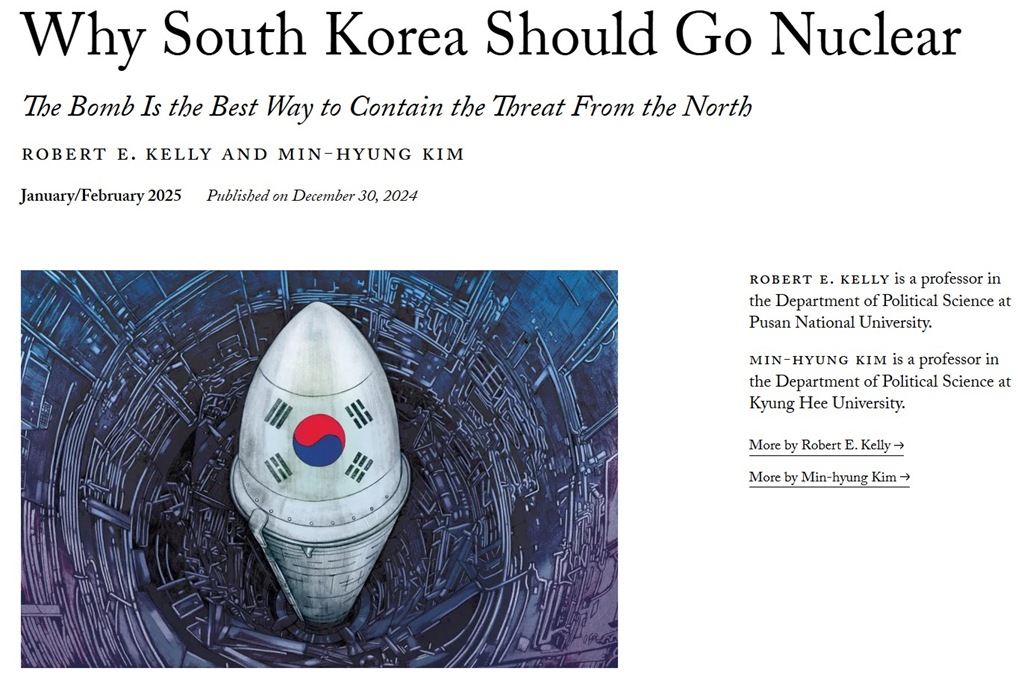
Original Version of My Foreign Affairs Essay on South Korean Nuclearization: America’s Response to Nuclear Risk in the Ukraine War Tells Us a Lot about its Likely Response in a Second Korean War

Screenshot 2025-01-11 134514This post is the original version of an article I published this month in Foreign Affairs on potential South Korean nuclearization with my friend Kim Min-Hyung. I think the editing made the essay more readable, but some topics I wanted to elaborate got edited out.

Specifically, US hesitation against fully and robustly supporting Ukraine against Russia – because of Russia’s nuclear threats – is a model for what will happen to South Korea in a second Korean war, especially when Trump is POTUS.

We have known for years that the Biden administration has repeatedly held back on aid, discouraged certain Ukrainian military actions, balked at giving certain weapons systems, and so on for fear of Russian nuclear ‘red lines.’ Here is yet another example from the last few days. Apparently, the Biden team got Russia out of an even bigger defeat around Kherson in 2022 for fear of a Russian nuclear response. Russia’s nuclear threats have worked well, and they aren’t even as credible as North Korea’s!

A lot people think the Russians are just bluffing, but the Biden team has been super cautious anyway. So in a Korean contingency, where NK nuclear threats are even more credible, our behavior in Ukraine suggests we will respond even more cautiously. Our Ukraine behavior strongly suggests we will slowroll aid to SK and try to avoid full involvement for fear of nuclear escalation.

NK nuclear escalation threats are more credible than Russia’s or China’s, because NK is far more vulnerable to collapse after just a single significant conventional defeat than they are. NK’s military is conventionally obsolete; NK lacks strategic depth; its economy is a shambles; its state is sclerotic and shallow. One big defeat at the DMZ, and it’s all over for NK and the Kims who will be lynched by their own people. Russia by contrast does not face regime collapse and an existential leadership crisis if it loses badly conventionally in Ukraine; nor does China face immediate implosion if it loses in a war over Taiwan. But NK and its ruling family do face immediate existential risk if they lose even one battle at the DMZ. So NK has to threaten nuclear use immediately, and it has to use those weapons if its bluff is called. It can’t issue vague, maybe-sorta threats like Putin has for the last 3 years.

So if Russian not-so-credible threat have successfully gotten the US and NATO to slow-roll aid to Ukraine, imagine how much more successful they will be in Korea where NK’s nuclear threats are far more credible because nuclear escalation is its only chance to survive?

If NK will go nuclear almost certainly, will the US risk nuclear strikes on US targets for a distant, medium-sized ally of mid-range importance to US national security? Probably not  because that also describes Ukraine. Like SK, Ukraine is an exposed, mid-sized ally of middling importance to US security under direct nuclear threat. In both cases, a victory by the US partner would be good, but its loss would not be a huge loss for the US either. It would be more important for regional locals. Specifically, SK’s defeat/destruction by NK (or China) is more important to Japan, India, and Australia than to the US, just as Ukraine’s is more important to Europe than to the US.

Now, you say that SK is a treaty ally of the US, but Ukraine is not. So the US will be willing to risk nuclear war for SK, but not for Ukraine. I find this fantastical thinking. US alliance commitments are credible in conventional scenarios in Korea, but would they really be in a contingency where NK would launch a nuclear weapon against Guam, Hawaii, or even CONUS? Are alliance commitments automatic in nuclear escalation scenarios? I doubt that. De Gaulle realized this point 65 years ago. Maybe Biden would act on the US alliance commitment to SK despite high nuclear risk, but Trump very obviously won’t. In fact, I doubt Trump would even fight conventionally for SK.

Then you object that SK is not a mid-sized partner like Ukraine which could be lost, but a major ally because we need it against China. This would be so if SKs wanted to come with us on great power competition with China. But they don’t, especially not the SK left which is about to take the presidency when impeached conservative president Yoon is removed in the next few months.

So if you don’t think the US is going to risk highly like nuclear escalation for you; and you face a frightening nuclear opponent who routinely threatens you with nuclear devastation; and your alliance patron is about to be governed by an irresponsible, autocrat-admiring con-man, what should you do?

If you think about potential SK nuclearization that way, it’s not too hard to figure out why SK opinion tilts towards nukes.

The original, pre-edited version of my essay follows the jump:

Continue reading

No, Donald Trump is Not a Realist or China Hawk; He’s Too Ill-Disciplined for That: The Full Version of My Trump Essay for Foreign Policy

AP-putin-trump-handshake-g20-jef-170710_16x9_1600Trump is too lazy, ill-disciplined, and venal to be the ‘thinker’ or strategist realist and China-first hawks keep trying to make him out to be. This post is the longer and pre-edited version of an essay I just wrote for Foreign Policy magazine.

In fact, I am amazed anyone thinks Trump has the discipline to do this. Are you not watching the same Trump – erratic, confused, chaotic – the rest of us are? Trump is far more likely to simply sell US foreign policy to the highest bidder if he becomes president. He loves money and adulation. The Chinese and the Russians are more than happy to throw that at him to get him to bend on their interests.

We keep hearing that Trump will prioritize China and Taiwan over Europe and Ukraine, but listen to what he says about Taiwan and China. He doesn’t sound a realist at all. He dislikes Taiwan for protectionist and free-riding reasons, and he clearly admires Xi Jinping’s autocracy.

The best predictor for Trump’s second term is what he did in the first term, and that was a confused mess. He dislikes Ukraine – and will surrender it to Russia – because Zelenskyy wouldn’t help him cheat in the 2020, not because of a strategic re-prioritization toward Asia.

Maybe realists will get their wished-for realignment or re-prioritization out of Trump’s staff. Perhaps Elbridge Colby will push that through. But it’s hard to imagine a major foreign policy realignment without POTUS’ consent, if not participation. And Trump just isn’t focused enough. Worse, Trump has a tendency to staff himself with clowns. Your more likely to get incompetence out of a Trump second term than anything.

The full, unedited FP essay is below the jump. Continue reading

North Korea will Use Nuclear Weapons First in a Serious Contingency – and No One Really Quite Knows What to Do about That

d-thumbnail-600x370This re-posts an article I wrote for the Bulletin of Atomic Scientists recently on N Korea’s likely first-use of nuclear weapons in any serious Korean contingency.

The University of Pennsylvania invited me to participate in two-day forum on nuclear weapons back in September. This is the short paper I brought. Here it is at BAS.

My core argument is that NK will go nuclear almost immediately because: 1. It faces a very intense use-it-or-lose-it dilemma. 2. It can’t hope to win conventionally. 3. Any conflict almost immediately become existential for it.

No one really quite knows what to do in response. Missile defense doesn’t work well enough to guarantee that we can shoot down all their inbounds. And sanctions can only slow NK down, not stop their nuclear march. So my suggestion is to start deconcentrating US forces on the peninsula – to more and smaller US bases – so that they are not such a juicy hostage-taking target.

But that runs directly counter to what we have been doing here for the last decade or so – concentrating US forces in a few super-bases like Camp Humphreys. That may make logistical and financial sense. But it offers huge, inviting, clustered targets of Americans for NK to threaten or strike.

And if they NKs do nukes a US base in East Asia and kill thousands of Americans, the pressure on POUTS to massively retaliate will be enormous. And if we respond by nuking NK, the potential for spiraling escalation, including possibly China is high.

Below is my original, pre-edited and more technical version of my paper:

Continue reading

The US Leak about Ukraine’s Military Troubles Does Not Change Russia’s Inability to Exit the Ukrainian Quagmire with Anything like a ‘Victory’

skynews-ukraine-pentagon_6118871Russia is bogged down in a war it can’t win. A weaker-than-expected Ukrainian spring offensive does not change that. Russia’s still lacks a path to victory which remotely justifies the costs and isolation of the war, even if it manages to hang onto some Ukrainian territory.

The leaks strongly suggest that Ukraine’s offensives this year will be last successful than last year’s. Ukraine lacks the heavy and precise weaponry its needs (shame on us for dragging our feet on that stuff), and it has suffered tremendous casualties. This is unfortunate. I always thought hopes that Ukraine would win by the end of this calendar year were too optimistic. The war will likely last into next year at least.

But this doesn’t get Russia off the hook. It is still tied down in a costly, unwinnable quagmire. Even if the lines do not change much this year, Ukraine will not give up. It will fight a protracted, defense-in-depth, semi-insurgency conflict if necessary, biting at the Russians for years, looking for opportunities to strike; not allowing the Russians to withdraw; not allowing its conquered areas to be developed, exploited, or populate; not allowing Russia to escape from sanctions and isolation. A model here is the failed Japanese invasion of China in 1937. The Imperial Japanese Army could win battles but not the war, and conflict degenerated into a long, unwinnable slog which drained Japanese resources for no clear gain compared to the growing costs, including diplomatic isolation and sanction.

I have some other recent thoughts on the Ukraine war at 1945.com:

1. Russia Probably Can’t Win without Substantial Chinese Assistance. Excerpt:

The Russian spring offensive in Ukraine already appears to be running out of steam. No less than the President of Ukraine himself recently visited the frontlines’ most contested sector – the city of Bakhmut. Volodymyr Zelensky is known for his courage – he stayed in Kiev last February as the Russians marched on it. But visiting Bakhmut, against which the Russians have thrown the weight of their forces this spring, would be remarkably risky if the chances of Russian breakthrough were genuine.

Zelensky also felt secure enough this month to receive the Japanese prime minister in Kiev, at the same time Chinese President Xi Jinping visited Russian President Putin in Moscow. And certainly the frontlines have not moved much. Russia was supposed to come off the winter refreshed and restocked, capable once again of major offensive action. This has not been the case. There have been no armored punches threatening a breakthrough, no wide-front advances threatening to overstretch Ukrainian reserves.

Instead, Russia is doing again what it has done since last summer – targeting a few small cities in the east with massive, human-wave infantry assaults, while randomly terror-shelling Ukrainian cities. The former has resulted in high casualties and small advances, while the latter continues to alienate world opinion for pointlessly killing noncombatants. This is not a winning strategy, and if this is the best Putin has after just a year of war, it is unclear how expects to win if the war drags on as it appears it will.

2. Russian Nukes in Belarus are just another Saber-Rattling Gimmick by Putin. There is No Remotely Cost-Beneficial Scenario for Putin to Use Nukes in Ukraine or Against NATO. Excerpt:

Russian President Vladimir Putin plans to station tactical nuclear weapons in Belarus, Russia’s eastern neighbor. Belarus also borders Ukraine’s north, and Putin wants Minsk to participate more openly in his war against their shared neighbor. Belarusian dictator Alexander Lukashenko has acted warily with respect to Russia’s invasion, but he depends on Russian assistance to stay in power, especially after Putin helped him fight off mass protests in 2020. Lukashenko probably has little choice but to assent to the deployment of Russian nukes on his country’s territory.

Belarus also borders NATO countries. Putin’s emplacement of these weapons is likely meant as an oblique threat to the West. It fits Putin’s regular habit of talking up Russian nuclear weapons to unnerve Ukraine’s Western supporters. The tactic makes sense. Russian conventional power has embarrassed itself in Ukraine. Its army has struggled, and most of the world had expected a quick victory for Russian forces. Putin invokes Russia’s nukes to compensate. He has a long history of such bravado.

Putin’s Western sympathizers, who have talked up the possibility of World War III for over a year, will argue again that this deployment means we are sliding toward a global conflagration. But they are probably wrong. It remains unclear how invoking nukes will help Putin win a limited conventional war.

3. Russia’s Apathetic Response to Finland’s NATO Accession should End the ‘NATO-Expansion-Caused-War’ Argument.

It is widely understood now that Russian President Vladimir Putin blundered badly in his invasion of Ukraine. He planned the war as a fait accompli blitzkrieg. The whole thing would end in a week or two. Putin would re-organize post-Soviet space in one swift stroke. NATO would be caught off guard and scared about further Russian moves. China would be impressed at Putin’s audacity, helping to off-set the unbalanced economic relationship between the two countries. The world would once again be impressed by Putin the master strategist.

Instead, the war has turned into an expensive, embarrassing, debilitating calamity. Russia may still win in the minimal sense of holding onto some conquered territory. But in every other important aspect, the war has been a disaster, and it is getting worse, not better.

Economically, the sanctions placed on Russia because of the war are pummeling its GDP. Politically, Russia is mostly alone. China and India have not supported the sanctions but otherwise kept their distance. Militarily, the war has turned into a stalemate, tilting slowly toward the Ukrainians. Russia has taken no new territory in a year. Ukraine has launched two successful offensives since then, and another is expected later this spring. And now, strategically, Russia has just suffered another set-back. Finland has joined NATO.

The Iraq War after Twenty Years: There was a Neocon Theory of the War, but It was Packed with Tricky Assumptions and Demanded Excellent Execution. So yeah, Let’s Never Do that Again

Saddam was terrible but we had security': the Iraq war 20 years onI do think there was a theory for the war, but the neocons did not elaborate it well and it did not convince the public. Hence the emphasis on WMD instead. As Wolfowitz noted, a lot of people in the Bush 2 White House wanted to depose Saddam, and post-9/11 WMD was a rationale they could all agree on. But neocons like Krauthammer, Wolfowitz, Kristol, and the rest did have an intellectual framework for the war, even if it turned out all wrong.
Here are my thoughts on the tenth anniversary of the war (one, two, three). And here is a response from back then by my friend Tom Nichols.

I think these comments hold up pretty well ten years on – particularly my effort to sketch a neocon logic for the war (post two). I think that is valuable, even now, because it became fashionable to describe the war as foolish American hubris after it all went bad. Then it seemed ‘complementary’ to suggest that neocons had some kind of framework rather than just being ‘cowboy unilateralists.’

I also remain genuinely embarrassed that I supported the war for so long, which I say in post one. I defended it until 2009 or so. I had students tell me, both in the US and in Korea, that I was the only professor they had who defended the war. Yikes. This was probably my worst professional judgment in my 25 years in political science.

Two things more I would add looking back:

1. Iraq has become an all-purpose excuse for every dictator in the world to declaim American imperialism. This is an important reason to never do anything like this again. American power in the world is not just its material weight, but its soft power too. Others don’t balance US power, in part because they trust us to be more liberal and responsible than China or Russia. But the neocons never thought the ‘unipolar moment’ would recede, never had a lengthy shadow of the future in their planning, never thought the war would catch up with us.

2. Restrainers need to move on from Iraq. I support restraint too. I think we should slowly disengage from the Gulf. I don’t mind if South Korea or Japan build nuclear weapons, because they should be managing their own defense more. And I think the European pillar of NATO needs to get its act together. But too much of the restraint school sees every conflict since Iraq as a re-run of Bush-era hegemony-seeking. Iraq sent a lot of otherwise interesting analysts off the rails – Chalmers Johnson, Glenn Greenwald, the Quincy Institute.. Restrainers need to have more foreign policy wisdom than just saying the US should do less, that intervention is a perpetual slide toward another Iraq. You really see this in a lot of the terrible ‘restraint’ commentary on Ukraine, which would essentially sacrifice the country to Putin as some of kind latter-day US penance for Iraq. What restrainers really need is a theory of when they would tolerate US intervention and how much

If the GOP and MAGA go Bananas over Every Chinese Spying Attempt, We’ll Fall into a Cold War with China even Faster than We are Now

Chinese spy balloon shot down after drifting across continental USThe GOP’s response was grossly exaggerated and hypocritical. Yes, the balloon was bad, but it did not nearly justify MAGA’s weeks of fear-mongering and alarmism.

We’re already sliding toward a cold war with China. Let’s not charge into it, though, by overreacting to every coming Chinese provocation. There will a lot of these sorts of incidents as Chinese power continues to grow. So we need to learn how to contain and manage them, not over-react every time they happen.

This essay is re-post of an essay I just published with Channel News Asia. I am in the US at the moment, and the hysteria over this on the news here was pretty startling. I am not sure how many Americans realize just how much spying, intelligence-gathering, hacking, satellite coverage, and so on the US government also does.

In fact, the US actually flew spy planes – the U2 – over the Soviet Union until 1960. So everyone should relax. This is the sort of thing great powers do to each other. It is the sort of thing the US would do and then deny if it got caught.

This doesn’t mean it’s unimportant. We should devote resources to detecting these balloons in the future, and ideally shoot them down before the reach US soil and cause a falling-debris problem.

That the Trump administration looked the other way on three past Chinese balloon overflights tells you all you need to know about the hypocrisy of Fox, Ted Cruz, Marco Rubio, and so on. Biden has had a decent presidency, and the GOP is desperate to find something to tar him with for 2024 – this balloon, Hunter Biden, tech ‘shadow-banning,’ etc. Last week’s MAGA freak-out is about 2024, not national security.

After the jump is the essay in its original, pre-edited form:

Continue reading

The Anti-Ukraine-Aid Crowd is Using the Accidental Missile Strike in Poland to Argue, Yet Again, that Escalation is Imminent, so We should Cut Off Ukraine. This is Wrong and has been All Year.

downloadThe anti-Ukraine-aid crowd has jumped from one argument to another to get NATO to stop helping Ukraine since February. Many of these claims are inconsistent, but that makes no difference, because their real purpose is to help Putin win the war by saying anything which might convince NATO to halt aid to Ukraine.

This is why the MAGA right and ‘anti-imperial’ left keep bringing up these arguments. They want Putin to win for their own ideological reasons, but they don’t want to say that publicly, because it is embarrassing to side with a fascist imperialist who commits war crimes. So instead they jump from one disconnected argument to another, whose only commonality is the policy recommendation that we abandon Ukraine. And this week’s missile strike in Poland – likely an accident of Ukraine missile defense debris falling on that country – is being instrumentalized yet again for this purpose.

Let’s review the say-anything laundry list of reasons we should abandon Ukraine:

– First we were told that Ukraine couldn’t possibly win the war, so helping it would needlessly provoke Russia.

– Then we heard that because Russia is a ‘great power,’ there really isn’t much we can do. The Ukrainians just have to suffer like the Melians.

– Then, after Russia stumbled, we heard that aid to Ukraine would prolong the war, so we should cut it off to force a settlement.

– Then, after Russia started losing the war, we heard that aid was so expensive that we couldn’t afford it in these times of inflation and rising energy costs, despite a bill around $100 billion against a combined NATO GDP of $40 trillion.

– Then we heard that NATO aid was depleting NATO’s own weapons stocks so much that it would vulnerable to a Russian attack, the same Russia which can’t subdue Ukraine

– Then we heard that European winter heating bills would be sky high because of the Russian gas cut-off. So we should abandon Ukraine, because Germans and Italians apparently won’t wear sweaters when it is cold.

– Then we heard that aid keeps going a war which might escalate into a NATO-Russian general war, a nuclear exchange, or even World War III.

I find this so exasperating and craven. Pro-Putin MAGA righties should just be honest that they admire the Christian nationalist authoritarianism of Putin and Orban. Similarly, anti-imperial lefties should just say that a Putin victory would be a deserved defeat of Western imperialism, neocons, and the blob. Stop lying and pretending you care about peace or stability or whatever.

I wrote an essay on this for Channel News Asia. After the jump is my pre-edited version of that op-ed.

Continue reading

How will NATO Respond in the Unlikely Event Russia Uses a Nuke in Ukraine? We will Not Counter-Nuke; We have Many Other Options

Ukraine-3Russian nuclear use in Ukraine is extremely unlikely, and NATO would not hit back with a nuke even if they did.

I am fairly exhausted with the lurid alarmism that we are tumbling toward world war 3 or some kind of nuclear exchange with Russia. I have argue against this here, here, and here.

This claim mostly gets brought up my pro-Putin voices in the West whose real interest is a Russian victory in the war. They therefore stoke exaggerated fears of nuclear war to push NATO to stop aiding Ukraine. The bad faith – the manipulation of nuclear anxieties to pursue unrelated ideological goals – is transparent.

Mostly this comes from MAGA rightists, for whom Russia and Hungary are models of ‘post-liberal’ governance, plus some ‘anti-imperial’ leftists for whom US action is ipso facto bad. Both are trying to scare NATO into cutting off aid to Ukraine by threat-inflating a nuclear exchange. In fact, that event is VERY unlikely.

Further, even if Russia did use a nuke in Ukraine, there is no obvious reason for NATO to hit back in-kind. There is only a ‘slide’ toward escalation if both sides do it, and the US won’t counter-nuke, because 1) it does not want to slide toward a wider nuclear exchange, and 2) it has lots of other economic and conventional options to respond.

I cover those options in this essay for 1945.com:

Throughout his war in Ukraine, Russian President Vladimir Putin has obliquely hinted that he might use nuclear weapons. I have argued in these pages that this is unlikely. There is no obvious Ukrainian military or infrastructural target of a size commensurate with a nuclear weapon’s power. Russia would be badly isolated by the rest of the world if it took this step, so any target would need to be worth the huge geopolitical blowback. Ukraine does not appear to have one. Its army is spread out across a thousand-mile front. None of its important infrastructure is so massive that it needs a nuke to disable. Much of the nuke-talk in the West is overwrought.

Nevertheless, it is wise to consider how NATO and the wider world of democracies will and should respond if Putin nonetheless takes this step. If Putin is losing badly in Ukraine and his rule at home is threatened by widespread unrest over the course of the war– a somewhat credible scenario for next year – perhaps he will take this gamble to turn things around. So what will the West do?

We Won’t Counter-Nuke Russia

So long as a Russia nuclear strike was limited to Ukraine, NATO would almost certainly not respond in kind. To do so would risk a further Russian nuclear response and a spiral of nuclear exchanges. The Ukrainians might be so shocked and horrified by the extraordinary damage, that they would demand this. But the West will almost reject that request, just as it rejected Ukrainian demands for a no-fly zone back in March.

But the West also need not escalate like that. NATO is conventionally superior to Russia, and that lead has widened considerably because of Russian losses in Ukraine. If Russia cannot defeat Ukraine, then it is very vulnerable to NATO conventional retaliation. The West will almost certainly start there, if only to prevent nuclear escalation.

Read the rest here.

My Extended Comments on Potential South Korean/Japanese Nuclearization for the Asian Leadership Conference and Foreign Policy Magazine

imageI spoke at the Asian Leadership Conference in Seoul a few weeks ago on S Korean/Japanese indigenous nuclearization and then published my basic thinking with Foreign Policy magazine on the topic a few days later.

Both of the venues required a more abbreviated presentation for time/space constraints, so I thought I would put up my full remarks here, at my own site. Here is the 2022 ALC site, and here is my original article for FP.

In brief, my argument is that the US should get out of the way to let Seoul and Tokyo make up their own mind. The US has long opposed ROK/Jpn nuclearization, but increasingly that strikes me as inappropriately hegemonic or strong-arming of them. There is a pretty strong case for SK and Japan to counter-nuclearize against China, Russia, and especially NK. I sketch that in detail after the jump, but the short version is:

1. The US is not going to exchange LA for Seoul/Tokyo. In 1961, de Gaulle asked JFK would he exchange NY for Paris. JFK waffled; de Gaulle was no idiot; he built French nukes shortly afterwards. The logic is the same here. The US is not going to fight a nuclear war solely for non-Americans. This will raise endless, irresolvable credibility debates between the US and its Asian allies. The best way to resolve that is to do what our European allies did – self-insure through indigenous nuclearization.

2. Trump will likely get elected – or ‘elected’ – in 2024, and he will ‘blow up’ the ROK alliance as he promised he would. So ROK nuclearization may happen no matter what we think. And a US retrenchment from SK would probably scare Japan so much that the whole nuclear debate there would shift substantially to the right.

There is a lot of anxiety about this step, and I share it too. So I don’t endorse SK/J nuclearization. But there is SK polling showing high interest in this, and SK is terribly exposed to NK nuclear devastation with few good options as the NKs continue to build relentlessly. (All this I cover below.) So the least we Americans can do is get out of the way and let them debate it themselves.

The original, pre-edited FP essay on this follows below the jump:

Continue reading