North Korea Survives. Start Hardening South Korea for a Long Contest

Image result for security hardening

This essay is a local re-post of an essay I wrote last month for The National Interest. Basically this is my sketch of how to deal in the medium- and long-term with North Korea. North Korea is not going to collapse anytime soon. It has some source of strength we don’t fully grasp, and China is willing to bail out North Korea indefinitely. That means South Korea needs to start hunkering down – hardening itself – for a long-term conflict of attrition. There is not magic bullet – barring China pulling the plug, which, honestly, doesn’t look like it is going to happen soon.

So it’s time for South Korea to get more serious about winning the stand-off with North Korea and carrying the costs and inconvenience to do so. On the other hand, if South Korea only continues to manage North Korea, it will still be here in 20 years. If the ROK wants to win this stand-off – not manage, but win – then it needs to do a lot of things it doesn’t want to do, such as spending a lot more on defense, moving the national capital (so that it’s not right on the border, which makes it so vulnerable that South Korea can never hit back when North Korea provokes), consider drafting women (due to precipitous birth-rate decline), nuclear civil defense, and so on. This will be hard.

So far, South Korea has ducked these sorts of dramatic steps in the permanently short-termist expectation that North would just collapse one day, or that it could be bought off and somehow go away. But of course, it won’t. So if South Korea doesn’t still want to be ‘managing’ North Korea in 20 years, it needs to start thinking long-term now. For example, it should have moved its capital 40 years ago, like West Germany did during the Cold War, but it never did. And now North Korea has a massive city hostage it can threaten whenever it like to prevent South Korea from taking any kinetic action, like airstrikes on its missile sites. Yes, it will take a long time to unwind that, to decentralize South Korea, but then, North Korea is not going to collapse. Constantly hoping/expecting it would, and therefore taking no steps to check Seoul’s growth, is exactly the problem. Time to think long-term.

The full essay follows the jump:

What Have We Learned from Kim Jong Nam’s Death? Nothing We Didn’t Already Know

Image result for kim jong nam

This is a local re-post of an essay I wrote this week for the Lowy Institute. I wrote this, because I was getting tired of reading or hearing on TV about how this poor man’s excruciatingly painful death changed things. It did not. Quite the contrary. The assassination, along with the February rocket test, just reconfirmed, for the zillionith time, what we all already know – that North Korea is a lying, brutal, norm-less regime that has no compunction about violating international law (the missile test is prohibited by UN Security Council resolution) or releasing a hugely dangerous toxin (VX) in an open, heavily travelled public place.

So one again, because the US has a new president and South Korea will likely have one soon too, we hear that we must engage North Korea and all that. Honestly, I keep wondering how this is supposed to work after 25 years of failure. What about North Korea has changed that suddenly makes it more likely to take negotiations more seriously? Who cares if the leadership in other countries changes. What matters is NK, and in February, it violated two major international norms – a missile test and an assassination. Yet at the very same time (!), we hear that talks should resume. Really? Isn’t that a glaringly obvious contradiction? The murder some poor guy and shoot a missile toward Japan, and we…reward them with talks? .

But honestly, talks in themselves are a concession to NK given its appalling behavior. So tell me why this time is different? I am not completely hostile to negotiating with NK; I could be talked into it. But there needs to be a compelling, this-time-is-different element.

The full essay follows the jump:

Continue reading

Cancelling TPP, Protectionism Not Necessary for a Restrained Foreign Policy

Image result for tpp

This is a local re-post of an essay I wrote for The National Interest a few weeks ago. Basically I argue that a restrained political and military foreign policy does not imply an isolationist or protectionist economic foreign policy.

This strikes me as an important distinction. There is a lot talk that Trump’s election implies a less interventionist foreign policy, that the white working class doesn’t want to fight neocon wars anymore. I am sympathetic to that. But a greater caution in military choices does not have an economic correlate of withdrawing from free trade, or picking foolish fights with allies. Restraint is neither economic protectionism, nor bashing allies Trump-style. Those tow together are more like isolationism.

As I say on this site regularly, the concern of foreign policy ‘restrainers’ is not to abandon American allies, but to get them to take their own defense more seriously. But I see no reason to extend that to trade. Greater protectionism will simply drive up prices for the white working class at Walmart, while re-shoring a few jobs at most. Recall that it is technology that wiped out smokestack jobs in the Midwest, not China. Worse, protectionism has a powerful long-term negative impact on security. States which seal themselves off start to fall behind technologically. That impacts military tech too, as one can see in the communist states during the Cold War. It is critical for American military pre-eminence that it remain a free-trade economy that regularly absorbs the most recent technologies, no matter how much dislocation they bring, no matter where they come from.

The full essay follows the jump:

Continue reading

Does Secretary of Defense Mattis Speak for President Trump, and Co-President Bannon?

Image result for bannon trump

This is a local re-post of an essay I wrote for the Lowy Institute earlier this month on US Secretary of Defense James Mattis’ trip to Japan and South Korea. It was your fairly typical meet-the-allies thing, but under Trump nothing is what it seems. In brief my argument is, why would US allies listen to SecDef when the president is this erratic and impressionable? What really matters, especially if Michael Flynn is on the way out, is what Steve Bannon, Trump’s very own Dr. Strangelove, thinks. Creepy. I still can’t believe this guy is POTUS.

The full essay follows the jump:

Continue reading

Obama did about as well in E Asia as could be Expected: One Last Defense of Strategic Patience

I know the only thing people want to talk about now is Trump, but here is a parting review of Obama in Asia. I wrote this a few weeks ago for the Lowy Institute. All in all, I’d say he did about as well as you could expect.

Yes, he didn’t prevent North Korea from getting a nuclear weapon and missile, but no one knows how to do that barring kinetic action which is off the table because of South Korea’s ridiculous decision to place its capital, and allow it to flourish, just 30 miles from the border. And no he didn’t slow China’s rise, but no president could do that without kinetic action either. And that’s even crazier than bombing North Korea.

There are no good solutions to our challenges out here, just as there were none to communist power in the 1950s. Hawks calling for ‘toughness’ and ‘leadership’ should remember that rollback was a catastrophe (in the Korean War) that almost ignited WWIII. We then settled for hanging tough’ until communist power imploded, which it did. The contemporary Asian analogue of hanging tough is Obama’s ‘strategic patience.’ Everyone criticized it, but no one has a better option that isn’t hugely risky. So stop complaining about strategic patience until you’ve got a better, genuinely workable idea.

The full essay follows the jump.

Continue reading

What are the Chinese Telling Us by Bullying South Korea so Much over Missile Defense?

MASTER GFX TEMPLATE 2015v05

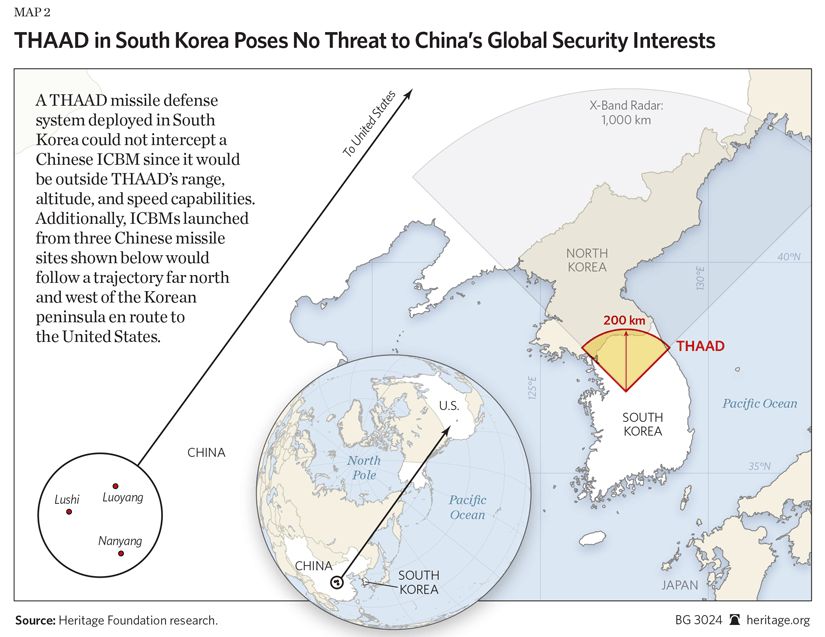
This is a local re-post of an essay wrote for The National Interest about 10 days ago. Basically, I’m curious why the Chinese are making such a huge deal out of THAAD missile defense. They’ve been bullying South Korea relentlessly for a year or so now over this. But THAAD doesn’t even impact them, as everyone knows now. That graphic over, from the Heritage Foundation, nicely illustrates that.

So the big question is why. Why is China making a huge deal of something where it’s so obviously on the wrong side of the debate? (Everyone can see North Korea’s nuclear missile program and South Korea’s obvious need for a ‘roof.’) Why does China think something this minor – THAAD has no impact on Chinese strategic forces – is worth wrecking a decent relationship with South Korea, one of the few regional states that is not that scared of China’s rise? Is this coercive diplomacy to prove Chinese regional hegemony, with South Korea being the first target to be bullied into knuckling under? Is Vietnam next? Or does China really care about North Korea so much that it wants NK to be able to blackmail South Korea with nuclear missiles?

I can’t believe that latter explanation is right. To me, this is China feeling its oats. It’s rising; no longer feels it has to keep its head down per Deng’s early advice. Now it’s number 2 in the world, on the way to being the world’s largest economy. So it’s going throw its weight around, and the states closest to it will feel the hammer of its prestige-seeking fall first.

The full essay follows the jump:

Continue reading

2017 Preview, part 2: Korean Security

Image result for north korea mobile icbm

This is a local re-post of an essay earlier this month for The National Interest. It is also intended as a sequel to my last post, drilling down from East Asia generally to Korea specifically.

There are three big challenges for South Korean security this year:

1. Will China insist on South Korean removing American missile defense? And how far will they go to insure that? (It’s looking pretty far.) Is China prepared to alienate one of the few countries around that is genuinely ambivalent about China’s rise (where most others are nervous)?

2. Does President Trump care about Korean security? If his inaugural address is anything to go by, then no, he doesn’t.

3. Will South Korean President Park Geun-Hye’s successor – almost certainly from the left – accommodate (read: appease/sell) out to North Korea and China?

The full essay follows the jump:

2017 Preview, part 1: East Asian Security

250px-East_Asia_(orthographic_projection).svg

This is a local re-up of a broad predictive overview of East Asian security issues in 2017 published first at the Lowy Institute a few days ago.

The standard first line of reviews like this is to bemoan North Korea and China. I do a little of that here, but tried to look beyond facile predictions that the US and China will fight in the South China Sea shortly. Asia is a pretty status quo place, so the only big ‘disruptors’ are the usual suspects – the Kim family of North Korea and Donald Trump. The Chinese and the Japanese aren’t really interested in rocking the boat much, so they’re barely mentioned, curiously enough. For example, the next time North Korea does something dumb, we can count on China saying that we should all calm down and maintain stability – in other words, do nothing. One thing I do wonder about is if the left wins the South Korean presidency this year, will it dramatically change South Korean foreign policy by accommodating (read: appeasing) North Korea?

Part 2, next week, will focus on South Korean security issues in the new year.

The full essay follows the jump.

Continue reading

Restraint and Burden-Sharing to Revive US Alliances, not Tear Them Down

Image result for restraint

This is a local re-post of an essay I published with The National Interest last month.

My concern is to separate the idea of greater US caution and self-discipline overseas from faux-complaint that this is ‘isolationism.’ Just because the US is more cautious in its use of force, or more demanding of its allies, doesn’t mean the US is abandoning them. Indeed, pushing them to do more, spend more, think more strategically about their own security is a way to revive US alliances, to make the US alliance framework less unipolar, richer. and more fully capable. I don’t see why this is so often derided as isolationism

Will Trump do this? Probably not. For a moment there, it seemed like he might embrace a foreign policy of restraint, but his hawkish cabinet picks and proposed DoD build-up suggest that is unlikely.

The full essay follows the jump.

Continue reading

Year in Review, 2016: Top 5 Events of Northeast Asian Security

Image result for trump abe

If that thrilling post title doesn’t pull you away from It’s a Wonderful Life or Sound of Music, I don’t know what will.

This essay is a local re-post of my op-ed posted with the Lowy Institute this month. The pic is President-Elect Donald Trump in his first meeting with Japanese Prime Minister Shinzo Abe. It well captures what a banana republic amateur hour set will be running the US shortly, which makes Trump the number one Asian security story of the year. That is Trump with his daughter and son-in-law business partners, but no US-side translator or Japan expert, because heh, what really matters is getting Trump Tower Tokyo built…

My top 5 security events for the region in 2016 follow the jump, but honestly you’re probably a lot more interested in my picks for the worst TV show and movie of the year.

Continue reading