What are the Chinese Telling Us by Bullying South Korea so Much over Missile Defense?

MASTER GFX TEMPLATE 2015v05

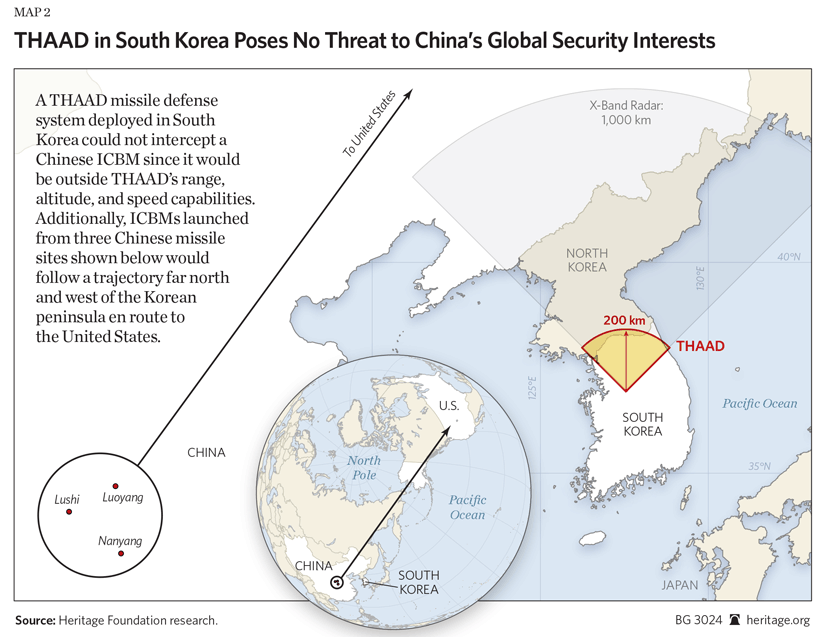
This is a local re-post of an essay wrote for The National Interest about 10 days ago. Basically, I’m curious why the Chinese are making such a huge deal out of THAAD missile defense. They’ve been bullying South Korea relentlessly for a year or so now over this. But THAAD doesn’t even impact them, as everyone knows now. That graphic over, from the Heritage Foundation, nicely illustrates that.

So the big question is why. Why is China making a huge deal of something where it’s so obviously on the wrong side of the debate? (Everyone can see North Korea’s nuclear missile program and South Korea’s obvious need for a ‘roof.’) Why does China think something this minor – THAAD has no impact on Chinese strategic forces – is worth wrecking a decent relationship with South Korea, one of the few regional states that is not that scared of China’s rise? Is this coercive diplomacy to prove Chinese regional hegemony, with South Korea being the first target to be bullied into knuckling under? Is Vietnam next? Or does China really care about North Korea so much that it wants NK to be able to blackmail South Korea with nuclear missiles?

I can’t believe that latter explanation is right. To me, this is China feeling its oats. It’s rising; no longer feels it has to keep its head down per Deng’s early advice. Now it’s number 2 in the world, on the way to being the world’s largest economy. So it’s going throw its weight around, and the states closest to it will feel the hammer of its prestige-seeking fall first.

The full essay follows the jump:

Continue reading

2017 Preview, part 2: Korean Security

Image result for north korea mobile icbm

This is a local re-post of an essay earlier this month for The National Interest. It is also intended as a sequel to my last post, drilling down from East Asia generally to Korea specifically.

There are three big challenges for South Korean security this year:

1. Will China insist on South Korean removing American missile defense? And how far will they go to insure that? (It’s looking pretty far.) Is China prepared to alienate one of the few countries around that is genuinely ambivalent about China’s rise (where most others are nervous)?

2. Does President Trump care about Korean security? If his inaugural address is anything to go by, then no, he doesn’t.

3. Will South Korean President Park Geun-Hye’s successor – almost certainly from the left – accommodate (read: appease/sell) out to North Korea and China?

The full essay follows the jump:

2017 Preview, part 1: East Asian Security

250px-East_Asia_(orthographic_projection).svg

This is a local re-up of a broad predictive overview of East Asian security issues in 2017 published first at the Lowy Institute a few days ago.

The standard first line of reviews like this is to bemoan North Korea and China. I do a little of that here, but tried to look beyond facile predictions that the US and China will fight in the South China Sea shortly. Asia is a pretty status quo place, so the only big ‘disruptors’ are the usual suspects – the Kim family of North Korea and Donald Trump. The Chinese and the Japanese aren’t really interested in rocking the boat much, so they’re barely mentioned, curiously enough. For example, the next time North Korea does something dumb, we can count on China saying that we should all calm down and maintain stability – in other words, do nothing. One thing I do wonder about is if the left wins the South Korean presidency this year, will it dramatically change South Korean foreign policy by accommodating (read: appeasing) North Korea?

Part 2, next week, will focus on South Korean security issues in the new year.

The full essay follows the jump.

Continue reading

Restraint and Burden-Sharing to Revive US Alliances, not Tear Them Down

Image result for restraint

This is a local re-post of an essay I published with The National Interest last month.

My concern is to separate the idea of greater US caution and self-discipline overseas from faux-complaint that this is ‘isolationism.’ Just because the US is more cautious in its use of force, or more demanding of its allies, doesn’t mean the US is abandoning them. Indeed, pushing them to do more, spend more, think more strategically about their own security is a way to revive US alliances, to make the US alliance framework less unipolar, richer. and more fully capable. I don’t see why this is so often derided as isolationism

Will Trump do this? Probably not. For a moment there, it seemed like he might embrace a foreign policy of restraint, but his hawkish cabinet picks and proposed DoD build-up suggest that is unlikely.

The full essay follows the jump.

Continue reading