Teaching the American Gun Debate in a Foreign Country: No Matter What You Say, They Think We’re Bananas

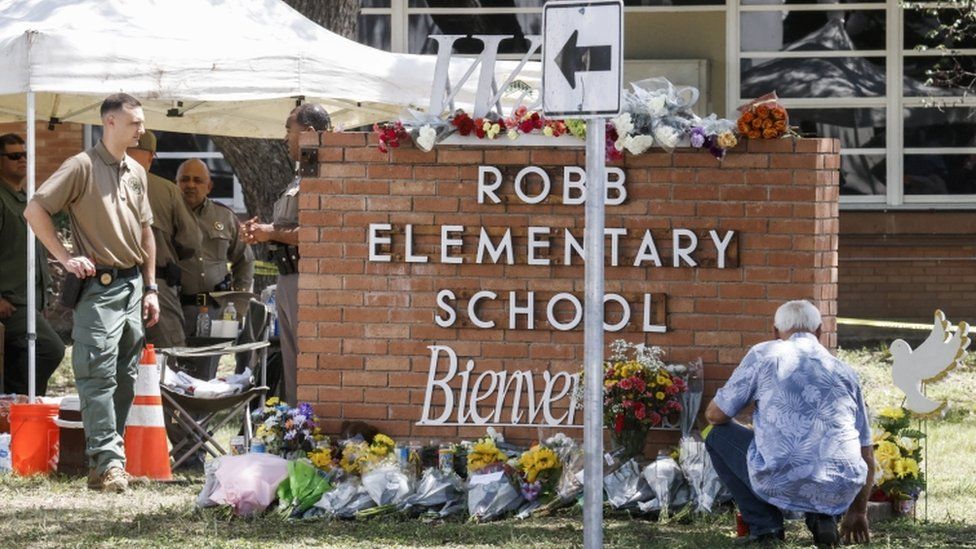
Officers stand near a memorial of flowers at the scene of the mass shooting at the Robb Elementary School in Uvalde, Texas on 25 MayUS politics is part of my teaching load here in Korea where I live. Inevitably, part of that is the US gun debate. The US fascination with guns bewilders foreigners – and that is putting it mildly.

I have lived outside the US for almost 18 years – in East Asia and Western Europe – and I have discussed guns in America with non-Americans countless times. I am a political scientist by training, so this comes up a lot. Non-Americans are genuinely curious why we allow private fire arm ownership, especially when it so obviously correlates with gun violence. I can say that I have never had a non-American tell me they wished their country had US gun laws. Not once.

I have written a lot on foreign perceptions of US gun ownership on Twitter in the last two days. Try this, this, this, this, and especially this.

In short, there is no other country in the world which approaches guns with the laxity we do. More importantly, no other conservative party in a democracy approaches guns as the Republican party does. Often my foreign students do not even understand how gun ownership is a ‘conservative’ or partisan issue, which I think would surprise a lot of Americans. Conservatives in other countries are not gun fetishists. Even other societies with a frontier tradition – Canada, Australia, New Zealand, South Africa, Russia – do not have the gun culture we do.

No one else thinks about Mad Max/government collapse scenarios which would require you to be armed for the end times. (Trying to explain American apocalypticism to non-Americans is almost impossible.)

No one else talks about an ‘armed citizenry’ resisting tyranny, like in the movie ‘Amerigeddon.’ In trying to explain this one, my students often can’t even figure out why they would be battling their own democratic government. Good question!

And then they wonder how regular Americans with guns could outshoot the heavily-armed cops or military. They can’t, of course. Another good question!

And very definitely, no one wants armed teachers, metal detectors in schools, open carry, concealed carry, and so on. Hardening schools and letting regular people walk around packing guns strikes non-Americans as insanely dangerous.

Inevitably then, I get three or four papers about guns in my US politics class each year. They are uniformly negative and incredulous. One particular title I remember from years back: ‘The US is a Gun-ocracy.’ That just about sums it up.
Support for Ukraine is Not ‘Pro-War’, because Some Things, like Sovereignty and Freedom, are More Important than Peace

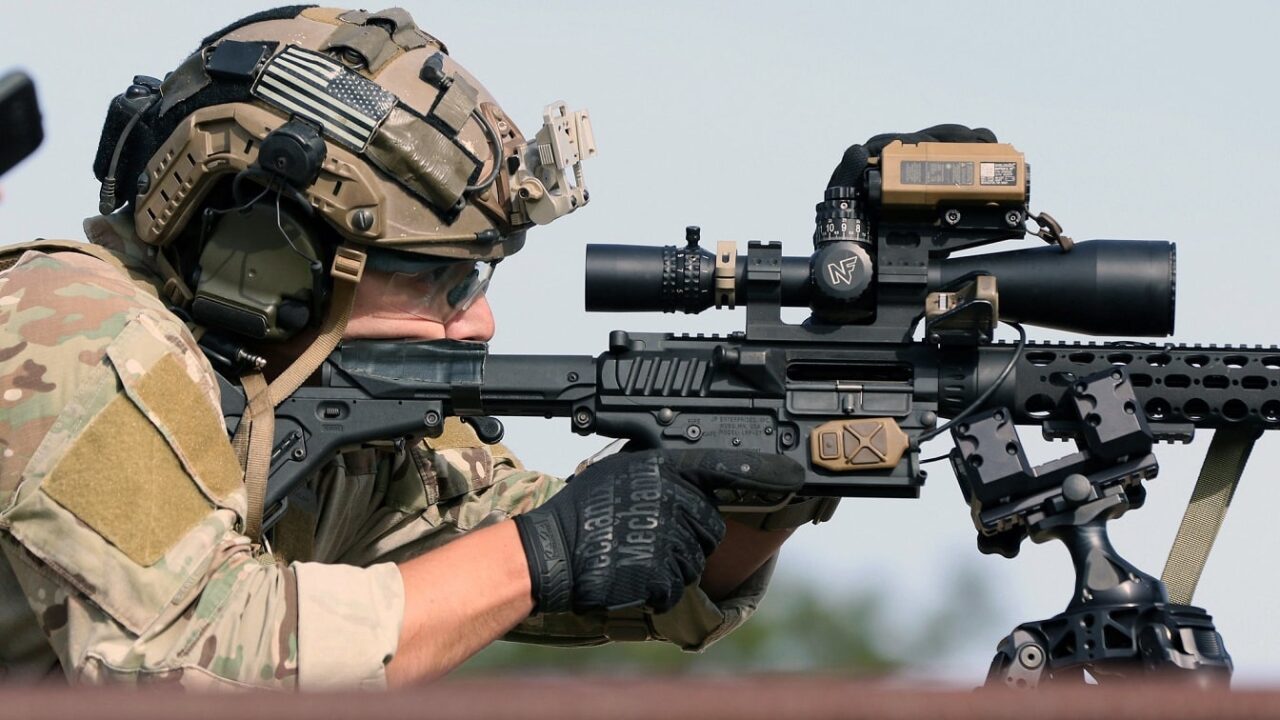
Sniper RifleCalling Western support for Ukraine ‘pro-war’ is grossly manipulative and deceptive with its implication that Western elites ‘like’ war. That is obviously not the case. Does Ursula von der Leyen strike anyone as ‘pro-war’? Gimme a break.

The following is a re-post of an essay I wrote for 1945.com.

The most nauseating part of the Ukraine war in the West has been the pro-Kremlin ‘anti-war’ set – Tucker Carlson, Tulsi Gabbard, Glenn Greenwald, Michael Brendan Daugherty, and so on. To be ‘anti-anti-Putin’, at this point, is to be effectively pro-Putin and pro-fascist, just as being anti-anti-Trump at this point basically means your MAGA. You’d think the left would not go to the lengths of supporting Russian fascism in order to oppose US imperialism, but that’s where Michael Tracey, who denies the Bucha massacre, has landed.

The usual anti-imperial leftist tropes are meaningless here: Ukraine is not Iraq; this is not a US foreign policy issue; the military-industrial complex is not profiteering off the war; Hillary Clinton, the CIA, Goldman Sachs, the IMF, Davos, and all your favorite neoliberal shills are just irrelevant. Putin has built a semi-fascist regime at home, launched an aggressive war against a weak, democratic neighbor, and tolerated, if not endorsed, war crimes. That’s what matters, not relitigating the American empire debate of 20 years ago.

It is ironic that the anti-imperialist left, which wants to bemoan American empire, makes the same Amero-centric error as the neocons they hate so much: both read US choices as the only thing that matters in world politics. Foreigners have no agency; the Ukraine war is apparently about the US, not Ukraine and Russia. So the war in Ukraine becomes about NATO expansion rather than Putin’s own bluntly stated explanation that it’s because Ukraine is a fake country and really part of Russia. Good grief.

Here is that essay for 1945.com:

“Western Support for Ukraine is Not ‘Pro-War’” – Since the start of the Russian invasion of Ukraine, a small but vocal clutch of Twitter and television personalities have argued that Western support for Ukrainian resistance is ‘pro-war,’ a worsening of the conflict via the provision of aid which prolongs the fighting. This posture might be best described as ‘anti-anti-Putin.’ That is, these voices read Western dislike for Russian President Vladimir Putin since February as overwrought and exaggerated, thereby deepening the war.

To critics, this position is nearly indistinguishable from a pro-Kremlin posture that refuses to admit Putin’s apparent agency in launching the war.

The most prominent voices in the group are Tucker Carlson, the highly-rated Fox News host, and his frequent guest Glenn Greenwald. Others include former Congresswoman Tulsi Gabbard, and Substack gadflies Michael Tracey, Michael Brendon Dougherty, and Matt Taibbi. All seem to suggest that the West should cut off aid to Ukraine, on the premise that the war would end sooner.

Please read the rest here.

South Korea’s New President is Probably a Bland Centrist – and That’s Fine

South Korea's new president, Yoon Suk-yeol (right), greets the country's outgoing leader, Moon Jae-in, at his inauguration ceremony in Seoul on Tuesday. | REUTERSThis is what a peaceful transition of power looks like, American Republicans! Moon and Yoon follow the rules. That’s good. Learn from that.

This is a repost of an article I wrote for The Japan Times.

My impression from teaching my student is that the new South Korean president, Yoon Seok-Yeol, ignites no enthusiasm. He reminds them of their grandfather – old, kinda out-of-touch, lacking charisma. But honestly, after 5 year of Moon Jae-In’s rollercoaster with Donald Trump and Kim Jong-Un, I’ll take some bland boredom.

Yoon jumped into the race last year and does not have deep roots on the right here. Most importantly, he does not (seem to) share SK right’s fatiguing obsession with vindicating impeached former conservative president Park Geun-Hye. Park was guilty already! Get over it. I am hopeful that means he won’t prosecute Moon in his post-presidency solely for revenge, which I think almost any other traditional right-wing POTROK would do.

On policy, Yoon will lean to the right. He’ll be conservative on social mores – no gay marriage, no anti-discrimination law (sigh) – but he won’t be Trump. On economic issues – chaebol power, overlong work hours – he’ll do nothing, unfortunately. But at least on NK, we won’t have to hear anymore about what a misunderstood great guy Kim Jong-Un is. Enough of that. Those calling him the Donald Trump of Korea are probably just casting around for a label. Yoon doesn’t behave like Trump at all, thankfully.

Here is my essay for The Japan Times:

Yoon Seok-Yeol was inaugurated president of South Korea this week. He is a former prosecutor who only entered politics in the last year. He is from the conservative People Power Party. But he has no roots in that party or its various factions. Nor does he seem particularly ideological. He channels the basic anti-communism – aimed at North Korea – of the South Korean right. That has long been the core motivator of South Korean conservativism. But beyond that, he seems like a bland centrist.

This is a surprising turn. There is no obvious reason why South Korean conservatives would want him as their candidate, beyond simply defeating the left in the election. Yoon has no particularly programmatic interest in domestic politics. He is not a libertarian or religious social conservative, for example.

He has been called the ‘Donald Trump of Korea,’ but that feels mostly like foreign journalists grasping for an ideological handle for him. If he is a Trumpian populist, he has not talked that way. Trump’s signature mix of bombast, racism, tariffs, and loud nationalism is not how Yoon campaigned.

Please read the rest here.