Unrising Sun – Japan as the Austro-Hungarian Empire

images

Perhaps the biggest Asian security news of the summer is the high-profile marker of the shifting tectonic plates out here – China’s surpassing of Japan as the world’s second largest economy. You know your society is in real trouble when being displaced like this is termed a “relief” by a fellow citizen on the New York Times op-ed page. Is anyone in Japan really relieved that China has pushed it aside this way? China’s meteoric growth is nerve-racking enough, but who wants to live in a society that wants to be eclipsed? To boot, how should Japan’s allies/partners on the China question (US, Korea, India) respond to a society that is “shrugging” over its decline?

So this made me think of the fin-de-siecle Austro-Hungarian empire. Maybe there is something romantic in the twilight pessimism of fading greatness coupled with high culture? I remember Poindexter asked in Revenge of the Nerds, ‘would you rather live in a society during its rise or its decline?,’  and maybe there is something lush, overripe, decadent, boozy, and deliciously self-conscious about watching one’s own tragedy (think about the character of Hayward from Of Human Bondage). Contrast this with the regular hysteria that greets the bout of American declinism that besets the US every generation. Americans go into neurotic fits, and start talking about moonshots, new frontiers, mornings in America, new foundations (Obama), etc. By contrast, Kingston wisely asks after yet another dreadful summer for Japan, can anyone govern it anymore? Increasingly you don’t need to be a Japan expert to think the answer is not really…

The sociological questions for Japan broached by this are beyond my skills, but the international consequences can’t be good. This slow eclipse of liberal, democratic, modern Japan can’t make Asia anymore secure. It will only bait China more, scare Korea more toward a separate regional deal with China, and pull the US deeper into Northeast Asia at a time when we desperately need to constrain defense spending and commitments. India, for all its ‘emerging’ potential, still can’t really compete with China as Japan might. In effect, this cedes regional order building to China: Japan won’t try, the US can’t afford to it, and India is still to0 immature to contest it. Normally we think of rising challengers battling leaders to primacy – Wilhelmine Germany v. Britain, the USSR v. the US. But in Asia at least, China is taking the game as much by the failures of the rest as by its own abilities. Note also, that as China takes over Asian leadership by default, it becomes impossible to test its real intentions.  Much of the debate over China is whether or not it is prepared to use to force in the future to get its way. Increasingly, it looks like we won’t know because the democracies are simply abdicating the game to it.

So I’ll ask the same question Kingston does, what needs to happen to get Japan back in the game? Have they really just dropped out to become the Switzerland of Asia?

Off to China… 4) Impressions

P100528006

So last weekend was my first trip to China. As I said a few days ago, actually being there did change my mind a bit. I was pushed a little from the ‘China threat’ to the ‘peaceful rise’ school. I imagine this is natural. Travel humanizes other people and makes one less suspicious…

So here some relevant observations:

1. Tiananmen Square has a  Mao mausoleum, just like Red Square has the Lenin mausoleum. I have visited both, and I can genuinely say they are some of the strangest, creepiest political artefacts I have ever seen. You go in well-dressed and walk in silence around the embalmed body kept under glass. (What must they do to preserve it one wonders.) It is like visiting the Vatican for commies. As communist ‘holy relics,’ they are conceptual oxymorons. Russians used to tell me that Stalin killed God, so he took him out of heaven and put him in Red Square mausoleum as Lenin. Communism could destroy individuals religions like Christianity, but not the religious impulse – which of course was a central point in Marxism. These mausoleums, in deifying communist founders, betray a central principle of the movement. On top of that irony, they sell red kitsch of Mao inside the mausoleum. So after you see the Great Helmsman and think Great Thoughts about China, you can buy Mao cufflinks and playing cards in the on-site giftshop. Hah! If that doesn’t make a mockery of the whole point of the mausoleum… Mao is now a tourist attraction, not a communist patron.

2. The Great Wall really spurs the imagination about big, Will Durant-style topics like ‘Civilization vs barbarism.’ It is hard not to be swept away by the romanticism of it all. You can easily picture some Ming guard pacing in the cold night suddenly looking out at some vast swarthy horde like the Teutons from the beginning of Gladiator. The Great Wall is built along dramatic mountain ridges, so it grips the imagination as Hadrian’s Wall does not. It is also more intact and much larger than Hadrian’s.

3. The Forbidden City, like the Winter Palace or Versailles, explains why republican and communist revolutions happen. The opulence is just astonishing. Wow. I was just blow away by how big it was. As you go through, you keep thinking that this court or that room will be the last one, but no, it keeps going and going. The emperor even got his own individual tunnel to exit and enter. (Ie, the place is so huge, that there are multiple giant tunnels through the walls, not just one, and the emperor got one all to himself.) I visited Versailles and Winter Palace as well, and every time I see these megalomaniacal monuments to a ‘sun-king,’ it is easy to see why these guys get tipped at some point and frequently executed. I also think that is terribly hard for moderns raised in a democracy to feel the moral weight of such places. To us, they look more like criminal waste of national resources than the necessary glorification of the unity of man, state, and god in the sung-king’s person, which contemporaries must have seen.

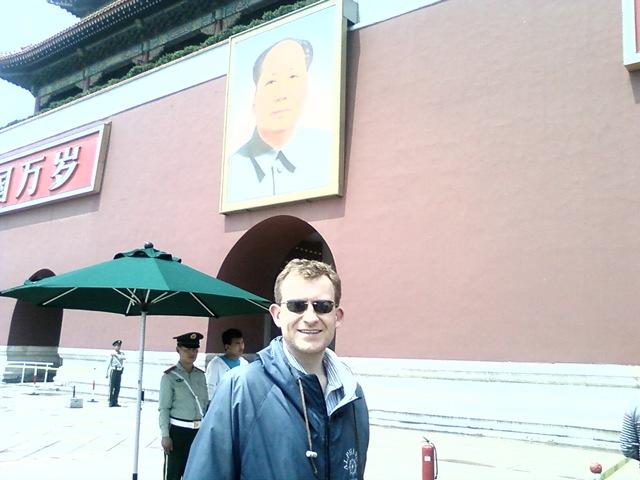
4. The Mao portrait on the Forbidden City is a symbol of communist modernity’s defeat of feudalism. This did not really hit me until I went there. Once you see the size of the Forbidden City, and then the huge portrait placed right on top of it, you get the idea. How ironic then that China is now digging around in its history for its post-communist nationalist identity. Chinese language institutes are called the ‘Confucius Institute,’ even though Mao loathed Confucius as a reactionary. Communist modernity failed, so now China’s feudal past is being reworked as a tourist attraction and cause for nationalism.

5. You can see the two Chinas phenomenon everywhere. Any rapidly developing state is going to have this kind of social fracture, as the young and globalized pull away from the older and traditional. This is happening in India right now also. You can see the older parents – smaller, worse teeth and skin, plain clothing – and the increasingly US teenager-looking kids in bluejeans and t-shirts. This must be quite a culture clash in the home, and it makes me wonder if that is the reason China emphasizes harmony so much. The social cleavage is wide, and both sides have strong claims. The young represent the future and wealth of China; the old built the place (however mixed that accolade might be) and are deeply vested in the party-state that ended the ‘national humiliation.’

6. China’s scholars are reveling in big talk about the changing balance of power. At the conference I attended at the China Foreign Affairs University, speaker after speaker made sure to tell us how China was rising and the US needed to make room for China’s ‘legitimate interests.’ I heard this a lot last year too, but this time I was on the home-turf, so it was even more self-congratulatory than before. At one point, I just couldn’t take it anymore, and got into a major scrap over the Cheonan. I told them everyone in SK knows that China is propping up NK. The response was more obfuscation – maybe the ship hit a rock, we need ‘calm’ on the peninsular. Bleh…

Off to China… 3) There was a Confucian Peace After All…

eindex01

About 8 months ago, I wrote that the notion of a ‘Confucian Peace’ was probably wrong. I thought that usually common cultures inspire competition for dominance. Like envies like. We save our greatest passion for inquisitions not crusades. We would rather punish errant insiders in the name of purity than hazy outsiders we can easily classify as ‘barbarians’ and forget about it. I figured Christians massacred each other for centuries over tedious doctrinal issues despite a New Testament ethic to turn the other cheek. So I figured the Confucian Asians (Japan, China, Korea, Vietnam) would be the same way.

But when I actually did the research it really turned out wrong for Confucians. While it is correct that Christians were hypocrites regarding ‘Christendom,’ Confucians generally were not among themselves. This does mean that Confucians states did not war. Like the Democratic Peace, a Confucian Peace posits only that Confucians don’t war on each other, not that they forgo war altogether. Below is the abstract and two of the graphs. If you want the whole paper, please email me. What is most important is the Confucian ‘peace score’ in the bottom table: one two-month war in 195 years of Confucian diplomatic history. That is quite striking compared to 92/151 war years for Christendom.

“International relations theory about East Asia has increasingly argued that East Asia before Western penetration enjoyed a protracted peace. As explanations, a Chinese military hegemony would fit IR theory fairly well, while a cultural peace based on shared Confucian norms would be a significant anomaly. A Confucian long peace challenges widely-held, albeit Eurocentric, IR presumptions including the perils of anarchy, the arms-racing and misperception of the security dilemma, and the regularity of power balancing. This paper therefore investigates, first, whether such peace did in fact exist, and, second, whether this might be attributed to Confucianism. A cultural peace theory requires a strong anti-war cultural norm and a shared sense of community. Skepticism is established by examining 3 comparative cultural spaces that nonetheless did not enjoy a culturally informed peace: the classical Greek city-state system, early modern Christendom, and the contemporary Arab state system. All were deeply riven and competitive. Nevertheless, empirical investigation of the last Chinese (Ching) dynasty before the Western arrival (1644-1839) demonstrates that it was remarkable peaceful toward its Confucian neighbors, while more ‘normally’ exploiting its power asymmetry against non-Confucian ones. Process-tracing specialized Chinese practices toward fellow Confucians suggests the low Confucian war finding emanates from cultural restraint.”

Model of a Politically-divided Cultural Community

Polities

                                           Japan

China

Korea

Vietnam

Cultural Base or Substratum

                                                                         Confucianism


Empirical Summary of Cultural Peace Cases


Classical Greece

Western Christendom

Modern Arab State System

Pre-Western Confucian-Ching System

Anti-War Ethic

No

Yes

No

Yes

Society of States

Yes

Yes

Yes

Yes

Total War Years / Total System Years

73/141

92/151

8/55

(15/55)[1]

1/195

Percentage of ‘Cultural Peace’ Years

48.22%

39.07%

85.45%

(72.72%)

99.48%


[1] This second figure includes the Libyan 1980-87 invasion of Chad.

Off to China… 2) The ‘Peaceful Rise’ Thesis

image029

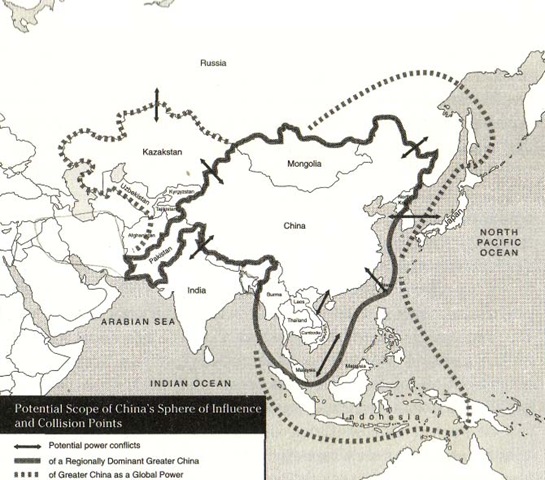
Part one of this post is here. I found this very provocative map here. For the official claim that China’s rise to global power is to be peaceful, read this. For the best academic argument for China’s peaceful rise, try this.

Hawks and realists tend to see China through the lense of history. Lots of other powers have risen in the past to challenge established powers, and usually conflict ensued. Everyone says that peace is preferred and war unnecessary, but in the end, jealous, bitterness, and the ideological pleasures of domination take hold. Minor conflicts grow and worsen; at some point, a hot war or protracted cold war begins. You could throw this model onto Germany (twice), the Punic-Roman competition, Japan’s 19th century rise at China’s expense, the USSR’s rise in the 40s and 50s, etc.

By contrast liberals and especially constructivists  look more at China specifically. Instead of seeing her as just one more hegemon with the same characteristics as others, China’s unique features because a causal possibility for peace. Here is a quick-and-dirty summary:

1. China is getting rich in the current world economic order (epitomized by its membership in the WTO), so why would she rock the boat? Right now she is gaining wealth and prestige, while dumping public goods/security provision on the US military (especially in Afghanistan, which war helps her more than us). Given this great benefit, a peaceful rise makes sense.

2. China has a history in the Sinocentric world order of treating the smaller peoples around it with some generosity. (I actually disagree with this empirically, but so be it.) The idea here is that the Chinese tributary system, especially of the Ming and Ching, only relied on violence when absolutely necessary. Much of Chinese pre-modern hegemony was based in ritual and moral suasion. So future Chinese hegemony in Asia will look back to this model rather than the Nazi or Roman ones in Europe.

3. Globalization has made a collision less feasible and valuable to the riser. This is a Thomas Friedman argument, rather similar to the one made before WWI by Norman Angell. The idea here is that globalization makes war less useful as a tool to pursue national interest and may in fact be remaking the idea of national interest altogether. In this new flat world, war is an anachronism of the nation-state era. The costs of war in the interconnected era are higher, because wars break all these international trade and financial connections that have made China so rich. Also, the benefits of war have declined, because in net-world, holding territory is not really a valuable economic commodity anymore.

4. Globalization and modernization are changing China into a status quo power, possibly prepared to accept US leadership. This is the cultural variant of the argument above. Here the idea is that as China joins the world to get rich, she will also learn from the world to be nicer. This was basically the gamble of the Clinton administration – economic modernization would entrain political liberalization – when it agreed to PMFN 15 years ago.

5. The Chinese elite have seen what happens to other, aggressive risers, and they have learned. This is a Ned Lebow learning argument, and the one I find most persuasive (probably because Ned was on my comps committee in grad school). The idea here is that the rise and fall of powers need not be some mechanical process, as if these states are robots. Instead, later hegemons and risers can learn from earlier ones. Ideally, they learn to avoid the mistakes of the past risers who collided and provoked wars.

6. Chinese made a policy choice to rise peacefully, and we should believe them. Call this the naive argument. One would accept at face value what the Chinese say. Words have meaning; pacta sunt servanda. So if the Chinese say they will rise peacefully, we should take them at their word and not fall back on pre-set notions of realism that permit blithe ignorance of anything the Chinese have to say.

7. The Chinese are nice. This is the most cultural and sino-specific of all the arguments I have heard. It is the one I heard the most last weekend in Beijing. Basically it says ‘we Chinese are different. We are nice and not belligerent. If you see us as a threat, that is your problem, in your head. Instead of telling us we will be mean and nasty someday soon, why don’t you come to China now and see how nice we are.’ As ridiculous as it sounds, I find this one somewhat persuasive. I have generally tilted against the peaceful rise school, but my time in China really gave me pause…

Off to China… 1) The ‘China Threat’ Thesis

China_Decal

Here is part 2, on China as a ‘peaceful riser.’

I am in China right now for the first time for a conference on Asian security (what else?) at the Chinese Foreign Affairs University. I will post impressions on my return. A standard methodological quip in the social sciences is that you should never generalize about a country until you at least flew over it, so I guess I am paying my dues.

So I thought it might be useful to lay out the big running debate about China: whether it will be nasty as it gets more powerful, or will it play in the established global rules of things like the WTO? This is the ‘China threat’ vs the ‘peaceful rise’ school. I lean toward the former, but maybe going there will change my mind…

1. China’s internal politics are repressive: Falun Gong, democracy dissidents, Muslim Uighurs, Tibet. Why would you expect a regime that treats its own people that way to be nicer to the ‘foreign devils’ (the 19th century mandarin term for western traders) ? Why would you trust a regime that shoots its own people? When Iran and Zimbabwe do it, we worry. Why not with China? China is not a democracy.

2. While China is rising, it is vulnerable. It is benefitting enormously from the US/WTO-lead trading order. So of course they will say they want to rise peacefully. They won’t shoot themselves in the foot. They see how Germany’s belligerent rise in the late 19th century got it encircled and crushed in WWI. They aren’t stupid enough to say they want changes, but we shouldn’t be stupid enough to believe them either, especially given point 1 above.

3. China has a historical legacy of xenophobia and cultural supremacism. You can overcome history of course; the Germans did. But the Chinese aren’t there at all, and its historical reservoir of national myths clashes badly with just being ‘one more country.’

4. As countries grow and get wealthier, their perceptions of their national interests change, ie, grow. So yes, today, the Chinese do want to rise peacefully, and maybe they are sincere. But eventually, as its sense of its global role grows, and as the scope of its interests grow, it will become pushier and probably more belligerent. This usually happens when countries grow to new prominence. Britain in the 19th century intervened all over Asia. The US got more involved in Latin America and the Pacific. The USSR dabbled in all over the place during the Cold War. Maybe China is different, but the historical record of big states developing new ‘needs’ and ‘appetites’ is pretty clear. Expect it here.

5. What will they want after they get rich? James Fallows’ work at the Atlantic suggests that China just wants to get rich, and that’s true, but what happens after they get there? As states become richer and more influential, their perceptions of their national interests expand – particularly as states trade more and import resources more (as most rising states must). It is all but inevitable that China’s global footprint will expand as it already has in Central Asia, Africa, and the South China Sea. This does not mean it must be belligerent, but it does mean that there are more possible loci of conflict. The sheer size of China and its reach will insure friction and collisions – just as it did with the British Empire, the USSR, and the US.

Add to this China’s rather toxic internal politics. China is hypernationalist (the replacement ideology after Tiannamen), mercantilist, and repressive. I see nothing benign in that mix. If you were China, wouldn’t you be chafing at the bit, having to listen to Bush or Hillary lecture you about human rights and your exchange rate? And once the first missile lands on Tibet, all the talk of peaceful China will fly out the window. My first-cut schtick on the US and China is in galleys at Geopolitics for publication this fall; here it is in brief. For China’s muscle in the Northeast Asia, try here and here.

In short, I lean toward the view that China is a rising power likely to collide with the US, because its range of interests will expand as its power expands. In 20 years, when China has a bigger navy, it will suddenly ‘discover’ national interests in the South Pacific or Indian Ocean. Rome, Britain, the US, the USSR all went down this path. It is worse, because China has the Sinocentric history of informally dominating its Confucian neighbors. And the regime ideology is still fairly illiberal – mercantilism, hypernationalism, internal repression.

The Six-Party Talks as a Game Theoretic ‘Stag-Hunt’ (2): China Likes the Rabbit Too Much

hackaert-stag-hunt-forest-NG829-fm

Part one of this post is here.

In the formal language of game theory (GT), here is the pay-off matrix for the hunters (SK, PRC, Japan, Russia, US) if they capture the stag (NK’s better behavior in the region):

1. SK: SK is the most obvious winner from taking the stag because NK is an existential threat to the South – both physically and constitutionally.

2. Japan: Japan is the second big winner, because the NK nuclear and missile program increasingly represent a major physical threat to its cities, and perhaps even an existential threat if the North can put enough nukes on missiles.

3. US: The US is a weaker winner, because it is far less threatened by the North directly. The big pay-off from NK change (the stag) would be the reduction in troops and other expense from keeping USFK in Korea. Another benefit would be the reduction in the post-9/11 concern for proliferation of missile and WMD technology to terrorists and rogue states. But this is still far less critical than SK and Japan’s benefit. To the US, NK is more a troublesome, throwback-from-the-Cold-War headache when it would rather concentrate on salafism and the rise China.

4. Russia: Russia has essentially no stake in Northeast Asian security, given that it has basically retrenched from the region to focus on Central Asia and Eastern Europe. However, the Six Party talks are a prestige-generator for a country desperate to still look like a great power even as its lineaments erode. So Russia doesn’t get much from the stag.

5. China: The PRC’s portion of the stag is the smallest, while its rabbit is the biggest. A more docile NK would almost certainly fall heavily under the influence of its southern twin. The more ‘southernized’ NK becomes, the less sinified it will be. (This of course is the whole point from the Korean perspective – reunification.) And the PRC almost certainly reads greater southern influence in the North as greater American influence. So the Chinese rabbit is the long-term survival of a separate NK state to act as a buffer against the democracy, American influence, liberalism, and Korean nationalism that would all flood into NK were an inter-Korean settlement (the stag) finally struck. (A friend at the Renmin University of Beijing all but says this here, and I generally find Chinese scholars will openly tell you why the PRC props up the DRPK even though the PRC’s official policy is reunification.)

What to do then? How do the other hunters get China to stop defecting and start cooperating? The most obvious way is to equalize the pay-offs more, i.e., make it more valuable for China to coordinate by increasing China’s portion of the stag. Here is where strategic restraint on the Cheonan sinking may be useful. If SK holds its fire over the incident, it may be able to ‘sell’ this restraint to China as a hitherto unrecognized benefit. The SK claim to China would be:

See how small your rabbit really is? NK is so unpredictable, so erratic, so uncontrollable, that the stag is more beneficial than you think. Without a long-term settlement, NK’s erratic behavior could eventually generate a crisis the SK population will no longer choose to overlook. Next time this happens, SK government may be forced by popular outrage into coercive retaliation that could pull everyone in northeast Asia into the vortex.

Recall in early 1991 that Israel demonstrated similar strategic restraint as Saddam Hussein shelled it with Scuds before Desert Storm. This helped convince Saddam’s Arab neighbors that Saddam really was a danger to everyone. SK might be able to do the same here.

However, this is unlikely to be enough. China will probably as for a higher concession – a promise for the removal of USFK after unification. It is not clear to me if a unified Korea would need USFK, so this may be an option to explore.

How to Respond if North Korea really Sank that SK Destroyer: ‘Sell’ Southern Strategic Restraint to China for Pressure on the North

15214047

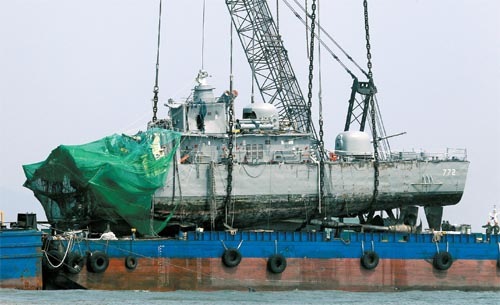
The sinking of a South Korean vessel, the Cheonan, has dominated the news here for weeks. Increasingly it looks like an external explosion caused the ship to break in two and sink rapidly. Suspicion is high that the only external force strong enough to sink a modern reinforced warship would have to a be a (presumably NK) mine or torpedo.

Predictably the conservative SK press has started the drumbeat for an aggressive response, including possible military action. President Lee of course is painted into a corner. A wholly unprovoked attack like this screams for blood, and the South Korean right is virulently anti-communist. If Lee does nothing, he’ll be hammered in the media and by his rivals within the governing party.

I sense a decisive moment building, akin to Austro-Hungary’s 1914 debate on how to respond to Archduke Ferdinand’s assassination, or Bush’s post-9/11 reckoning. Here is a moment rich and justified in the aggressive rhetoric so beloved by conservatives the world over; try to imagine how Fox News would respond if the ship had been American. This could easily slide into nationalist hysteria and escalation. 9/11 too raised America’s temperature and pushed the US government to aggressive action in the Middle East. Only a few years later did it become apparent how much the US overreacted. I fear the same here. As Andrei Lankov (one of the best NK experts – read him if you don’t) notes, Lee doesn’t really have much room to do anything against the North that is significantly punishing, yet won’t cause a NK escalatory response, and then a dangerous tit-for tat downward spiral. I think the Korean Foreign Ministry sees this too.

In brief, the problems with any military response are:

1. North Koreans will suffer the costs of any retaliation, not the KPA/KWP elite likely responsible for the attack.

2. NK is heavily ‘bunkered’ and hardened. Any military response would likely be from the air and would require multiple sorties. This means more chances for accidents, shootdowns, and other ‘kinetic’ interactions that could lead to a spiral of violence.

3. Realistically, the US would have to political approve of SK action; this is unlikely.

4. The North is already so deprived and impoverished, it is hard to find a juicy target that would both hurt but not lead the KPA to call for war. (This is what would happen if the nuclear sites were bombed, so scratch that idea.)

5. My friend Brian Myers has convinced me that NK is such a paranoid, ‘national-defense state,’ that any attack is likely to provoke an escalated armed response. The KPA derives it prestige and legitimacy from its ability to defend the country – indeed this built into the constitution now as as the “military-first” policy – so it would be existentially important for it to hit back.

Hence it is extremely likely that any SK strike would be immediately countered and escalated. This is not like Israeli airstrikes in Lebanon or Syria. The North will almost certainly pursue escalation dominance into a quickening and widening cycle of hits and counter-hits. This is not a game the South really wants to play, especially given Seoul’s extreme exposure to North Korean artillery. So swallowing its anger out of sheer fear of escalation is my prediction of SK’s response.

So what to do? How about going to China and telling them, ‘we will hold off on a response in the interest of stability, but you really need to get serious with the pressure. No more bail-outs and trips to Beijing for the Northern elite.’ China doesn’t want a tit-for-tat, degenerative North-South spiral anymore than anyone else. Perhaps the South can use this to really push the Chinese hard on finally cutting off NK.

To be sure, the road to Pyongyang doesn’t go through Beijing. North Korea coldly plays China for gain as much as it does the US, Japan, and South Korea. But I have always thought that if NK ever faced a truly united front of the other 5 parties of the Six Party Talks (China, US, SK, Japan and Russia), the DPRK might finally be cornered. In this way, the relevant Six Party game theory is the stag-hunt. If only the 5 can coordinate and not defect on each other (NK’s constant goal), the can catch the big stag – change in NK. Strategic restraint on the Cheonan sinking might be a way to convince China to finally stop defecting over North Korea.

Revaluation Downside: Low-Cost Chinese Goods Help America’s Poorest

ts-krugman-190

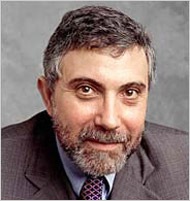
My big concern is that all the focus is on the negative side of China’s undervalued currency. Krugman (above) and others, correctly, complain that it artificially reduces US competitiveness. If the yuan floated, the price of US goods in China would slide dramatically. Rationalist Chinese consumers would move toward suddenly cheaper US goods, and that gets you the export boom Obama talked up in the State of the Union. (Although Asian buyers are stubbornly nationalistic. The home country bias here is extreme, so don’t get your hopes up for some big US export surge to Asia. You’ve never seen as many Korean cars as you will in Korea…)

The downside of course is that the poorest Americans benefit most from the undervalued yuan, and their unorganized, underprivileged, and non-corporate voice is completely unheard in this debate. The poorer you are, the more it matters to you that Chinese imports at Walmart are super-cheap. By definition, the tighter your family budget constraint, the proportionally more valuable low consumer prices are. The undervalued Chinese currency ensures that all that consumer stuff imported from China and sold at the big box stores like Walmart and Target helps the poor stretch the dollars. The purchasing power of their fewer dollars goes farther when Chinese imports cost so little.

1. So the poorest benefit the most proportionally from the undervaluation. Why doesn’t that make the news? Because the poorest are also the least political organized, and consumer interests are generally far less well-organized than business interests. So US exporters, who would benefit from a weak dollar, scream, and Congress listens. US consumers benefit enormously from a strong, especially overvalued, dollar. But their voice is disaggregated and diffused across the country, compared to the concentrated corporate power of exporters. Consumer gains from a cheaper Chinese-Walmart stuff is far smaller and diffused than the steep and concentrated pain of exporters suffering from a strong dollar. This is a classic protectionist response: gains are diffused, hard to see, and enjoyed by the weakest, while pain is concentrated, easy to indentify, and felt by the politically privileged.

None of this means that the yuan isn’t overvalued. It is, and the world’s largest economies clearly have a systemic responsibility to let their currencies float. The distortions coming from China’s currency are downright bizarre, with China’s foreign exchange reserves at levels never seen in the history of finance before. But if you wonder why DVD players that used to cost $20 at Walmart suddenly cost $30, now you’ll know. And while you, the middle class reader, might not care because that is within your disposable income range, recall that the poorer you are, the more that extra $10 means. The more overvalued the US dollar, the more America’s poorest are helped.

2. The temperature is rising on China’s currency. The US Congress is starting to seriously pressure the US Treasury to formally label China a ‘currency speculator.’ DoT must once again decide in mid-April. Krugman (above) got the ball rolling on the argument that the US should finally come out and openly accuse China of manipulation for its nationalist/mercantilist trade purposes. And just about everybody seems to agree that the yuan is overvalued. Just how undervalued is the yuan? 49% (!!) according to the Economist and 40% according to the Peterson IIE. For what it’s worth, I certainly agree with these estimates. I don’t think anyone really believes the dollar currently reflects its real purchasing power in Asia. US goods are ridiculously expensive in Korea; a fifth of Jack Daniels costs about $40!

3. All these Asian countries want their currencies undervalued because of the nasty lesson they learned in the Asian financial crisis. Most Americans don’t know this at all, it seems. 15 years ago, Asians did not have the dollar reserves to defend their currencies and when capital flight hit, these economies were turned upside down. Indonesia’s government collapsed into anarchy, Thailand lost something like 1/3 of its GDP, and South Korean couples were donating their wedding rings for gold to the government to pay its foreign debts! In short, the region got turned upside down/inside out, and everybody out here remembers this, while Americans just missed it altogether. So afterwards, the Asians did exactly what the DoT and the IMF told them to – they balanced their books and stocked up dollars in case there would be another crisis.

4. Here is good background on the conflict; try this too. To place the China currency evaluation in the global context, read this excellent introduction to the current problems of the global economy, specifically the problem of ‘imbalances.’ In brief, the US and Mediterranean countries are spendthrifts now carrying huge piles of debt, while Germany, China, and other Asians are overthrifty supersavers. So the broke Americans have no more money to spend to prime the global economy, and the supersaver Asians should fill in the gap by buying a lot. The more stuff they buy, the more people will be hired to make all that stuff they are buying. This will reduce unemployment. So the supersavers are the key to getting global unemployment down, because they have the cash to go on a spending spree.

Korea’s Post-American Alliance Choices (1): India?

200x


This will be an occasional series. The US is entering a period of decline. Its ability and willingness to meet its alliance commitment to South Korea is waning. So Korea is, quietly, beginning to poke around in Asia. It is setting up preferential trade areas where possible, signing up whomever it can for ‘strategic partnerships,’ and generally branching out in the region. This serves both its desire to be a more regional player (rather than be permanently trapped in its peninsular ghetto with NK) and its growing need for friends beyond the US. The US has neither the money nor the domestic will to fight another Korean war. So it makes sense for Korea to look around, even if no one will admit that that is what it is doing.

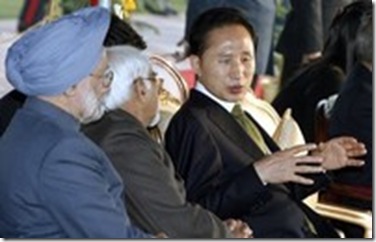
On Monday, I spoke on the radio about this. Last week, the president of Korea had a state visit to India. India is a good choice for several reasons. Like Korea, India is

1. a liberal democracy with a lot of religious diversity.

2. worried about China’s rise.

3. an American ally.

4. Bonus: India is not Japan.

While more common than in the past, stable democracy is still hard to find in Asia. It makes sense for Korea and India to hang together. Of course, the closest democracy to Korea is Japan, but the mutual loathing is so severe, that Japan is a last ditch alliance choice for Korea. Further, both have a good tradition of internal tolerance based on their religious diversity. Everyone knows of India’s of course, but Korea too is one of the most religious fragmented states in Asia (sizeable minorities of Catholics, Buddhists, born-again protestants, and agnostics, with no dominant bloc).

This commonality of values is complemented by a commonality of interests, or rather an interest: China. Both are edgy about its quick rise (no surprise there), and both continue to hedge it and ally with the US in order to do so.

The downsides though are high. India is far away. It does not have the two-ocean fleet necessary to project serious power into Northeast Asia, and it is still losing the race with China.

__________________________________________________________________

TRANSCRIPT – DR. ROBERT E. KELLY, PUSAN NATIONAL UNIVERSITY

BUSAN E-FM: “MORNING WAVE”

MONDAYS, 8 AM

February 1, 2010

Petra:

So President Lee went off to India last week. What happened? Why is this important?

REK:

Two reasons. First, Korean has a trade relationship with India. Second, Korea is slowly poking around Asia for other friends and possible partners.

Petra:

Ok. Is Korea’s trade with India significant?

REK:

Middling. Korea is India’s 9th biggest trading partner. That is ok. But there are 1.3 billion Indians, and they are getting wealthier. So it makes sense for Korea to try to push into this market. This is similar to the growth of China. As China and India both develop and get wealthier, their huge internal markets will attract interest from around the world.

Petra:

So if this was basically a trade mission, why did President Lee go?

REK:

Well, it was more than that. President Lee was a guest of honor for India’s big national holiday. It was an official state visit. Such trips fit President Lee’s style of diplomacy. First, the president has increasingly used his position to act as a salesman for Korea industry. You may recall his earlier bout of commercial diplomacy in the United Arab Emirates regarding Korean-designed nuclear power plants. Second, the pursuit of trade agreements has grown into a major Korean foreign policy tool in the last decade or two.

Petra:

Can you explain that a little more?

REK:

Sure. The bedrock of Korean foreign policy is the security alliance with the United States. But increasingly Korea has looked for an autonomous economic foreign policy. And Korea’s chosen manner of reaching out, especially in Asia, is trade deals. Korea has sought all sorts of preferential and free trade areas, and President Lee has made this a regular focus of his trips abroad.

Petra:

Has it been successful? I thought Korea belonged to the World Trade Organization which organizes global trade rules.

REK:

That’s true. But the WTO is stuck right now. The current round of trade negotiation, begun in Doha in Qatar in the Middle East, has been bogged down for years. With the Doha round frozen, Korea has turned to bilateral and regional trade deals in its foreign policy. This trip to India, as well as the recent sale of nuclear reactors in the Middle East is a part of this process.

Petra:

So the WTO is stuck, and President Lee is trying to push Korean exports on his own on these trips?

REK:

Yes, that’s right. In international relations, we call this commercial diplomacy, and President Lee is getting quite good at it. The big prize, an FTA with the US, is still out of reach though.

Petra:

Ok. Let’s stay with India. You said something about Korea looking for other friends and partners. What does that mean?

REK:

Well Korea is a tight neighborhood. It is surrounded by three big countries – Russia, Japan, and China – who have traditionally bullied or informally dominated the Korean peninsula. Korea’s political geography, or geopolitics, is quite poor; it is encircled. This is the great benefit of the US alliance. The US is too far away from Korea to dominate it, but the US alliance does help Korea prevent itself from being dominated by others. As long as US troops are in Korea, Korea can push back any encroachment by China, Japan or Russia.

Petra:

So what does this have to do with India?

REK:

Well, the US is in trouble now. The US deficit is gigantic. The US public debt is too. The US is fighting two hot wars in the Middle East, and several clandestine conflicts there as well. It is eight and a half years now since 9/11, and Americans are exhausted with all these wars and conflict.

Petra:

Does that include Korea?

REK:

Not really, but Americans certainly don’t want to get pulled into a big conflict here. As most Koreans know, the US military footprint in Korea is shrinking, and the US will officially relinquish wartime authority of the Korean military in 2012. In short, the US is increasingly looking for ways to lower the costs of the Korean alliance.

Petra:

So Korea is shopping for other friends?

REK:

Probably, quietly. I certainly would be. The US looks at Korea, and it sees a wealthy modern country that it believes should be able to defend itself without much US assistance. So Korea is wise to begin to think about friends and possible allies beyond simply the US.

Petra:

So can India be an ally to Korea?

REK:

Maybe. India has some definitely upsides for Korea. Like Korea, India is a democracy. Democracy in Asia is still somewhat rare, so Indo-Korean cooperation on security makes good sense. India also worries a lot about China’s rapid growth. India has an ongoing border dispute with China, much as the two Koreas and China do over the ancient Koguryeo role’s in history. So there is a community of values between India and Korea – liberalism, democracy, religious tolerance – as well as a community of interests – careful observation and response to China’s rise. Finally, both Korea and India are American allies.

Petra:

So how is the Korean government proceeding?

REK:

Well President Lee and the Indian prime minister agreed to upgrade Indo-Korean ties to a ‘strategic partnership.’ That implies that the two see each other as more than just trading partners or friends. President Lee pursued the same approach with US President Obama in the summer 2009. But for observers, it is hard to know the details of this new partnership. There will be regular meetings between officials of the two countries’ ministries, but it is hard to know how serious this will be.

Petra:

So there is no Indo-Korean alliance in the offing?

REK:

Probably not. Better to see this another sign that Korea is aware that the US is in trouble because of the long war on terrorism and the huge financial burden of the crisis. Korea is wise to start poking around for new friends, if not trade partners, and India is a good choice.

Petra:

Thank you coming again, Professor.

A ‘Confucian Long Peace’ among East Asian States (2): Probably Not…

east_asia

(For part one of this post, click here.)

1. I am skeptical, because shared cultural bases have rarely stopped conflict in other areas. Instead, they often seem to encourage it, as various states claim leadership of the cultural space as a whole. Every Continental would-be hegemon from Charles V to Hitler said they were ‘uniting Europe.’ Further, we usually save our worst fury and anger for dissenting insiders, not outsiders. So Plutarch and Thucydides both noted somewhere that the ancient Greeks, despite their shared culture, were far more zealous in destroying each other than uniting against their common foes, the Persian, Macedonians, and Romans. Hedley Bull and the EU framers argue that European ideals and perhaps Christianity provide a shared cultural base for a ‘European society,’ but Christendom hardly stopped the Europeans from fighting bitterly to dominate each other, particularly over which form of Latin Christianity was right. Today, the Arab state system shows the same problems. Supposedly united by common language, culture, and religion, the Arab states have vied brutally against each other, frequently recruiting outsiders like the US or USSR to help them defeat local rivals.

Now, one can argue that Confucianism has special or unique war-reducing or –dampening properties, but that needs a lot of research and detailed process tracing rooted in specific examples of conflict averted by appeals to shared values. A far simpler answer is to say that China was a regional unipole (i.e., huge, when others were small), and therefore war against it was pointless. IR strongly believes this logic explains the current global Long Peace; war against the US unipole today is fruitless. So why not simply apply the logic to the regional level? Chinese preponderance made war in classical Confucian Asia less likely, because China’s opponents never stood a chance and so never tried. Following that causal logic, we should speak of a Chinese hegemonic peace, not a cultural Confucian peace.

2. The idea of a Confucian long peace stumps IR, because we aren’t really sure what to do with ‘culture’ as an explanation for outcomes. In fact, social science in general dislikes ‘culture,’ because it feels like a cop-out reason when you’ve got nothing else. If you can’t explain something otherwise, say it is ‘just their culture.’ So if I don’t know why Russians like vodka, the Irish like Guiness, and the Koreans like soju, then it is just ‘cultural preference.’ But that is awfully soft. It does not actually tell me much; it provides no account of mechanisms and choices. Besides, lots of so-called cultural artifacts actually have functional roots. For example, the Jewish and Islamic prohibitions on pork are rooted in the possibility of contracting trichinosis from flesh that might quickly sour and rot in the sun of the ME. Social science prefers such rationalist explanations. Actor X does Y, because there is some tangible material benefit. Maybe Confucian Asia will bandwagon with China for cultural reasons, but the causal map for this behavior feels soft, especially in contrast the explanatory clarity of the regional unipolarity thesis.

For examples of culture’s softness, look at the other three systems I noted with multiple states functioning within a shared culture (Greeks, Christian Europeans, and Arabs). They did not enjoy any war-reducing affects from common culture. In fact, the evidence from psychology points the other way: we tend to save our harshest opprobrium and violence for lapsed insiders (national traitors, religious heretics) than outsiders who are comfortably relegated as ‘barbarians.’ This was Plutarch and Thucydides’ tragic insight, e.g., on the ancient Greeks.

3. If there was a Confucian peace, I don’t think it is coming back. Kang does. He thinks China’s EA neighbors will accept some amount of Chinese hierarchy; that is why they are not balancing against China now. I don’t buy it. Koreans and Japanese strike me as way too nationalistic today to accept that. If anything, the Koreans and Japanese look down on the Chinese as culturally inferior. Koreans will tell you that the Chinese will eat anything (scorpions, beetles) and that Korea should ‘mediate’ China to the West. Sizeable chunks of Japan still think its imperialism liberated Asia from the West and brought modernity. EA states today are just way too nationalized now. Just like the nationalization and de-arabization of contemporary ME states that sets them against each other despite shared culture, EA states may share a vague Confucian background unity, but vague is all it is. EA is far from the level of cultural sharing and trust that undergird a project like the EU. And remember that the Europeans had to destroy each other for 400 years before they decided to live with each other. If no one is balancing against China today, as Kang says, then, 1. they can avoid it, because the US is still around to reassure everyone, and 2, they are certainly hedging against China, if not openly balancing it. No one in Asia is openly running with China, not even NK. This nationalization of EA states is why Samuel Huntington’s proposed Confucian civilizational bloc never really ignited local opinion here; it was based on the Sinco-centric past, which although attractive perhaps as a route to peace today, no longer exists. Asians will have to do the hard work of forging institutions to build trust; culture is not enough…