The US will not ‘Pivot’ much to Asia (1): We don’t really Want to

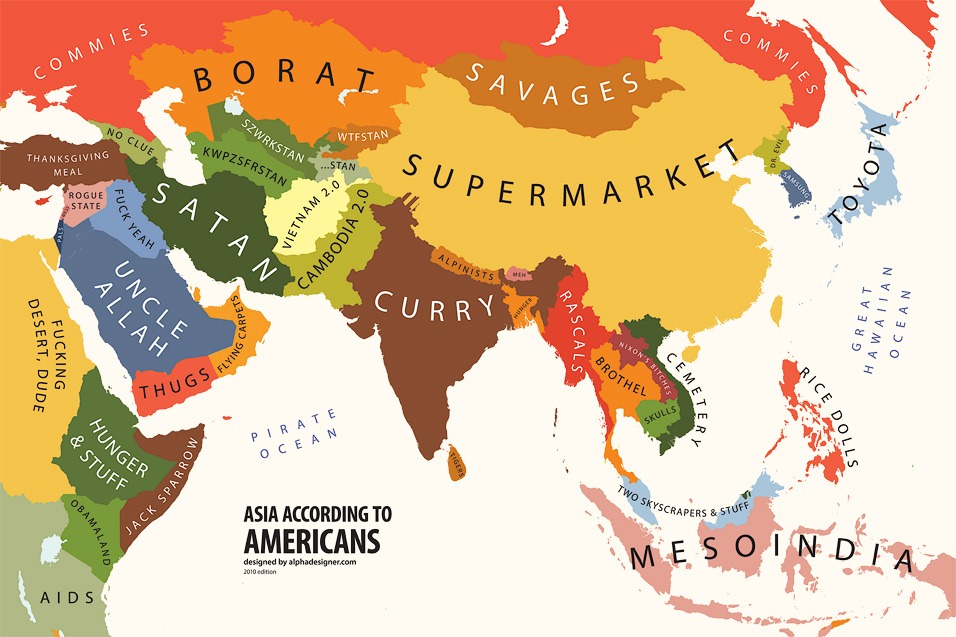
Asia According to USA

I pulled this image from here.

So the US pivot toward Asia is all the rage in foreign policy  now. Obama and Secretary Clinton genuinely seem to believe in this, and there good reasons for it. Briefly put, Asia has the money, people, and guns to dramatically impact world politics in a way that no other region can now. But I think the US Asian pivot won’t happen much nonetheless, because: 1) Americans, especially Republicans, don’t care about Asia, but they really care about the Middle East (a point the GOP presidential debates made really obvious); 2) Americans know less about Asia than any part of the world, bar Africa perhaps; 3) intra-Asian soft balancing (i.e., almost everyone lining up informally against China) means we don’t really need to be that involved, because our local allies will do most of the work; 4) we’re too broke to replicate in Asia the sort of overwhelming presence we built in the Middle East in the last decades.

Continue reading

Korean Nat’l Identity (2): 4 Simultaneous Sociological Transformations

In part 1, I tried to offer some comparative national cases (France, Israel, US) by which non-Koreans can get a handle on Korea. Today, I thought it would be useful to use some conceptual, rather than national, benchmarks. I can think of at least four sociological conflicts through which Korea is moving simultaneously, and hence make it such a boisterous place to live:

Continue reading

Korean National Identity (1): Comparisons to Israel, France, and the US

imagesCA0EEEZ1

isfrimagesCAYPLPUQ

Part two is here.

I get lots of questions from Western readers about this or that aspect of Korea in comparison. We don’t really know about Korea too much, but Americans often use it as an example for some larger political point they want to make. Here are a just few examples: 1) Obama: SK is kicking our butt on education and tech; 2) Obama: SK is an example of a country that modernized but didn’t westernize; 3) Michael Crichton and Amy Chua: SKs and other East Asians are work robots who will take over America and cost your kids a job; 4) John Bolton: Long-suffering SK gives us an excuse to stomp on NK.

Of these, I really think only the second is valid. A few years here can rebut the others without too much trouble:

1) Korea has huge educational problems that Americans don’t really know about. After taking insanely difficult tests in high school in order to place into a good universities, Korean college students often slack and party as a ‘reward.’ Too much of university here is about building the informal social network that will carry you through your professional life and not actually clamping down to do the work. Korean students are also not the readers that college education demands, which is why they often struggle in US graduate programs. And far too much of K-12 is focused on rote memorization, so plagiarism is a huge problem. Also, in case you ever wonder why Korea is so wired (which Koreans love to brag about), recall that Koreans live in very dense urban clusters, frequently in high rises. These are very cheap to wire, compared to the far more diffused American population and the high expense of the US ‘last mile.’ (That said, my broadband here is awesome and is about to get even better.)

3) As for Crichton and Chua, gimme a break. America’s inability to balance its budget, control its imperial temptations in the developing world, fix its K-12 schooling mess, reduce hyper-inequality and high crime, etc. are the reasons for US ‘decline.’ Asians like the Japanese, Koreans, or Singaporeans don’t have some magical growth formula. I will agree that East Asians are better ‘socially disciplined’ (crime here is mercifully low), but not the way Amy Chua’s ridiculously racist domestic fascism would have you think. I’ve been here close to 4 years, and I have never seen anything like what Chua describes in the Korean side of my family. As for the ‘Asians-as-work-robots’ idea so popular in the US in the 80s and 90s, once you’ve experienced the East Asian post-work business culture of hard drinking and debauchery, you know that’s bunk too. I have seen enough Korean ‘salary men’ lean out taxi windows on Friday night to vomit while the driver waits complacently to know that the whole ‘Asian values’ schtick is a fraud.

4) Bolton: I resent the way neo-cons manipulate SK unhappiness about national division to suit pre-existing ideological preferences for regime change and US military activism. This is cloying, pretended sympathy in service to American, not Korean, goals; that’s extreme bad faith. I have noted before that SK want nothing to do with ‘Axis-of-Evil’ talk.

Given this mediocre record of popular comparison, here are a few comparative classifications of SK with countries western audiences might recognize better. Compare and contrast is a basic social science method. And comparative politics in political science is always looking for similarities among states on which to build generalization. So here are the ones that have leapt out to me:

1. Like Israel, Korea is a barracks democracy striving for international normalcy. Both are democracies but under long-term siege. Both would like to join the global economy, get rich and be normal, but can’t. Both struggle to maintain civil liberties in an threatening environment with inevitable slippage. Korea, for example, blocks internet access to NK websites; in Israel, Israeli Arabs can’t join the military. Both are trapped in partial or incomplete states. Korea is half a country, and Israel’s borders are up for debate. Both are too militarized for a democracy, but still, they are doing a really good job balancing a huge military role in society with democratic freedoms. By comparison, look at simlarly over-militarized democracies like Indonesia, Pakistan, or Turkey.

2. a. Like France, Korea has aloof, farily corrupted political class in a too-cozy, corporatist relationship with business. Both also have weak political parties and weak legislatures. So voting doesn’t really make much difference; political participation looks for other avenues.  As a result, both have a vibrant street protest tradition. Working for serious change within the system feels pointless because of an entrenched, circulating elite, toothless opposition, close party-state relationship, and a bureaucracy rather insulated from popular pressure. So when Koreans and French are most angry, they turn to extra-parliamentary means. They march on the streets. Immobilist, scandal-ridden politics channels real political grievance onto the streets.

b. Also like France, Korea is extremely centralized on the national capital. Seoul dominates Korean life, vacuuming up talent, wealth, and prestige from around the country. The goal of just about everyone is to go ‘up’ to Seoul, whether for school, the best jobs, or the best cultural life. You even see it among the expats. Even we foreigners in Busan say we wish we had a Seoul gig! And, as Paris does to the provinces, the rest of Korea is impoverished by this.

c. Finally, both Korea and France are semi-presidential systems. Both have a tradition of a megalomanical ‘father of the nation’ who created a super-presidential post above ‘grubby’ politics. In France, de Gaulle directed the ship of state from a constitution he set up for his own personal benefit as the living embodiment of France. In SK, Park Chung-Hee did the same thing. In both countries though, political institutions are weaker than you’d think because of their ‘great man’ origins. Eventually a succession must occur – no one lives forever – and both France and SK have struggled to tame the office of the president and build more routinized, democratic institutions open to the public. To date, France has succeeded better. Korea remains a very presidentialized semi-presidential system. Ironically, that may help Korea, because the rise of the prime minister in French semi-presidentialism has effectively created a bifurcated executive, particularly when the PM and president have different party affiliations. In Korea, the reduction of the PM to essentially the first cabinet minister has helped unify its executive.

3. The cultural gap between the West and East Asia is wider than the between the West and Latin America, Russia, or even the Middle East. In terms of food, music, religion, and language, the differences are far greater. So it is therefore all the more surprising how Americanized Korea is. English is everywhere – in the schools, on street signs, music, TV. Its institutions, especially military ones, are heavily patterned on the US; until 1981, the Korean version of the CIA was even called – the KCIA! Today there is still the K-FDA. Koreans watch lots of American TV and film. They eat our fast food and junk food (and are getting heavier for it). And they are beginning to pick up the American culture wars. They fight increasingly over stuff like abortion and the death penalty as we do. Korean evangelicals (yes, they are here too) even say that God has a special mission for the US no less! (Now that really is brainwashing.) My own personal guess for why Korea is so Americanized, is that if Korea can close the cultural distance between it and the US, the US is more likely to honor its alliance commitment and fight for SK. In other words, cultural Americanization is a national security strategy to reduce the ‘otherness’ of Korea to average Joe American, in order that he will agree to fight here. Kinda smart if you think about it.

Don’t push any of these analogies too far, but Obama mentioned Korea five times in the 2011 State of the Union, so I thought this might help.

Continue to part two.

Happy Thanksgiving – Some Korean Humor – See You Next Week

I love this special. Enjoy.

For my passing thoughts on western holidays in Korea, try these for Christmas, Halloween, and Thanksgiving. The short answer is that US holidays have made only minor inroads, so we should be skeptical of antiglobalizers’ claims that globalization is really cultural Americanization/homogenization. Despite 5 decades of huge US cultural influence in Korea, local cultural integrity is pretty intact. I don’t see too much homogenization here; it’s more like hybridization.

So here is a little Westerners-lost-in-Asia humor to tide you over for a week.

Among the expat community here, lots of these ‘You know you have been in Korea too long, when…’ lists circulate on email. Here is a mish-mash of the many I have received over the years. Some are a little punchy; just try to laugh a little. They are meant to be fun and exaggerated.

You know you have been in Korea too long, when…

When you no longer wait for the subway on/off pell-mell to clear; instead you plow in and contribute to it.

When you bow to foreigners too.

When you wear high heels to the beach.

When you fear an imminent Japanese invasion of Pusan.

When you demand steel Korean chopsticks even when you eat at Chinese and Japanese restaurants.

When you use chopsticks even when your Korean dinner partners use a knife and fork.

When you tell your far-too-hot-for-you Korean girlfriend that she needs plastic surgery, and she accepts it without complaint.

When you tell your family that Korean food improves your blood circulation.

When Korean directions – ‘make a left turn at the mountain and go straight for awhile’ – are crystal clear.

When normal women from your home country suddenly appear overweight and underdressed.

When you agree that there are too many foreigners in Korea.

When you bring a dictionary on a date.

When you use your fan’s timer at night.

When you no longer pity the live crabs boiling in the pressure cookers at the street market.

When you prefer Korean beef to ‘imports.’

When you put a picture of yourself on your cell phone instead of your loved ones.

When you enjoy watching street vendors decapitating live shellfish.

When you no longer feel embarrassed talking back to the little kids who point and call you ‘foreigner.’

When you’ve mailed pot to yourself (probably from Canada).

When you smoke in your office and don’t worry or care you’ll get caught.

When you drink in your office and don’t worry or care you’ll get caught.

When you eat meals at FamilyMart.

When you know the HomePlus jingle by heart.

When you’ve stayed a love motel.

When you prefer love motels, because they’re cheap.

When you stop being surprised by ‘service-e-e,’ start expecting it, and then get unhappy when you don’t receive it.

When you automatically assume you should buy all your electronics from Samsung, even though you bought Sony at home.

When you find Arirang TV network a realistic portrait of Korea.

When you finally acquiesce to your Korean girlfriends’ insistence that you wear a tie with sparkles.

When you start agreeing that air-drying your clothes is better than your tumble dryer at home.

When you stop caring that your students laugh at your terrible Korean.

When drinking till memory loss on a work night constitutes ‘improving your network.’

When you stop worrying that your apartment security guard sleeps all night and never seems to be at his desk.

When you start to sort your trash in your apartment.

When you own gold formal chopsticks.

When you’re no longer embarrassed to hit the salons after work; instead you egg your Korean friends to take you with them.

When you keep sandal house shoes at your office.

When you no longer find National Assembly riots hysterical.

When you complain about the quality of the kimchi at restaurants.

When you sit out all night at a small food stand and get loaded with the other ajeossis.

When you start speaking Kongrish-e-e instead of English.

When you have a statue of the happy Buddha on your shelf.

When you keep a bottle of liquor in your office.

When your intestines finally make peace with red pepper at every meal.

When you start styling your hair like Rain.

When you start calling other foreigners ‘wae-guks.’

When you start believing in ghosts, spirits, demons, forest gods, the ancestors, and the 4th floor.

When you re-watch ‘Poltergeist’ for home defense instructions against the ghosts.

When you know who Dangun and the Su-ryeong are.

When you believe in Dangun and tell your students to call you Su-ryeong.

When you actually care about the fate of Dokdo.

When you think making out in the DVD bang is a normal part of a date, not a deportable offense.

When you unthinkingly speak of the “East Sea” to non-Koreans.

When you agree that movies like ‘D-War’ are a global cinema event.

When you no longer miss the Halloween-Thanksgiving-Christmas-New Years holiday season.

When you stop holding doors for people.

When you push through a crowd as well as an ajumma does.

When your cell phone danglies outweigh your cell phone.

When you can perform the full Buddhist bow without your knees cracking.

When you accept that kimchi really does ward off SARS/bird flu/Ebola/swine flu/mad cow disease.

When you do mental addition with your one hand on the palm of the other.

When you expect and want kimchi with your breakfast.

When you prefer soju to ‘imported’ liquor.

When you have watched TV on your cell phone.

When you have bought 2 cell phones in less than 1 year.

When you stare back unfazed at school girls smirking at you.

When loudspeakers on fruit trucks add ‘local color’ instead of ‘noise pollution.’

When ‘home’ is one room 40 stories off the ground with no air conditioner.

HAPPY THANKSGIVING.

Transformers 3 (1): “We will Kill them all in the name of Freedom” – Yikes!


In the name of freedom, we will kill them all!

– Optimus Prime (the protagonist in the clip above) updates the Bush Doctrine after a decade of war


Part 2 of this post is here.

I missed this over the summer, but the blu-ray just came out, and it’s a nasty, harsh, rah-rah militaristic mess. I won’t bother with the story. You already saw it and know how ridiculous it was. (Try here if you don’t.) I’ll only note that great actors like Malkovich, McDormand, Turturro, and Nemoy are complicit now in the militarization of American cinema, as is Buzz Aldrin (sooo embarrassing that was – wow). The Asian racism and gay jokes are a just as offensive (and painfully unfunny) as the black racism of the second one. And the new ‘Bay girl’ is even worse than Megan Fox, who at least had a grittiness. This one is just living plastic and skin-cream. Bay never misses a chance to promote emotionally debilitating lookism to young girls. (Even Bay’s female corpses must be hot. That must take a sexism award somewhere.)

No one captures the ups-and-downs for popular consumption of current American attitudes toward war as well as Michael Bay. Bay’s films obviously carry the moral weight and approval of the American Right. This is most clear when he guiltlessly references signature moments in US history like the collapse of the Trade Towers, the moon landing, or Challenger explosion. More leftish action directors like James Cameron or George Lucas would be relentlessly criticized were they to do that. Consider the Right’s response to Avatar and Star Wars III, compared to Transformers. But ‘America’s director,’ just like ‘America’s newsroom,’ can do this, because he is reliably nationalistic and pro-military. As Time put it, Bay has become the “CEO of Hollywood’s military-entertainment complex.”

As a result of Bay’s signature position as the filmic voice of the US populist-militarist right, no movies better capture the US emotional arc regarding the war on terror than his Transformers trilogy. As Americans have become more and more frustrated by an unwinnable war, more tolerant of brutality like torture, and less compromising, so has Bay. The films have become progressively more jingoistic, bitter, macho-sexist, and cruel. This is entertainment for the Tea-Party. In this most recent installment, there are even four battlefield-executions (!) in this Steven Spielberg (!) production based on a line of toys and aimed at young boys. But I guess that’s good stuff in the GOP primary these days.

The antagonists (the Decepticons) are nastier than usual, but the protagonists (the Autobots) are extraordinarily brutal for mainstream heroes, and Bay revels in it. The usual story about how the Decepticons are ‘evil’ is thrown in to provide a moral fig-leaf for the Autobots’ violence, but it’s a sham. Bay really wants to show us a vengeful bloodbath (the last hour), and here is where the Tea-Partier frustration and anger at the confusion over the GWoT’s course is most obvious. The film, like current the Tea Party-influenced GOP primary season, is filled with a deeply disturbing bloodlust for brutality. This is not a fun action film for the comfortable, amiable America of the 1990s (like Bay’s Armageddon). This is war carnage for a bitter America desensitized to vengeance and brutality after a decade of torture, confusion, wounded veterans, ‘ingratitude’ from Iraqis and Afghans at being ‘liberated,’ sky-rocketing costs, and global condemnation. T3 is wish-fulfillment for the people who hoo-rahed at OBL’s death: if only we could just go and kick the s— out of all them.

The Decepticons execute an Autobot made up to look like an old-man by shooting him in the back of the head. This came off so harsh, that a woman sitting next to me gasped and looked at her rather shocked boyfriend. When a Decepticon fighter crashes, the Autobots dismember the pilot alive to the jokingly-delivered line, ‘this is going to hurt.’ Holy c—! Sadism is hilarious? Kids are supposed to find that line humorous? At the end, Optimus Prime – remember, this is main good guy – kills one bad guy (Megatron), who had actually just assisted him, by hatcheting him unsuspectingly in the back of the head and them pulling out his entire brain stem, complete with arterial spray. Next the chief bad guy is dispatched after he is badly wounded and crawling on the ground begging for mercy. Nevertheless, Optimus Prime shot-guns him in the back at close range. Twice. And the camera lingers on his pained face as he’s being shot. Wow. WTH happened to Michael Bay (and Steven Spielberg)? Does Bay really expect us to endorse this kind of brutality as entertainment? Both antagonists are in morally compromised positions, yet the hero effectively executes them?! Are we supposed to cheer on the Autobots (allied with the US military in the film) when they brazenly disregard the rules of engagement (which makes liberal states’ use of force more trustworthy) and just execute people?

“Homefront” Video Game: ‘I Pledge Allegiance to Kim Jong-Eun’ – Hah!

Yes, it’s ‘Red Dawn’ all over again, only yet more ridiculous


What blog from Korea on security issues would be complete without some discussion of Homefront, the new video game from THQ on a North Korean invasion of the United States. H/t to Koehler for catching this hysterical vid. Unfortunately THQ has not released the game Korea – why not? South Koreans are stridently anti-communist and terrified of the North. I can imagine this game selling truckloads here… Oh well.

The debate is heating up on this, so here is my contribution, limited albeit by my inability to get the game here.

1. The game is hyped as written by the writer of Red Dawn, John Milius. Milius also co-wrote Apocalypse Now, which he originally intended to end with a massive race war in which Colonel Kurtz (Brando) was to have lines like ‘isn’t it great to be a white man in the jungle with a gun?’. (Don’t believe me? Go watch Hearts of Darkness, the documentary on the making of Apocalypse Now to see Milius and director Francis Ford Coppola discussing this, as well as Milius’ creepy Wehrmacht fetish. Coppola openly [thankfully!] rejects the notion of some macho white fascist ending.)

Milius is exactly the sort of rightie that IR types love loathe in public, but secretly we get a total laugh out of wack-job entertainment like this. This is what world politics looks like in the fetid mind of a cold warrior NRA member who reads too many histories of World War II, Hitler, and Waffen-SS. In Red Dawn, the USSR invades the US on the ground by crossing the Bering Strait (!), because you know how well developed Arctic sea lanes are for moving millions of soldiers and huge amounts of supplies. Further, the intense cold weather of Alaska and the Yukon, plus the heights of the Rocky Mountains, plus the minimal road-network and infrastructure of the Pacific Northwest are clearly no hindrance to a massive armored invasion. Hah! If that is not enough glorious paranoia for you, Cuba and Nicaragua invade the US from Mexico added by Hispanic illegal immigrants who acted as saboteurs. (Yes, it is that ridiculous.) Finally, the US rebels against Soviet occupation include the captain of the football team, whose gets his arms from friends who are NRA members, and the nerdy school president turns out to be a commie traitor. So, yes, that jock who used to bully you in high school was actually a patriot ready to defend America and football, while the dorks who did their homework were wimpy red sell-outs. Ah, the ideology, the wild delusions of right-wing paranoia, and closet admiration for the Wehrmacht. You gotta love it… if it weren’t so d— frightening. The film so completely captures 80s right-wing themes and paranoias, I know lots of IR professors who actually teach it.

2. I can only imagine the even more insane script for Homefront. Here is the official trailer:

Did you know that North Korea’s navy can sail across the Pacific to amphibiously assault the US? Me neither…

This is so thoroughly ridiculous, it hardly bears comment (just read Foster-Carter). I would only add two observations:

a. Movies and games like this tell the world the US is genuinely obsessed with war and militarism. Yes, it is just a game, but US film and videogame producers make lots of this sort of stuff that endlessly celebrates American power and a—kicking; just in the last few years: 24, Transformers 1 & 2, Terminator 4, Call of Duty. You wonder why people think we are a nasty, militaristic empire, well this is a pretty obvious place to start. Even our pop culture is suffused with this sort of military posturing and machismo. Just this year we have a Red Dawn remake coming, the Marine Corps recruiting vid Battle: Los Angeles, and yet another Transformers epic. Yes, the world is dangerous; yes, we have to defend ourselves; I love explosions and aliens as much as any male movie viewer; and I guess this is the sort of entertainment we get after ten years of the war on terror; but Hollywood is practically an adjunct of the military-industrial complex. How about a more nuanced portrait of force?

b. It is very noticeable how so many of these films and games take place on US soil – terrorists infiltrators, foreign invasions, alien landings (don’t miss Chuck Norris’ uber-cheese Invasion USA). The reason should be pretty obvious – if the Americans are defending their home, then all the moral problems of the use of US force disappear and the heroes can be as vicious as they want without worrying about the moral consequences. All the real-world agonizing about how American force sometimes kills the innocent (however unintended) in foreign places where maybe we should not be (Afghanistan, Iraq, Pakistan, Libya), falls away.

So the righties like Milius or Michael Bay who come up with this stuff can show Americans as heroes, even though they are mercilessly mowing down the bad guys. Want to execute Geneva Convention-certified POWs (Red Dawn)? Sure, it’s ok, because “we live here.” Want to blow the head-off a defeated, wounded enemy (Transformers 2)? No big deal; they’re ‘evil.’ What to perform a vivisection (!) on a wounded opponent (Battle: Los Angeles)? Sure; this isn’t Abu Ghraib (though did anyone else think that in watching B:LA?); these alien SOBs invaded America, so do whatever you want. There are no namby-pamby liberal college professors and NGO activists around to moan that we kill too many civilians, seek imperial domination, war for oil, blah, blah, blah. Instead the dialogue can recite macho, posturing cliches about never giving up, defending our homes, and a—-kicking victory. This is the no-holds-barred, no-moral-errors-admissable, American-wars-are-always-right image of US force that neo-cons and Fox News so desperately want to legitimate. Placing these events on US soil opens the door for behavior we should find grossly illegitimate – and do when we do it in far away places. But in an invasion, the American defenders occupy the (easy) moral high ground, and therefore we can reveal in militarism and killing without moral anxiety. It’s all so callous and grotesque as to be morally outrageous, and it panders to the worst ‘Jacksonian,’ US-force-as-conflict-resolver instinct in US democracy, but then we live in the Fox News, post-torture era.

Apocalypse in Asia (2): Yet Another Idiot Video Portrayal of Academia…

No one in academia talks this way to undergraduates…


In this website’s continuing tradition of reducing difficult issues to ridiculous YouTube videos (here, here, here ), the above is a nice follow-up to my previous post on teaching the Apocalypse in Asia. Didn’t you know that American academics regularly berate their students’ beliefs, plot against Christians on campus, and openly criticize students’ parents to their faces? Enjoy the above for the ideology, but maybe the director should sit in on an actual class sometime…

Back in the 1990s, I worked for moderate Republicans and donated to GOP candidates; my 1996 vote for Bob Dole for president is still the most heartfelt vote I ever cast. So I still get the occasional right-wing email, and none better than this recent one pitching the movie above:

Fellow Patriot–

I wanted to forward this message about The Genesis Code, the conservative movie of the year! It deals with some important conservative issues that deserve to be discussed: the intersection of faith and science, the right to life, and discrimination against people of faith in American higher education.

When paleontology student Kerry Wells is told by an academic advisor that she’ll need to choose between her faith and her career in academia, she begins a search for truth that will touch the hearts and minds of everyone around her.

Despite the fact that university studies are purported to be a marketplace of intellectual diversity, Kerry’s constant inquiries in class and involvement in Christian campus ministry lead the faculty to consider her unfit for a life of science. Can her determination and academic talents overcome the department’s prejudice against religion?

For the actual website, try here. To be fair, I have not yet seen the film.

For Asian readers, I post this stuff once in awhile just so you have a sense of where the bizarre US stuff you see in the news comes from. I get lots of questions out here like, wth Palin is about, what is up with loopy Tea party, why do Americans think Obama is Hitler, etc. I have warned before that the American Right’s extreme reaction to Obama’s election is delegitimizing America’s global leadership. Why would anyone follow the US when 1 in 3 Americans think Obama is a Kenyan imposter or something? Not only is all the paranoia unnerving in itself, but it has real foreign policy consequences – namely that the rest of the world – which US conservatives claim we lead – thinks we are batty. The above vid is yet another demonstration of the kind of creationist idiocy that Asian science institutions simply would not tolerate.

I also feel compelled to note the unbelievably ridiculous portrait of academia yet again on display in film. That Chinese professor ad (plus Dr. Strangelove, Wargames, and Fail Safe) got people thinking we are fascists; network TV shows show us regularly sleeping with our students; Indiana Jones and Michael Crichton make us into skilled gunmen and adventurers; Bret Easton Ellis thinks we’re lazy druggies (also sleeping with our students); Michael Bay apparently thinks we can rant out authoritarian sexual innuendo without students/faculty noticing or caring;  the Social Network treats us as behind-the-curve prigs; in Animal House, we’re tedious ballonheads; Tom Clancy turns us into lefty traitors; and of course the absent-minded professor is a stock character across media. In the Christian apocalyptica genre, we are written in as postmodern stalinists responsible for tyrannizing our conservative students (while secreting pining to sleep with them presumably) and de-Christianizing America.

Yet none of this even close to accurate; I am still waiting for a movie with professors who actually look and talk like what I know. I’ve been in academia for more than decade and my father’s been in it for 40 years, and I can’t think of one good movie that actually shows what professors really do and how we really interact with our students. Sure, individual professors do dumb things, but I challenge anyone to find quantitative data to support the classical stereotypes listed above, much less the Christian right view that university is some kind of liberal concentration camp. The portrayal of the professor in the media is so routinely inaccurate, I feel compelled to say something, especially to the Christian righties who are convinced we’re tenured atheists stripping patriotism and faith from students. To see what we really do, in all its boring, nerdy scholasticism, take a look at the sort of dry, Tylenol-PM-in-print articles that fill the Chronicle of Higher Education.

The vast majority of our time is spent in fairly mundane office work – meetings, grading, research. Most of the professors I have known take this stuff reasonably seriously, and come to work on time and dressed properly to do their jobs with no more or less level of commitment than other knowledge workers. Yet almost no movie portrayals of academia actually show this; the most realistic portrait of higher education I have seen in the last few years in a film was in Knowing. I have never known a colleague who slept with a student or schemed against them, lost his a glasses on his forehead, got in wild adventures in the field, or fought ideological wars against student groups. The latter can get you in a lot of trouble, as students have grievance recourses the above vid clearly doesn’t show.

Very rarely do we get students coming to our office to simply to talk about ideas and life and what not; the Kerry character described in the third quoted paragraph is extremely rare. Far more common student behavior, and real issues that universities grapple with, are illustrated here or here. When students do come to see us, it is usually some need or grievance: grades (why did I get an F even though I never bought the book?), attendance (can I get the last 4 weeks of classnotes?), recommendation letters (how can I get into Yale on 2.5 GPA?). And we certainly don’t get into personal criticisms and harsh career counseling like in the vid above. The professor’s behavior is shockingly unprofessional, and I dare the director to find real evidence that this is common.

My point is that, yes, we are usually secularist, not Christian, and cosmopolitan, not nationalist. But students almost never come to our classes to fight for God and nation against us. Their needs and concerns are far more banal and everyday. Far more of our interaction with students is coaching them through hard material (I know you loathe the book, but Wikipedia is not really a substitute), trying to professionalize them (you can’t just cut class for a week or two and expect a bailout), begging and pleading with them to read (cliff notes are a high school gimmick you have to give up now), encouraging them to study and not just party away the four years (even though we did that too). It’s a lot more about management, mentoring and helping than about ideology. And if students raise their hand to discuss God and evolution, our response is to rejoice that students want to participate on a meaningful, exciting topic, not to stomp on them like some KGB of atheists.

So please, before yet another insulting, idiot, ideological, or conspiratorial portrayal of academia, someone make a movie that actually looks like college. That would be a real ‘revelation’…

Merry Christmas – Some Asian Humor – See you in a Few Weeks

Xmas-Tree_thumb2

That’s our Christmas tree, the only one in our building…


It is the Christmas season, and I need a break from blogging. For my previous thoughts on Christmas in Korea, try here. But I certainly hope you have a nice holiday and be sure to watch Charlie Brown’s Christmas.

Next year, I will post my comments on my 2010 predictions. I did ok on them – about 50%. I will also list some new predictions and try tougher ones. My 2010 ones were a little tame and too easy.

I also want to expand my reach more beyond Korea and (less so) China. Inevitably, I seem to write on Korea a lot, because it is where I live and because of the US commitment here, as well as China just because it is so important. Next year, I am planning cooperation with the excellent Japan Security Watch to produce more stuff on Japan as well. Reader comments on the utility and direction of the blog are always welcome.

(For a bit of new content in passing, I think this article is worth pointing out to American readers. I continue to be impressed at the humanity of crime and punishment in Korea. Crime here is far less widespread and violent than in the US; Korea is wonderfully safe. And the criminal justice system and the police are more balanced and humane than the US flirtation with militarized policing and torture. Score one for the Koreans.)

So here is a little Korean-Asian humor for the winter break. Enjoy. WARNING: It includes vulgarity, but it is pretty hilarious.


MERRY CHRISTMAS

Korea and the G-20: An Exercise in Koreaphoria

P101025001

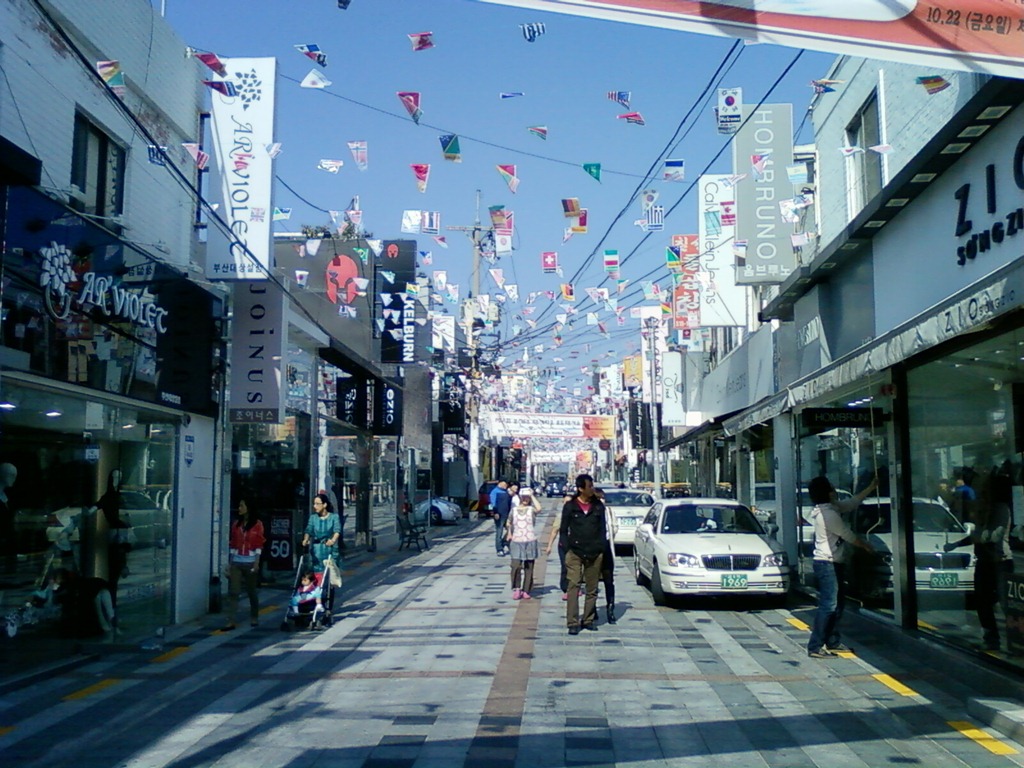
A street near my house got festooned with G-20 flags for a week.

There has been lots about the G-20 in the major financial press, but little on the way in which Korea has rewritten the meeting, at least to itself, as a global homage to Korea’s arrival. Most Koreans haven’t the slightest clue what the G-20 is. Nor do they really care much for OECD trading norms – which, of course, is the whole point of the G-20. In fact, they flagrantly violate those norms (as just about every western businessman I have met in Korea reminds me at every conference I go to). The ROK is irritatingly mercantilist, and Americans are right to think Korea cheats on trade. So if Koreans actually wanted the G-2o to be a success, how about dialing down the protectionism and currency ‘fine-tuning’ (i.e., sterilization of inflows to favor big exporters like the ship builders)? I am hardly one to defend the US auto industry for making cars that no wants to drive and that wreck the environment, but Ford nails it with this write-up. So the Chosun Ilbo says Korea should be a good global citizen, but that’s not what Korea really cares about in the G-20.  In Korea-land, the G-20 is an opportunity to preen, not what it actually is suppsed to be – a global economic coordinating body. In the words of no less than the SK president, the G-20 in Seoul means, “Koreans are great and that the world is now recognizing that fact.” Somehow I doubt that is what Medvedev, Singh, Kirchener, and all the rest had in mind. *Sigh*

The Korean press is nothing if not unprofessional and arriviste, aggressively desperate for recognition that Korea is a ‘player’ or, in the locution most preferred by the jingoistic media here, an ‘advanced country‘ (with the obvious implication that other countries are therefore ‘below’ Korea – ask Koreans what they know about Africa, e.g.) Start here and here, in order to learn that the G-20 in Seoul means that the whole world is watching Korea, that Koreans should be proud, that Korea is a global player, a powerhouse, a model, blah, blah, blah. Among other narcisisstic disinformation was the media line that Korea was the ‘first’ non-G-7 state ‘ever’ to host the G-20 leaders. Technically this is so, but the G-20 leaders have only met 4 times before, so it’s hardly as unique as it sounds. (This is preceisely the kind of faux statistic the ROKG and media love to create in lieu of something meaningful; try here for a simliarly desperate non-category – that Korean is a ‘top five food.’) But nothing could stem the self-congratulation. For the three weeks previous, there was a media countdown to ‘D-Day’ – yes, that’s what they called it. Literally, in the top left corner of the major TV networks’ broadcasts, there was a permanent ‘D-15’ (day minus 15) or ‘D-3’ graphic counting down to the big day the whole world would swoon over Korea. Perhaps my favorite moment in this bathos of self-absorption was the televised message on ‘D-1,’ by no less than the mayor of Seoul, that Koreans should be nice to visiting foreigners if they meet them on the street. Hah! How about the rest of the time for those of us who live here, huh? The last thing already hyper-nationalistic Koreans need is to be told that they should be even more proud.

I have said it lots of times before, but Korea is a really nice place to live actually – a lot better than the Central Valley – but then Koreans insist on spoiling that with over-the-top insistence that Korea is unbelievably awesome, and using almost anything to argue that Korea’s ‘brand’ – whatever that means – is on the rise. If all this sounds like the Tea-Party’s hysterical American exceptionalism it should.

For a more serious take on the G-20, one that actually recognizes Korea’s small size and its consequent limits, try this piece by a friend of mine at the Korea Times. Cho admits what Koreans know in their hearts, but adamantly refuse to admit to foreigners: that Korea is a bit-player, that it faces severe constraints in the future, and that Korea’s super-growth days are over. In short, Korea is a middle power, will remain one, and Koreans should accustom themselves to this rather than demanding, Uncle-Tom style, that resident foreigners recite a mawkish Koreaphoria.

Is there Halloween in Korea? Alas, no…

I still love Charlie Brown 30 years later…


It’s Halloween, so here is something semi-serious – if US holidays show up in Asia, is that proof of cultural Americanization?

One of the things I miss most in Korea as an expat is the US holiday season. In terms of fun, parties, color and festivities, nothing beats the three-month run of Halloween, Thanksgiving, Christmas and New Year’s. Interculturally then, it is always interesting to see how much of this washes into other countries, given the endless debate about Americanization, globalization as cultural American imperialism, and all that.

In that vein, readers from the left might be glad to hear that little of that occurs in Korea. US holidays are generally un-celebrated here. While Korea is christianizing rapidly, Christmas has not even come close to the annual fun-time blow-out it has become in the US. It is still a religious holiday, not the cultural and shopping event it has evolved into in the US. (Ironically, religious conservatives who disdain the commercialization of the holidays might like the Korean attitude.) And Halloween has come mostly as an odd American event that is seen as somewhat fun, but kind of strange. When I explain Halloween to Koreans – Hallow’s Eve as the last night for evil spirits’ rampage in old Christian tradition – most Koreans find it fairly ridiculous. And all those new Korean Protestants don’t seem to know that story either.

Because of the big US presence in Korea for decades – first political-military, then commercial, increasingly now religious (American Protestantisms are pretty successful here) – you do have an awareness of US holidays, and some celebrations. But interest in this among Koreans generally serves Koreans’ interest to demark themselves from their fellows as cosmopolitan, worldly, and traveled. Ie, if you’re a Korean who celebrates Halloween with some resident expats, then you are ‘linked-in’ to the US culture in a way other Koreans are not, and that is a mark of social prestige. It is ‘cool’ to be able to say you celebrated Halloween with some white guy, kinda like it was to own a pair of blue jeans in the USSR.

In practice, then there is no trick-or-treating at all. Koreans mostly live in high-rises anyway, so trick-or-treating would be a weird, vertical affair requiring constant one-floor trips in the elevator. Horizontal neighborhoods filled with lights and people ambling about don’t really exist here. There are Halloween parties though. Korean clubs have them, but I have heard they are pretty strange events – just like a regular night at a club, only with some people in weird make-up. (Technically, there is no race-line for club attendance, but there are Korean clubs where foreigners would just never go in practice.) Ultimately though, it is the expat bars that try the hardest. They have costume contests and catch the spirit pretty well. The best expat bars are mixed; ie, Koreans come too. My impression though at these has always been that Koreans in attendance find the whole thing pretty bizarre and don’t get it at all.

So enjoy your Halloween. You are lucky to have the real deal…