Stand with “South Park” vs Sharia Orwellianism

SouthPark

By now you know that not even “South Park” is immune from salafism’s insistence on terrifying and alieanting the rest of the world. You may love or hate the show, but the defense of free-speech is a central values breakpoint between liberal modernity and reaction, between the best traditions of the West and the worst of Gulf Islam. This is an important part of the battle of ideas in the GWoT, as is defending the Salman Rushdie, Ayaan Hirsi Ali, and the Mohammed cartoonists in Denmark. Ali, herself a terrible victim of this paranoia, has a nice summary of the explicit free-speech threat of Muslims exporting sharia onto non-Muslims.

Everyone with a blog should do as Jon Stewart did on April 22 and explicitly defend the right of free speech, especially the right to ridicule and mock religion. Religions as a body of thought deserve as much scrutiny as any another paradigm, intellectual system, or philosophy. And religion certainly needs this criticism if it is not just to be superstition and received ascientific silliness, repackaged as ‘time-honored tradition,’ and codified by some book written a long time, then repackaged as ‘divine revelation.’  Even the faithful know this in their heart of hearts. Consider this counterfactual: if your friend told you that snakes could talk, that people came back from the dead, or that bushes burned without disintegrating, wouldn’t you be pretty incredulous – unless you heard it at Sunday school? I never had a teacher in my Catholic grade school who could answer that one, which was a pretty big let down.

If you don’t know the story of Augustine’s conversion to Christianity, it is an object lesson in this healthy interchange between religion and criticism. Read the Confessions for the whole story, but the short version is that the young Augustine found Christianity ridiculously primitive, intellectually soft, and superstitious. Trained in Greek philosophy and the high Latin of the great Roman authors, he found the writing of the New Testament poor and unconvincing. The story of how Augustine still came to Christianity and helped drag Christianity into a meaningful interaction with Greek philosophy is intellectual gripping, spiritually provocative, and more likely to convince you of Christianity’s veracity than any of the Palin-esque, family values TV preachers who masquerade today as authorities on Christianity. (If you want a 20th century version of this back-and-forth, read about CS Lewis and JRR Tolkein’s lengthy discussions of Christianity.)

The point is that religions, most especially today Gulf Islam (and American evangelical Christianity), desperate need their Nietzsches, South Parks, Hirsi Alis, and Christoper Hitchens to force them to stay up to par. Defending “South Park” is not just about free speech. It’s also about the larger point made by the New Atheists in the last 10 years: that religion must find a way to live in a the modern, plural, ‘impure’ multicultural, scientific, democratic world. If it can’t, if it simply lashes out to demonize (Benedict XVI) or butcher (salafism) its opponents, then trained people will never take it seriously. And that is the greatest ‘disrespect’ the faithful should really fear – when even the mildly educated think you’re like the Raelians or something – simply ridiculous and unworthy of meaningful consideration.

Addendum: It should be noted that the Islamic prohibition against imagery of Muhammad is far less totalist than the Gulf Sunni salafists would have you think. Shi’ites don’t care a whit, and Southeast Asian Sunnism was pretty lenient on this too until Saudi oil money and clerics start bringing the ‘pure’ (i.e., ‘arid-as-the-Gulf-desert’) version of Islam in the last generation. ISLAM DOES NOT HAVE BE MONOPOLIZED BY THE JIHADIS.

Communist Kitsch Update: North Korean Traffic Cops Gone Wild!


There is something genuinely surreal about communist kitsch. In the midst of the grey, dingy, low-growth, high-corruption, fearful yet boozy commie sub-cultures stretching from East Berlin to Pyongyang, weird, irrelevant, yet distinctly socialist-bloc cultural images tied people together. Stephen Kotkin nailed it by calling this ‘trashcanistan.’ Think of commie-kitsch as the Red version of MTV’s ‘I Love the 80s’: we all know its god-awful and that it embodies the fall of Western civilization; yet we love the trashy, wannabe celebrity commentary and the references to long-lost 80s junk we nonetheless remember, like jerry-curl or Whitesnake; we can all use it as a reference point with each other, if only for inanity; and we could easily pass a hangover afternoon watching it as a guilty pleasure.

So transpose that moronic intellectual frame onto the grinding, burned-out, alcohol-sodden, polluted, ‘they-pretend-to-pay-us-and-we-pretend-to-work’ world of 20th century communism. [You didn’t know there were Soviet proverbs? You’re not even sure you know what an ‘east-bloc proverb’ is? 🙂 Try here.] What would be the trashy mediocrity, nonetheless widely shared and still socially tying post-communist populations together?

The  best known treatment of communist kitcsh is the movie Goodbye Lenin. In East Germany, former GDR citizens fought to retain their pedestrian streetlights, because the red and green lights were shaped as cute little people (Ampelmaenner), not just the colored blob most of see. Don’t believe me? There is an internet campaign to save the Ampelmaenner, as ridiculous as that sounds. (Don’t these people have to go to work?) You can even learn why the Ampelmann is a “cult figure.” Hah!

In the ‘red-kitsch-yet-to-be’ category has to be the scary as hell, yet… disturbingly sexy female traffic police of North Korea. Again, you think I am lying? Try this website set-up by westerners (men presumably) just to celebrate these stalinist sex symbols (yes, in trashcanistan, ‘stalinist sex symbol’ is a meaningful concept). Among other surreal commie kitsch wonders is the monthly,“Pyongyang Traffic Girl Of The Month” Contest (on the homepage), the forum moderated by “Jong-Il’s Hair Apparent,” and a picture gallery in which you can admire the umbrellas the cops use when its very sunny. Hah! You can’t make this stuff up its so loopy…

Watch the video at the top of this post, and consider of ALL of the following contradictions in just 80 seconds (h/t to Tom for catching this genuinely surreal vid):

1. How can two dumb American guys pull off wandering around Pyongyang alone?

2. Where is their minder, and how did they possibly get a video-camera in?

3. Why are they so stupid as to film a cop, without permission, in the world’s worst police state?

4. Wth is that other dude in Mini-Cooper?

5. How did HE get in alone, with a video camera, to film a cop also? Hey, wait a minute! I thought NK was the world’s worst police state? How do these guys pull this off?!

6. How do you get a Mini in North Korea?

7. How do you ‘pimp-out’ a Mini in North Korea? ‘Fast and Furious 5: Pyongyang Milk Run’? Haha!

8. Isn’t that car exactly the kind of thing the predatory DPRK elite would confiscate?

9. Is the guy in the Mini filming the cop or the dumb Americans? I am not sure which is scarier…

10. Why doesn’t the guy in the Mini freak out when the cop gets angry? Good lord, who has the b—- to provoke the North Korean police?!

Honestly, someone needs to write a master’s thesis on red kitsch. It is clearly a shared social context the provides meaning in its own way, and the laugh potential is awesome, especially for regular, all-too-drab social science.

If you need more vids of North Korean terminatrixes gone wild, try here.

Can Walter Russell Mead Walk the US Right Back from Torture?

waterboard

Walter Russell Mead is an exceptional blogger in IR. If you don’t read him, you should. He can somehow write lengthy, intellectually rich, and sharply incisive posts on foreign policy almost everyday, while at the same time being one of the best diplomatic historians in the US. (Start here.) I am baffled, because my best posts take hours to write, and there is no way I could do my job well and simultaneously blog well every day. Even more amazing for a social science writer, some of his posts are genuinely moving, like this and especially the one I discuss below. Do these guys ever see their families, write even on Christmas morning, go to the movies? I just don’t know where the time comes from…

Perhaps most important politically is his conservatism. Quality conservative punditry was simply decimated by the Bush era. The rise of the Ann Coulter-Rush Limbaugh-Michelle Malkin-Glenn Beck-Sean Hannity set has done terrible damage. Glenn Greenwald has built an entire career just around lampooning and deconstructing this stuff, it’s so prevalent. And Fox News – so relentlessly craven before GOP power, so desirous of  grievance and anger, so aggressively loathesome of academia and learning – has just pushed me over the edge. As an example of the collapse of the intellectually rich conservative movement into partisan hackery, look at the great work of Irving Kristol – one the writers that thrilled my mind and pulled me into the conservative movement back in the 1990s. Then look at how low the son – once so promising as the founder of the Weekly Standard (WS) – has fallen, accusing the Justice Department last week of being the ‘Department of Jihad.’ I remember reading National Review in college, WS when I worked for a GOP congressman in the 90s, and then even Commentary after 9/11. I remember when WS was supposed to be the Right’s equivalent of the New Republic – smart, rooted in learning, not so partisan as to prevent re-consideration and flexibility. I scarcely look at that stuff anymore…

Given the right-wing echo chamber, built around Fox, talk radio, and shock-jock set, Mead plays a critical role, and I hope the pro-torture Right in the US will carefully read this. Money quotes:

The KGB undertook a ruthless and savage repression in Lithuania.  The old Gestapo prison came in handy; the communists tortured and murdered thousands of Lithuanians in padded, soundproofed cells just a few blocks from the city’s cathedral

Today the solitary confinement cells, the cells where prisoners were forced to stand in icy water and beaten brutally when they fell, the holding cells for the condemned and the execution ground are all open for visitors.  Garish and clunky Soviet high tech phones and communications devices are still in the guardrooms. [I am] standing in the cellar of the KGB prison, admiring the ingenuously designed torture cells, retracing the final steps of the prisoners on their journey from the condemned cells to the execution yard.

Visiting places like Lithuania, and seeing sights like the KGB/Gestapo HQ reminds me what the stakes are in American foreign policy.

What we do matters.  Developing American power and reinforcing its economic foundations at home, building alliances, promoting democracy, deterring aggressors: when we do these things well, people thrive.  When we fail, they die miserably, and in droves.

Hear, hear to the notion that US power is generally good for the world! I certainly agree. But maybe the Right will listen to Mead about why the US is a morally good power. It’s not some vague Hegelian metaphysics of ‘American exceptionalism’; it’s because of what we do and not do – like not torturing people like the Gestapo or KGB did, like giving people trials, even though we loathe them. Only willful blindness will allow you to feel the moral power of Mead’s description but not simultaneous sadness over Abu Ghraib or Guantanamo.

Mead’s salvo may be oblique, but it’s important, because he writes for the American Interest. Please tell the Right that torture is not some punchline, but an inversion of America’s moral identity.

The Olympics are a Moral Equivalent of War

2010021700635_1

William James wrote a great essay in 1906 entitled the “Moral Equivalent of War.” (That I never read it or even heard it discussed in my graduate training is but the latest example on this blog of how myopic, unhistorical, and excessively ‘scientistic’ IR has become.) I’ve always thought it provided a good key to explain the nationalism suffusing world sports, especially the sheer jingoism of the Olympics.

The Olympics provides a way for nation-states to engage in all the nationalist passion and competition the human dark side craves, yet in a way that does not involve mass-killing and property destruction. It is therefore James’ moral analogue or equivalent to international conflict or war. The Olympics allow us to reenact global conflict in zero-sum environments, but safely. Indeed, this is probably the great social benefit of the Olympics: they are a safety valve for nationalist furor to be channeled into neutral non-malign outcomes, but for the occasional soccer riot. Far from a being a global event that celebrates our common humanity, the Olympics is a good example of the state’s and its citizens’ resistance to globalization. The deeply-rooted nationalist passion of most people is easily on display; how often do you see supposedly mild Canadians drunkenly screaming and waving their flag? So forget that ‘we-are-the-world’ blather from the opening ceremonies. Let’s get to some serious national a— kicking.

War in the modern world has become ridiculously destructive and expensive. Nuclear weapons especially have made war nearly unthinkable among the biggest nuclear weapons states. This is excellent of course; nukes seem to be having a wholly unanticipated pacifying effect. But human bloodlust needs to be sated somehow. A moral equivalent of the ‘value’ of war is needed: defeat of an enemy, tales of courage and heroism, the exhilaration of triumph in a zero-sum competition for high stakes, the desire for mass rallying around distinct in-group symbols, an unashamed outlet for bigotry and prejudice, the lionization of physical beauty and strength, the unambiguous assertion and celebration of in-group superiority. There is a reason why the best movie ever made about sport was a by a fascist enamored of male virility filming an Olympics.

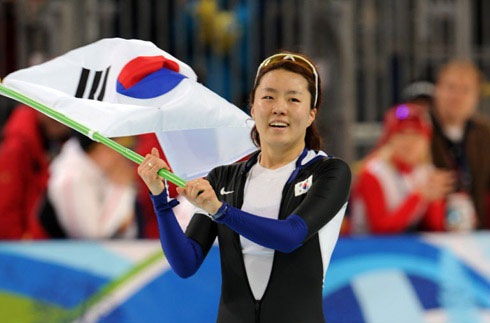
The Olympics is a great source for all those dark sides of world politics, and you don’t really need to look hard to see this. Consider the picture above. I saw some Korean iceskater the other day take a victory lap with a taeguki wrapped around his shoulders, and Koreans in the room with me were clapping and cheering. But the best know example is the US hockey team’s defeat of the Soviet team in 1980. Americans went bonkers, because everyone read it as some (bogus) triumph in the Cold War. Just in case your overweening sense of American awesomeness ever flags, you can watch this (unbelievably schmaltzy tripe) to remind yourself why America is the most amazing place ever.

Or consider the introduction of the teams on day 1. Did anyone else notice that when the Iranian team was introduced that the applause level dropped suddenly? Wasn’t it obvious how the introduction of those players of ‘global’ sport came under the moniker of national titles? What better way to reifiy and reinforce the state in an era of challenge by globalization. Even our athletes are national tools; they’re our athletes.

So please, spare me the multicultural fluff about the Native Americans in Canada, how the Olympics is ‘for love of the game’, your ‘appreciation’ for the success of other countries’ athletes, how you really do pay attention to curling beyond the two-week period it became your favorite sport. At least be honest that you want to see the Jamaican bobsledders crash and that you chest tingles when your flag goes up.

The Politicization of the Olympics

olympics

Honestly, I have never understood the appeal, much less the fanaticism, of professional athletics. To quote Ian Malcolm from the Jurassic Park (the novel), grown men swatting balls is not serious as a career, nor particularly entertaining. I certainly understand that there is something admirable in watching highly trained people perform their expertise, but MDs, PhDs, and soldiers are all highly trained too. At least what they do with all those long years of training is socially meaningful (health care, education, national defense). Beyond entertainment, it is not clear if there is any benign social purpose professional athletics serves. Note further, that its malign social impacts are well-known: corruption of US collegiate education, dead-end hopes with squandered education for millions of poor kids dreaming to be Michael Jordan, a huge diversion of social attention away from meaningful social questions to the ‘sports page,’ families and teen health ignored so athletes can spend 6 hours a day in the gym. I admire the old British tradition of the ranking amateur with a proportional view of athletics as part of physical health. How all this stuff can be a career genuinely baffles me.

As for the viewer, I think we watch not just for the entertainment of competition, but also for darker reasons. First, there is definitely freak-show curiosity. There is something deeply creepy about Barry Bond’s biceps being larger than your thighs, or those misshapen teen athletes who sacrifice their menstrual cycle to become Olympic gymnasts. That is why we respond so lightly to doping and steroids; we kinda want to see what these aliens will look like. Part of us is curious to see the East German women’s swim team with hairy chests or Mark MacGuire’s robo-body perform, even though we all know he cheated. I also think we find a dark pleasure in watching people with unique abilities purchased a terrible cost. Watching skiers fly into moguls at 100 mph or boxers get the hell beat out of them is part of the bloodsport of it all. You didn’t turn away when those lugers crashed, did you?

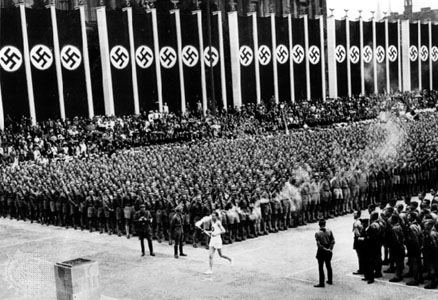
Nor is there any doubt that professional athletics, especially across borders, gets deeply politicized and nationalized. Today on the radio I talked about how South Korea has used the Olympics as a wedge against North Korea for decades. There is a long tradition of politicizing the Olympics that goes back at least to Hitler’s perversion of the games in 1936 into a demonstration of Aryan physico-racial superiority.

_________________________________________________________________

TRANSCRIPT – DR. ROBERT E. KELLY, PUSAN NATIONAL UNIVERSITY

BUSAN E-FM: “MORNING WAVE”

MONDAYS, 8 AM

February 22, 2010


Petra:

Hello everyone and welcome to …..

Right now we have our weekly foreign affairs expert for some commentary on Korea and Northeast Asia. Dr. Robert Kelly teaches in the Political Science and Diplomacy Department at Pusan National University. He’s been living in Korea about 18 months now, and his area of expertise is the international relations of East Asia. If you wish to contact him, please see his website at http://www.AsianSecurityBlog.WordPress.com.

Professor Kelly comes to us each Monday to talk about big issues in Korean foreign affairs. And this week we are going to discuss the two Koreas at the Olympics. Hi, Dr. Kelly.

REK:

Hi, Petra. Thanks for having me

Petra:


Thanks for being with us again today.

REK:


It’s my pleasure.

Petra: 

This seems like a lighter topic than usual. Why are the Olympics important for the inter-Korean relationship?

REK:

It is a lighter topic. We can’t always discuss trade or border conflicts in the Yellow Sea. But it is also true that countries take their international tensions into world sports. You can learn a surprising amount about the workings of the global economy or nation-state competition by watching the Olympics.

Petra: 

How is that? Aren’t they just athletes?

REK:

Well, yes and no. The Olympics is supposed to be apolitical, but they are very clearly not. The International Olympic Committee has been riddled with corruption for years. Countries are regularly caught trying to bribe the committee members to vote for their cities. Host countries routinely use the Olympics to display their modernity, prestige, economic growth, etc., to a global audience. Or countries that are competing with each other in more serious global arenas, like security or ideology, frequently seek to win medals at Olympics as a marker of national greatness or triumph in the larger international contest. In fact, athletes frequently allow themselves to be used in this manner. Korean athletes, for example, routinely carry the Taeguki in their victory laps. This is unnecessary, of course, and violates the Olympic spirit, but it is a hypocrisy that most countries demand from their athletes. In the Korean case, carrying the Taegukgi is a way to prove to the world that South Korea, not North Korea, is the real Korea.

Petra:

I never thought of that Olympics as so politicized…

REK:

Well sure. Let me just give you a few examples. In 1936, the Nazis used the Berlin Olympics to show the world that Germany had recovered from the devastation of World War I, that fascism was the wave of the future, that Germany was racially clean and hence physical superior. It was consequently a huge embarrassment when an American black, Jesse Owens, defeated German athletes. In 1980, before professional athletes were allowed in the Olympics, the US hockey team, composed of mostly amateurs from college teams, played the highly professionalized Soviet team and won. Americans took this as a huge underdog victory in the Cold War, and there is even a movie about it. More recently, Greece used the 2004 Olympics to prove that it was a modern European country that rightfully belonged in the European Union and the euro currency zone. Today we know how wrong that is, as Greek debt is now threatening to destroy the euro. In 2008, China used the Olympics to prove that it was rich, modern, intimidating, and a great power. And all Koreans, of course, will recall how South Korea used the ’88 Olympics as a world-wide coming out party or fashion show for the Korean economic miracle. Indeed, so highly politicized were the Seoul Olympics that North Korea engaged in terrorism to stop them. Kim Il Sung knew, correctly, that a successful Olympics in South Korea would be a significant defeat for North Korea in the inter-Korean competition.

Petra:

Yes, of course. And the 88 Olympics did presage the North Korea’s very difficult problems of the 1990s. It really did mark the beginning of South Korea’s victory in that competition. So what about today?

REK:

Well the Olympics today are relevant for South Korea as a continuing global marker of North Korea’s defeat and humiliation. The North Korean team is small, poorly-trained, and their performance has been weak. North and South Korean athletes did compete against each other in a few events, with the Northern athletes easily trumped. With no medals, no one in the global viewing audience will see the North Korean flag raised, nor hear the North Korean national hymn. By contrast, South Korea is wealthy and populous enough to field a major team. Yuna Kim of course will get lots of publicity, and other South Korean athletes will win here and there. So the monolithic image of Koreans in this global forum will be of South Koreans

Petra:

It sounds tough for the North.

REK:

Yes it is. Very clearly. Which is probably why the North declared last week yet another round of military exercise in the Yellow Sea, and yet more zones of military exclusion that will provoke the South Korean navy. Rocket tests are troublesome way to remind South Koreans and the world that Yuna Kim is not really that important.

Petra:

And South Korea has been trying to get another Olympics too, hasn’t it?

REK:

Yes. South Korea has come pretty close in the last few years to winning another Olympics. And it seems likely that it will get one again reasonably soon. This would be yet another humiliation for the North. Two Olympics in a row in the South, and none in the North. You can imagine the torrent of bellicose Northern rhetoric that another Southern Olympics would bring.

Petra:

This is somewhat cynical view of the Olympics as a tool of countries to show off and compete with each other. What happened to the idea of global sport something all people can enjoy, regardless of the nationality or citizenship?

REK:

Well, there is some of that. When the classical Greek city-states started the Olympics, they really did see them this way. But today, they really aren’t. The Olympics have become about much more than the sports – particularly money and nationalism. I would blame a few things. First, the Cold War. The East-West competition for decades all but insured that just about every Olympics would be highly politicized. The importance of Yuna Kim today as a triumphant South Korean athlete, fits exactly that Cold War context. Second, I blame television. TV has turned the Olympics into a global bonanza for countries – and companies – to strut their stuff. In the same way that TV and money have corrupted American college athletics, they have also corrupted the Olympics. Consider all the advertising revenue Yuna Kim will earn from her Olympic performance. She is clearly doing this more than just love of skating. Finally, I blame the host countries. Hosts as diverse as the Soviet Union, Greece, the Nazis, the Chinese communists, or South Korea have all sought the Olympics for primarily political purposes, and used the Olympics as such. Just recall how intimidating and subtly threatening the Beijing Olympics seemed; the whole vibe of Beijing 2008 was China rising. I even went to a political science conference last year on this topic! Even the mild-mannered Canadians used the opening Vancouver ceremonies as a celebration of Canadian nationalism, not a global sport community.

Petra:

So the Olympics are a nationalist backlash against globalization? It’s a global sporting event in which the athletes wear their national colors?

REK:

I think so. Certainly, Koreans don’t treat the Olympics as just a global sporting event. My impression from Korea’s coverage of the Olympics is that it is highly nationalized and politicized.

Petra:

Ok. How depressing. Thank you professor for coming once again. See you next week.

Merry Christmas – Is Christmas Any Different in Korea? Not Really…


Merry Christmas, all. I hope Santa brings you a Red Ryder BB gun.


As for a Korean Kristmas, there isn’t much difference. The holiday is not as big here. Korea is only about 20-25% Christian. And actually, the muted size of the festivities more appropriately matches Christmas’ relative importance (somewhat low) in the Christian calendar. As in the US, Christmas has been overtaken by commercialism. It’s all about tacky plastic decorations and the most decorations you see are in the stores, not in domiciles.

I was the only one to put up Christmas decorations in my office. I couldn’t find a live tree either – a crushing blow, that. All the Christmas specials you know aren’t on TV or at the DVD store. And about the only Christmas movies Koreans really like are the Home Alone films.

On a more serious, culture studies note, it might interest you to note that Santa is interpreted here as a Caucasian. The race of Jesus has been an issue of dispute occasionally – see the first few minutes of Ali for an sharp look at the impact of a white Jesus on the young Cassuis Clay. But there is not such tussle over Santa here.

A ‘Confucian Long Peace’ among East Asian States (2): Probably Not…

east_asia

(For part one of this post, click here.)

1. I am skeptical, because shared cultural bases have rarely stopped conflict in other areas. Instead, they often seem to encourage it, as various states claim leadership of the cultural space as a whole. Every Continental would-be hegemon from Charles V to Hitler said they were ‘uniting Europe.’ Further, we usually save our worst fury and anger for dissenting insiders, not outsiders. So Plutarch and Thucydides both noted somewhere that the ancient Greeks, despite their shared culture, were far more zealous in destroying each other than uniting against their common foes, the Persian, Macedonians, and Romans. Hedley Bull and the EU framers argue that European ideals and perhaps Christianity provide a shared cultural base for a ‘European society,’ but Christendom hardly stopped the Europeans from fighting bitterly to dominate each other, particularly over which form of Latin Christianity was right. Today, the Arab state system shows the same problems. Supposedly united by common language, culture, and religion, the Arab states have vied brutally against each other, frequently recruiting outsiders like the US or USSR to help them defeat local rivals.

Now, one can argue that Confucianism has special or unique war-reducing or –dampening properties, but that needs a lot of research and detailed process tracing rooted in specific examples of conflict averted by appeals to shared values. A far simpler answer is to say that China was a regional unipole (i.e., huge, when others were small), and therefore war against it was pointless. IR strongly believes this logic explains the current global Long Peace; war against the US unipole today is fruitless. So why not simply apply the logic to the regional level? Chinese preponderance made war in classical Confucian Asia less likely, because China’s opponents never stood a chance and so never tried. Following that causal logic, we should speak of a Chinese hegemonic peace, not a cultural Confucian peace.

2. The idea of a Confucian long peace stumps IR, because we aren’t really sure what to do with ‘culture’ as an explanation for outcomes. In fact, social science in general dislikes ‘culture,’ because it feels like a cop-out reason when you’ve got nothing else. If you can’t explain something otherwise, say it is ‘just their culture.’ So if I don’t know why Russians like vodka, the Irish like Guiness, and the Koreans like soju, then it is just ‘cultural preference.’ But that is awfully soft. It does not actually tell me much; it provides no account of mechanisms and choices. Besides, lots of so-called cultural artifacts actually have functional roots. For example, the Jewish and Islamic prohibitions on pork are rooted in the possibility of contracting trichinosis from flesh that might quickly sour and rot in the sun of the ME. Social science prefers such rationalist explanations. Actor X does Y, because there is some tangible material benefit. Maybe Confucian Asia will bandwagon with China for cultural reasons, but the causal map for this behavior feels soft, especially in contrast the explanatory clarity of the regional unipolarity thesis.

For examples of culture’s softness, look at the other three systems I noted with multiple states functioning within a shared culture (Greeks, Christian Europeans, and Arabs). They did not enjoy any war-reducing affects from common culture. In fact, the evidence from psychology points the other way: we tend to save our harshest opprobrium and violence for lapsed insiders (national traitors, religious heretics) than outsiders who are comfortably relegated as ‘barbarians.’ This was Plutarch and Thucydides’ tragic insight, e.g., on the ancient Greeks.

3. If there was a Confucian peace, I don’t think it is coming back. Kang does. He thinks China’s EA neighbors will accept some amount of Chinese hierarchy; that is why they are not balancing against China now. I don’t buy it. Koreans and Japanese strike me as way too nationalistic today to accept that. If anything, the Koreans and Japanese look down on the Chinese as culturally inferior. Koreans will tell you that the Chinese will eat anything (scorpions, beetles) and that Korea should ‘mediate’ China to the West. Sizeable chunks of Japan still think its imperialism liberated Asia from the West and brought modernity. EA states today are just way too nationalized now. Just like the nationalization and de-arabization of contemporary ME states that sets them against each other despite shared culture, EA states may share a vague Confucian background unity, but vague is all it is. EA is far from the level of cultural sharing and trust that undergird a project like the EU. And remember that the Europeans had to destroy each other for 400 years before they decided to live with each other. If no one is balancing against China today, as Kang says, then, 1. they can avoid it, because the US is still around to reassure everyone, and 2, they are certainly hedging against China, if not openly balancing it. No one in Asia is openly running with China, not even NK. This nationalization of EA states is why Samuel Huntington’s proposed Confucian civilizational bloc never really ignited local opinion here; it was based on the Sinco-centric past, which although attractive perhaps as a route to peace today, no longer exists. Asians will have to do the hard work of forging institutions to build trust; culture is not enough…

A ‘Confucian Long Peace’ among East Asian States (1): Does Shared Culture Stop War?

confucius 2

(For part 2 of this post, click here.)

This article is an excellent introduction to the tangle of East Asian security problems today. Chung-in Moon and Seung-won Suh lay out all the nasty problems of territory, nationalism, and historical imperialism that make EA a powderkeg. There is a running debate in IR theory about how peaceful EA actually is. A lot of it focuses on China. Aaron Friedberg and John Mearsheimer worry that China’s growing strength sets it on a collision course with other Asian states, and eventually the US. David Kang thinks that China’s claim to a ‘peaceful rise’ is real. He notes that for all the sound and fury in EA about nationalism or territorial disputes, there is no serious anti-Chinese coalition forming, nor has their been a major war out here since Vietnam and Cambodia in the 70s. This is a historically and theoretically rich debate; you should read about it if you can.

But I want to focus on remarks by Moon and Suh about how peaceful Asia’s IR was before the arrival of the West. The issue of today’s security dilemmas and tensions in Asia are hyperresearched. Everyone out here goes to one conference after another about Asian security. (I will attend 6 by year’s end, with 2 more scheduled already for next year.) But the counterpoint between Asia and Europe’s earlier history is far more fascinating, because no one ever talks about it. There is a vague argument that while European states were destroying themselves in early modern warfare, Asian states were getting along reasonably well under a Chinese umbrella of soft hegemony. Moon and Suh use the terms ‘long peace’ and ‘Confucian peace’ to describe EA IR until the late 19th C. This is woefully underresearched; there is a great dissertation here.

The “Long Peace” is an uncontroversial idea in IR theory. It says that it is pretty remarkable that there has been no global general war or systemic conflict since WWII. That was the last time all the big global powers lined up on one side or the other and destroyed one another. We are now in the 64th year of the Long Peace. And that does seem like quite an achievement… from a Eurocentric view of the world system. Kang has written a lot to convince me that actually Asian IR was a lot more peaceful than European IR before the Europeans arrived in force in the late 19th C and brought the strict state sovereignty system with them. Kang, Moon, and Suh all suggest that East Asia was a characterized by a much longer (as in centuries) “Confucian Peace.”

The deep cultural and historical details of the confucian peace really need to be researched a  lot more. But here is what I pull from Moon, Suh, and Kang. The ‘confucian’ peace suggests that nations/states in the confucian zone (that means China, Japan, Korea and Vietnam) shared a lot of values and cultural similarity. This sharing acted to slow the march to war; that is shared Confucianism has a war-dampening effect. The specific causal mechanisms are Confucianism’s emphasis on 1. respect for the older and more educated, 2. social harmony, and 3. social hierarchy.  China, as the oldest, most culturally ‘advanced’ state in the region, enjoyed formal superiority to Korea, Japan and Vietnam, but allowed them substantial informal leeway. War violated harmony and order and showed disrespect to the older brother (China). Think of this as ‘feudalism that works’ (unlike in Europe where vassals routinely rebelled). So causal arrow goes from shared culture to the specific war-dampening cultural aspects of Confucianism to peace. Someone needs to write a good IR history of this idea and whether or not it was really true. I have 3 criticisms: Go To Part 2.

Giving Kim Jong-Il the Nobel Peace Prize would have Done more Good

Greetings%20Earthlings

I agree with just about everybody else in the blogosphere that Obama did not deserve it. As many have noted, he has not done anything really. I also concur with the emerging center and center-left conventional wisdom that he should have declined it. The US Right will certainly pick this up as confirmation that Obama is just a celebrity, more interested in placating Europhilic cosmopolitan elites than defending Sarah Palin’s ‘real America.’ Fox can be counted on to get a week or so out of bashing ‘arugula-eating, latte-sipping, Mapplethorpe-loving bicoastal elites who like to be liked in France.’ You’ve already heard that story from Coulter & Co. for years, but Obama offers them ammunition when he revels in the glow of post-modern euros. He should have ducked this one. More importantly, he should do something.

The other obvious insight is that giving this to Obama does not really promote peace in the future. Maybe the Nobel committee is trying to bind/blackmail him into not bombing Iran or paying the US back dues to the UN. But basically, this is an award for not being George W. Bush. Far more useful to actually improving peace would have been to award it to those struggling to overturn or moderate some of the world’s worst regimes. Andrew Sullivan suggested some of the Iranian dissidents. A friend thought Morgan Tsvangirai. I thought perhaps some of those Russian journalists who get killed for reporting on Chechnya. The point of these choices – besides the obvious fact that they deserve it and O does not – is that the Prize might actually help their causes significantly. These dissidents need resources to press on and international press coverage to make sure they are not killed by the regimes they challenge. Tsvangirai, e.g., is almost certainly only still alive, because he garners so much western attention. The Prize would bring powerful moral credibility to those desperately in need of it.

But you want to know what Kim Jong-Il has to do with it. The Dear Leader’s greatest fear now is execution in post-unification South Korean courts. Survival, not juche, is the real ‘ideology’ of the regime. Kim basically wants to survive to die warm and secure in his bed, like his dad. As Hobbes famously said in the Leviathan, he fears not death, which is inevitable, but a violent death. He does not want to got the way of Mussolini, Ceauşescu, or Saddam Hussein. And before he goes, Kim wants to party for a few more decades. He loves the movies, the booze, and the ‘joy brigades.’

Because of his fear of hanging in a South Korean prison, he holds on to NK as best he can. So why not make a deal with him? The Nobel committee already gave the Peace Prize to Yasir Arafat. How about a secret deal to give it to Kim in exchange for an opening of NK? If Kim had a peace prize in hand, the SK government would certainly never execute him.

If this sounds pretty far-fetched, recall how damaged the Nobel Peace Prize’s credibility already is. If Yasir can get one and Gandhi can’t, who cares if Kim gets one? If it helps convince him he won’t get executed, then so much the better…

Top 10 Eurasian Sociopaths of the 20th Century

stalin-mao In myriad ways, living and working outside your own country helps you see things you never would at home. I teach American Government and American Foreign Policy at PNU, and the questions I get asked are frequently astonishingly naive or extremely creative. On the naive side, students frequently ask me about CIA plots to run the the Middle East or tell me about the JFK conspiracy. On the insightful side, they frequently bristle at the self-justifying language of US foreign policy. When I tell my American students about American exceptionalism, they love it. US students swoon when they learn that John Winthorp called the US ‘the city on the hill,’ or Abraham Lincoln said we were ‘the last, best hope for mankind.’ At best, I get some smirks and sheepishness about how purple and immodest US self-justifying rhetoric can be. (Read W’s second inaugural for your most recent, ‘God-has-a-special-mission-for-America’ hyperbole infusion.) So my average American student carries the US belief in the righteousness of US power acting in the world. Foreigners, on the other hand, go ballistic when you talk like this. When I explain how Americans talk about their own foreign policy, they laugh, smile, and roll their eyes. To them, American exceptionalism smacks of arrogance, imperialism, hubris, etc.

On of my favorite moments is teaching Eurasians about the US view of Eurasia as a sinkhole of US power and the spawning ground of world-breaking fanaticisms that ultimately Americans are tasked to destroy. Eurasians are generally convinced of their cultural superiority to Americans, so they are pretty shocked when they hear that US foreign policy sees the Old World as the land of the Kaiser, Stalin, bin Laden, etc. Whether living in Germany or Korea, one trope I have heard again and again in the 6 years I have lived in Eurasia is how young the US is, how primitive and shallow we are, how we have no culture, no deep traditions, watch too much TV, can’t write poetry, etc. This is old news though; any US expat has heard this for years. And there is some truth to it. The US has no author who has scaled the heights of Tolstoy, Dante, or Shakespeare. We have no architecture to rival the Forbidden Palace or Saint Peter’s. American philosophy, until recently, was a pale reflection of the long, rich traditions of, say, Germany or Confucianism.

But turn-around is always fun, and Eurasians are stunned when I tell them how dysfunctional Americans find their politics. If Eurasia is the font of world culture, it is also the breeding ground for the world’s most bloodthirsty ideologies and ideologues. Hah! That is always good for a laugh, as my non-American students look up in amazement.

The US view of Eurasia is that we should stay out of its entangling alliances, but unfortunately, we get pulled in when Eurasia’s pathologies attack us (the Lusitania, Pearl Harbor, 9/11). Put another way, if Eurasians want to kill each other in huge wars, the US attitude is ‘fine, it’s not our show, we’ll sit it out and get more powerful as you destroy yourselves.’ But since the 20th C, Eurasia’s psychotics have a growing taste for attacking the US. So increasingly the US attitude toward Eurasia is a paternalistic one: they can’t run their own house without slaughtering each other over religion, ideology, territory, etc., so we must order their affairs for them. If we don’t stay in Europe and Asia, eventually their paranoias (communism, fascism, Islamism, etc.) will metastasize and attack the US. When my foreign students tell me the US is arrogant, I tell them to try to see the world the way the US does. The long American foreign policy tradition toward Eurasia is isolationism and offshore balancing– stay out of its wars; intervene only if one power is on the cusp of controlling all of Eurasia (Nazi Germany, USSR). But now, the wars are brought to us, so we feel we must intervene.

My Eurasian students have never even thought this way, so I like to provide a list of the various ideological sociopaths Eurasia has given the world – just in the 20th Century.

 Top Ten: Lenin, Stalin, Hitler, Tojo & the Japanese WWII military junta, Mao, Kim Il Sung, Pol Pot, Kim Jong Il, Ayatollah Khomeini, bin Laden.

B-List: Kaiser William II, Czar Nicholas II, Mussolini, Franco, Sukarno, Tito, the Saudi clerical establishment, Zia ul Haq, Hoxha, Brezhnev, Ceausescu, Erich Honecker,the Shah of Iran, Suharto, Ho Chi Minh, Hafez al Assad, Yasir Arafat, Saddam Hussein, Milosevic, the absolutist megalomaniacs running the Central Asian ‘Stans’ in the 1990s, Mullah Omar

Runners-Up:  Park Chun-hee, Syngman Rhee, Marcos, A.O. Salazar, G. Papadopoulos, Chang Kai-shek, Indira Gandhi

That is a pretty grim list of the worst of the worst. Who else would you add ? (It can’t be a henchman like Beria or Himmler.)