My ‘Newsweek Japan’ Cover Story on the Agenda for Korea’s Next Prez

Newsweek cover 2

Newsweek Japan asked me for a long-form essay on the challenges facing the new Korean president-elect for its December 26, 2012 issue (cover story to the left). Here is the link in Japanese, but I thought it would be useful to publish the original, untranslated version as well. (If you actually want the Japanese language version, email me for it please.)

The essay was actually written up before the outcome (a Park Geun-Hye victory) was known, but the argument still applies. In brief, I argue that Korea is drifting leftward. The young in Korea want chaebol reform and less political elitism at home, and abroad they want a foreign policy both less hawkish on North Korea and less influenced by the United States. In fact, if Korea weren’t aging so extremely fast, this agenda would have won. But Korea’s demography is now so skewed that ‘missing’ youth voters due to Korea’s super-low birthrate probably cost Moon Jae-In the election. (Not surprisingly, the Korean news is already reporting on youth action against against free bus fair for the elderly, because they ‘stole’ the election.) Nevertheless, the generational split is real, and the right would be foolish to govern against future voters’ wishes in the name of aging voters who will naturally pass away. Hence my prediction that Park will govern as a centrist not a conservative.

Regular readers of this blog will see themes I have emphasized before. This was intended for their print edition, so there are no hyperlinks included in the text. Here we go:

“On December 19, South Korea will have its sixth democratic election since the end of military rule in 1987. The main candidates are Park Geun-Hye of the conservative New Frontier Party and Moon Jae-In of the liberal Democratic United Party. Park is expected to win, as Moon has run a poorly organized campaign and the Korean left has split. Ahn Chul-Soo, a popular reformist liberal candidate, dropped out late in the race and only weakly endorsed Moon, while a far-left party, the Unified Progressives, has stayed in the race. All this will fragment the left’s vote, likely throwing the election to Park.
Continue reading

My ‘Foreign Affairs’ Piece on the Korean Election – Longer, Fuller Version

Election pics 008

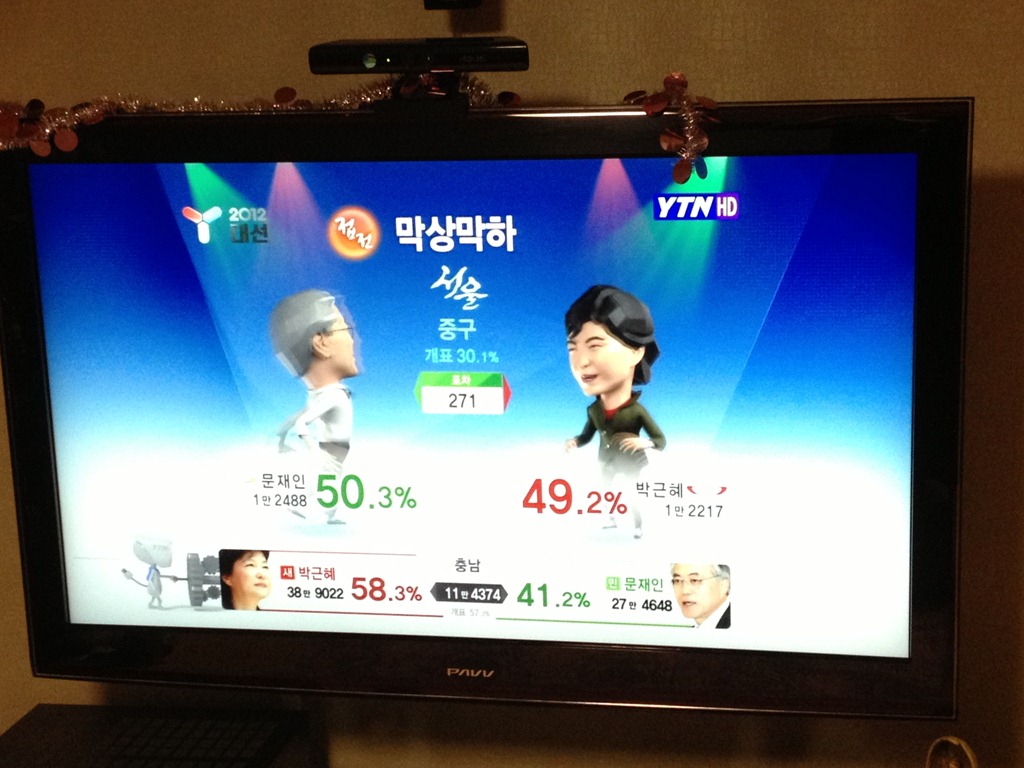
This pic is from the TV election coverage on the Korean version of CNN. That would be the two main candidates (the liberal Moon Jae-In on the left, and conservative Park Geun-Hye, who won, on the right) as dancing electronic cartoon avatars. Yes, they do look like boogying Nintendo Miis, and yes, they are the most bizarre, hysterical election graphics I have ever seen. Who says political science is boring?

So Foreign Affairs solicited me for a ‘snapshot’ essay on the Korean election. Here is the link, but I also thought it might be useful to post my first draft which is fuller:

“South Korea’s next presidential election will occur on December 19. The main candidates are Park Geun-Hye of the conservative New Frontier (Sae Nuri) party and Moon Jae-In of the liberal Democratic United Party (DUP). A third, unaffiliated liberal candidate, Ahn Chul-Soo, dropped out in late November. Ahn had no clear party identification, which was part of his attraction, although he was broadly center-left. A former hi-tech entrepreneur and professor, he was popular with the young who feel alienated by the closed, oligarchic character of Korean politics and for much of the year, he outpolled Moon. Because he and Moon were splitting the anti-Park liberal vote, they tried to merge their campaigns. But Ahn’s hasty, somewhat bitter withdrawal speech implied that old-style, backroom politics by the DUP had pushed him out. Post-withdrawal polls showed Park picked up around one-fifth of Ahn voters, a very strong showing.

Continue reading

What does South Korea Want from the US Election? the Status Quo

Barack-Obama-with-Lee-Myu-008

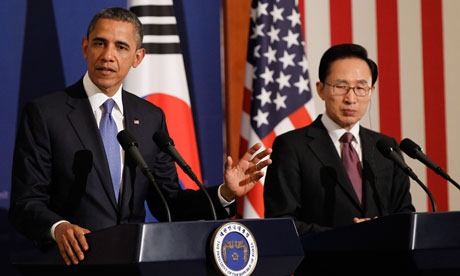
The Diplomat asked me for a short piece on what South Korea would like from the new US president, as part of a general forum – including Shen Dingli from Fudan on China and Adam Lockyer from Sydney on Australia – on Asia and the US election. I have reprinted my essay below, and here is the whole forum. It’s worth a read, and Lockyer’s disbelief at tea party rhetoric should once again be a wake-up call that American global leadership is not an entitlement of our ‘exceptionalism,’ but something we must earn through seriousness and responsibility. I’d like to thank Zachary Keck for soliciting my participation:

1. At the elite level, the ROKG (Republic of Korea government) probably wants a standard reaffirmation of the US- Korea alliance from whomever wins.

My sense from the media and my students and colleagues is that South Koreans are not really paying much attention to the US presidential race. (Neocons take note of such treachery!) Neither Romney nor Obama have much to say except for typical boilerplate on SK – defending freedom, resisting tyranny, close friend of America, yawn. In fact, I am not sure SK’s even been mentioned. And no one likes NK, so that is an easy issue to posture on too. (In fact, I am surprised Romney didn’t take the opportunity in the chest-thumping third presidential debate to accuse Obama of appeasing NK.)

Continue reading

3rd Presidential Debate, Foreigner Version: If you’re not an American, you’re Mentally Ill or something

Warning! The lyrics are explicit – but the movie is hysterical


Did anyone else find the third presidential debate just appallingly narcissistic and self-congratulatory? Good lord. Good thing America is around to show you bubble-headed foreigners the way to freedom. I could run through all the offensive, ‘America-is-tasked-with-upholding-the-mantle-of-liberty’ patronizing condescension, but why bother? (Nexon does a nice job here.) I told my students to watch it, and in retrospect, maybe I shouldn’t have. It was so embarrassing, and in class this week I kept trying to explain why we talk down to the rest of the world like this while my students rolled their eyes in disgust.

I keep saying this – running around the world telling people how exceptional and bound-to-lead we are is a great way to alienate the planet and convince them of exactly the opposite – to not to follow us. We’d have a much easier time with the world if we could back off the blustery, Fox News nationalism and actually speak maturely. But Americans couldn’t give a damn about the rest of the world, no matter how much we posture about our world historic role to lead it. Our ODA totals are disgrace for a coutnry as wealthy as we are. We don’t learn languages much. The only time we worry about casualties in the war on terror is when they are own; our clear disinterest for all the collateral damage we have done since 9/11 speak volumes to the rest of the planet.

So instead, here is the debate foreigners heard:

Continue reading

VP Debate once again tells Asia & the World that all We care about is the Middle East

Yes, it’s partisan, but it’s a somewhat useful deconstruction


First, I included the above video to reference a point I tried to make last week – that Romney flip-flopped so much in the first debate that I no longer have any idea what he thinks about the big issues of campaign. I just wish I knew wth Romney wants to do with the presidency. There has to be some purpose, some reason to vote for him, and I can’t find it. Someone tell me in a few coherent, specifics-laden paragraphs why I should vote for him? Not why Obama is a bad president – I know that already – but why Romney should be president. Honestly, I don’t know, which makes his presidential run look like a vanity project or something.

Second, did anyone else think that the vice-presidential debate once again broadcast to the world that our foreign policy is dominated by the Middle East? It was all about Iran, Syria, Libya, and Afghanistan. Obviously, these are all important places and issues. But it doesn’t take a lot of foreign policy training to know that Russia’s ever-more erratic course under Czar Putin, a possible euro-EU meltdown, or China are a lot more important to the US’ future than a bunch of small, poor fractured states in the Middle East. But no, let’s argue once again about Israel, Iran, terrorism, Iraq…  Good grief. There are other issues out there!

Continue reading

Going to IQMR – Some Summer Asian Security Reading – Back in August

CQRM

I am off to the Institute for Qualitative and and Multi-Method Research for their summer training at Syracuse University. Take a look at the syllabus. Whoa. ‘Can you spell ‘Bayesian hermeneutics’ correctly, little Johnny? No? Me neither!’ But the preparation looks great for qualitative-types like me. I must thank Colin Elman and Andrew Bennett for taking me. The people in that pic look so much more lucid and intelligent than me, that I think they must have read the wrong file or something. I hope they don’t bust me playing ‘Halo’ in the back there…

If debating multicollinearity doesn’t sound like fun (yeah, I don’t really know what it means either, but I think it’s bad), then here is my regular list of good reads from the last few months before I go on break:

Continue reading

Ranking US Allies: A Response to Stephen Walt, Andrew Sullivan & all those Canadians…

Who knew Canada could be so controversial…


Ok, this has gotta be my last response to the many comments from this sprawling series  (one, two, three, four, five) of posts on ranking US allies. Thanks for all the interest. Who knew Canada was so interesting or Canadians so passionate?

I’d like to thank Stephen Walt (whose blog I think is the best in IR) for linking this debate, and Andrew Sullivan for linking me twice. If you aren’t reading Sullivan yet, you’re at the wrong website. Thanks too to all those Canadians who came out of the woodwork to defend its boring relevance. Finally, who could fail to thank a website disturbingly entitled  f—-dgaijin.com?! (Yes, that’s the actual name; check it out for yourself; at least these guys know where we resident-foreigners stand in the East Asian racial food-chain – at the bottom.)

So here are some final thoughts on the many comments, but especially Walt and Sullivan:

1. I accept the arguments from several commenters that Turkey should be on the list. So here is a final list, a ‘top 12’ of US allies in order: Canada, Mexico, Saudi Arabia, Taiwan, India, Indonesia, Israel, South Korea, Japan, EU/NATO, Egypt, and Turkey.

2. I was please to see that Sullivan flagged – not necessarily approved, but just noted – my argument for Indonesia as America’s most important bridge to the Muslim world. I realize this is kinda off-beat, given that the ME is what dominates our perceptions of Islam and where Islamist pathologies are worst. (Here is a critic, a neocon perhaps, calling me ‘delusional’ for ranking Indonesia this way.) So here is a quick defense, more or less along the lines of what Secretary Clinton said a few years.

Indonesia is a syncretic model of pluralist Islam and politics; I think this is pretty widely accepted. No, it’s not as modern and liberal as we might like, but by the standards of the region, other developing countries, and the OIC, it is a paragon. Let’s be honest about that. It could easily be far, far worse (think Pakistan), which is why I find it unfortunate that we don’t pay attention much. We should not let the perfect be the enemy of the good, and a friendship with Indonesia doesn’t mean avoiding tough issues, just like engaging China doesn’t mean we should ignore human rights and other similar issues.

So in its own imperfect, struggling way, Indonesia represents the future of political Islam (speaking very broadly to be sure), not the past, which is a lot of what the ME represents and what Arab Spring is trying to break. If the flat-earth religious elites of places like Iran, Pakistan, or Saudi Arabia are allowed to dominate the global conversation on Islam, more conflict is likely. By contrast, Indonesia offers a possible model for Islam to live with both democratic politics and religious pluralism. That we should vigorously support such an effort, through some kind of alignment, strikes me as so self-evident, that I am amazed that we never talk about this.

Continue reading

More on Abusing America’s ‘Exorbitant Privilege’: How Long can the US Borrow to Sustain Hegemony – up to a 100% Debt-to-GDP ratio?

85448_Dollar-Hegemony-by-Luojie-China-Daily-China-515x335

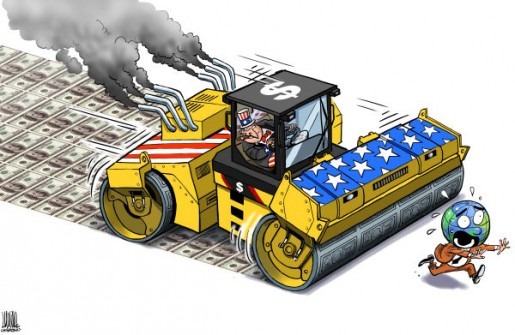
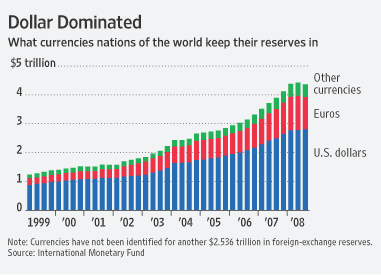
As part of a now lengthy chain (one, two, three, four) on US allies and the likelihood of US retrenchment (hat-tip to Andrew Sullivan for referencing this chain of posts yet again), I argued that American hegemony, despite America’s huge debt and deficit, is more financially stable than almost anyone expected. Because foreigners’ appetite for dollars seems unquenchable and because we print the global reserve currency, borrow in it, and face no serious reserve challengers (the euro and RMB maybe, see below), US can exploit this ‘exorbitant privilege’ far worse than anyone ever thought.

For example, I think almost everyone expected the bond-market to turn against the US in the last decade given: exploding debt and deficits, huge welfare state expansions like Medicare part D and ObamaCare, the expensive and financially-unplanned GWoT, China’s relentless ascent, the Great Recession, and two rounds of quantitative easing. Wow – that’s a helluva list. Despite all that, interest rates and inflation are low, because we can exploit (and have) that exorbitant privilege. Stein’s Law says there must be a limit, but I think almost everyone is amazed at just how deep confidence in the dollar goes.

More simply put, all this means is that foreigners so want dollars, that America can just print more and more dollars without consequent inflation, and borrow from foreigners a lot cheaply (because they want those dollars so badly). This means America can borrow and/or just print huge amounts of money at very low interest and inflation rates. That is ‘exorbitant,’ because no one else can do that without Greece-style financial trouble. We can borrow at low interest rates (the rate on the US ten-year bond is around 1.5% right now) and print lots of money (the recent quantitative easings, e.g.) without suffering like so many others who over-borrow and run the printing press. Barry Eichengreen’s book on this is helpful if you don’t quite get it.

Vikash Yadav gave such good commentary on this tangle over at Duck of Minerva, that I have reposted our full debate on US borrowing and hegemony below. Warning: it gets fairly wonky, so please be sure to read the OP. Also, further IPE are comments wanted. Specifically, someone tell me please when the US will finally hit the ‘soaring’ inflation and interest rates regularly predicted by deficit hawks at the WSJ or CNBC? This is what Romney means when he says we will become Greece, but I just don’t see any evidence of that. Does anyone have a good guess on the timeline for exploiting the exorbitant privilege? When does it finally give way? When do foreigners turn against us in the bond market? As I said in the OP, I think it (super cheap US borrowing) has gone on already far longer than anyone expected. But I also think that a 100% debt-to-GDP ratio might be the bond-market turning point. That is a pretty big psychological benchmark.

So here is our debate on this:

Continue reading

More on US Allies (2): A Response to My Critics

The_world_seen_from800

I found the above image here.

Here is part one of my response to two recent, heavily-trafficked posts (one, two) on hypothetical retrenchment under Ron Paul. (So yes, that makes 4 total posts, including this one.) I got some flak on how I ranked US allies in order of importance, with the implication that those further down were more likely candidates for a diminished American commitment. So rather than responding point-by-point, here are some broad responses on specific countries.

My original ranking, in order, was: Canada, Mexico, Saudi Arabia, Taiwan, India, Indonesia, Israel, South Korea, Japan, EU/NATO, and Egypt. (That’s actually 11, not a ‘top 10,’ because I originally put Canada and Mexico in together at # 1.)

1. I was surprised how much controversy my choice for Canada at # 1 provoked. I thought that was pretty self-evident actually. (Stephen Walt, in a riff on my post, says pretty much the same thing.) Just because Canada is quiet and boring (in a good way) doesn’t mean it is not existentially important for the US. (This same logic, boring ≠ unimportant, applies to my choice for Indonesia. The very fact the Indonesia is a moderate Muslim state is why no one cares about it, but that is a good thing! I guarantee you that if Indonesia had nasty salafists running around like in the ME, we’d all be talking about it.) The US trades the most in the world with Canada. We expect Canada to come with us on just about all our foreign ventures. Its cooperation provides crucial symbolic value: if the country most like us in the world can’t agree with us, then we must be doing something wrong. And most obviously, its security is a direct concern, because of the border. In fact, given that the border is something like 3x the length of the US-Mexico border, Canada easily beats every other state in the world for the most basic US national security concerns.

2. Japan (#9): A good commenter noted that after WWII, the US wanted to make Japan into the ‘Switzerland of Asia,’ and that we are reaping what we sow. Absolutely. I do think Americans send mixed signals to allies. We don’t want them taking an independent line, we want them to do what we say, but then we complain that they free-ride. As I argued in the OP, all this US commitment ‘infantilizes’ US allies by not forcing them to deal with their own regional issues. But Americans, or rather the neocon-liberal internationalist elite synthesis that dominates US foreign policy discourse, ultimately accept weak, dependent allies, because we are in love with our own hegemony. It fires our imagination to compare ourselves to Athens, Rome, or Britain. Neocons read Pericles’ Funeral Oration or Gibbon, and they tear up that America too is the noble, tragic ‘weary titan,’ carrying the great orb of its world-historical task of spreading democracy. Americans thrill to that kind of ‘national greatness’ pseudo-metaphysics while Europeans roll their eyes in disillusionment and Asians wonder wth we are even talking about. So yes, free-riding is pretty obvious to see, because we abet it.

Continue reading

More on US Allies: America’s ‘Exorbitant Privilege’ means it can borrow to Sustain Hegemony Longer than Anyone Ever Expected

P1-AP194B_CHINA_NS_20090323190818

This post expands ideas which were published in my recent JoongAng Daily op-ed.

Two of my posts this week (one, two) on hypothetical retrenchment under Ron Paul got a lot of traffic and comments. Hat-tips go to Andrew Sullivan and Stephen Walt for citing me; if you don’t read Walt and Sullivan already, you should. Given the large numbers of comments, both here and elsewhere, I thought I would try to capture some of the concerns generally. This post focuses on the surprisingly low likelihood of retrenchment; a second, in a few days, will look at specific countries mentioned by commenters.

The OP was intended as an emergency exercise if the US were to face a truly significant crisis that forced retrenchment. The purpose was to ask who are the most important US allies and commitments if we were forced to choose. Right now, the US is not choosing. We are all over the place; if anything, we are taking on more commitments (Iraq, Afghanistan, Pakistan, Yemen, the Asian pivot). As I tried to say in the second post, I don’t think we are about to pull out of Japan or Egypt, but if we get to the point where we really can’t afford globe-spanning hegemony anymore, it would be help to try to prioritize what is genuinely strategically necessary, from what are ‘extras.’ One doesn’t hear this much, except for Ron Paul, whose debate performances motivated the post.

On this point, I should say that the bifurcation of the OP into two parts was not to indicate the those in part 2 should get the axe; it was just a matter of convenience. The point of the OP was to try to force a ranking – who is more important to the US than who? This is why I tried to limit the listees to a conventional ‘top 10.’ To go beyond that tight focus, would get us back into the global alliance sprawl the US is in now.

The above point raises the next, obvious question about whether we are therefore getting to a point of forced US retrenchment. There is a whole declinist literature that emphasizes long-term US problems, like atrocious public finances, too many wars, bad public schools, political gridlock, rising anti-Americanism in the world, etc. Zakaria’s ‘post-American world’ captures are lot of this, and apparently the Chinese believe the US is in decline too. Probably the best I can think of at the moment is Gideon Rachman’s take.

I go back and forth on this myself. The economist in me finds it hard to imagine how the US can borrow $1-1.5T a year and stay on top. We’re borrowing around 9% (!) of GDP per annum, and the IMF calculates America’s debt-to-GDP ratio is 100% already (if you include state debts; it’s 75% now at just the federal level.) I wonder how we can fight so many wars without national exhaustion and diversion of investment from domestic priorities like infrastructure or health care. Signal markers in the decline and fall of empires are heavy borrowing and lots of wars which sounds a lot like us, no?

Continue reading