The Awful State of US Punditry on the North Korea Crisis: Bill Richardson called Kim Il Sung ‘Kim Yun Sum,’ or something like that, on CNN Yesterday

North Korea 2012 279I know what you’re thinking, I’m being a show-off area specialist, Asian language names can be hard for anglophones (and vice versa), and who cares about KIS anyway, because this crisis is about Kim Jong Un? All of that is true of course, especially the first one, but come on…

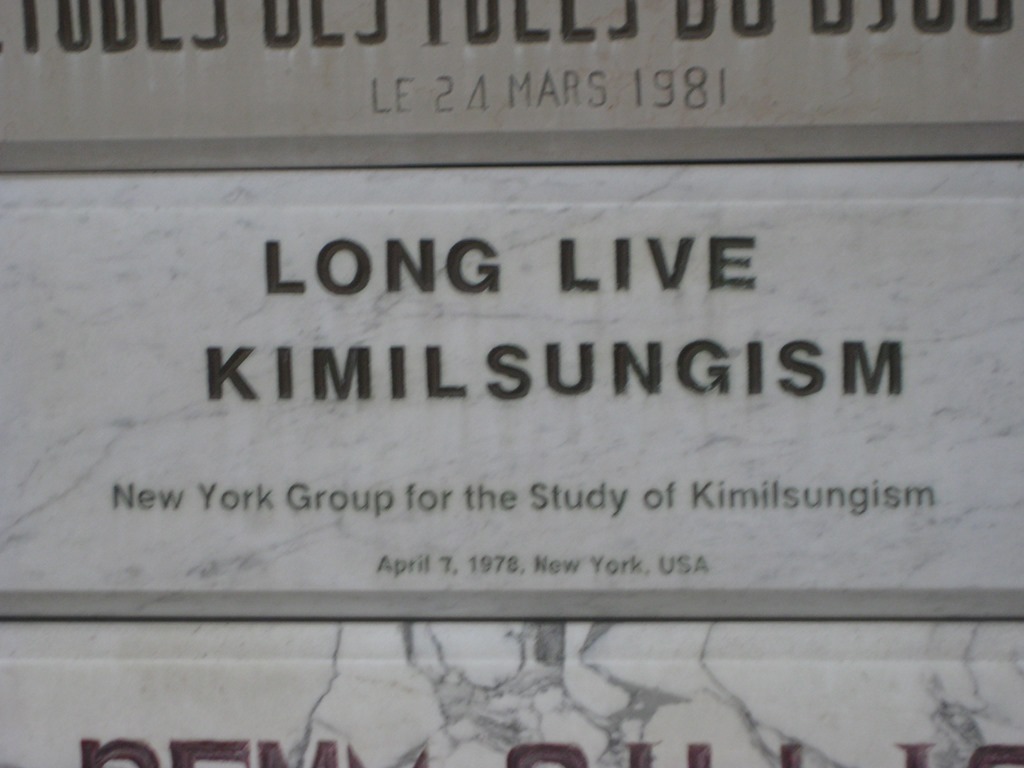
Richardson isn’t just any old hack like me on North Korea. (Here’s my take on the crisis.) He has been a regular point man for the  US on NK for more than a decade and markets himself as such on the talk-shows. And if you study NK in even the most basic way (here’s a good place to start), you know who KIS is. He’s everywhere. He founded the state in 1948 and ruled it until 1994 as his own personal fiefdom. The whole country is built around his personality cult. The regime even started calling its ideology ‘Kimilsungism,’ giving up the fictions of Marxism, communism, etc. KJU has called NK ‘KIS country’ and explicitly models himself after KIS in his clothing, hairstyle, and girth. Statues of KIS are everywhere, and Richardson has been there apparently eight times. I went there just once, and I’ve got my propaganda down pat about the Great Korean Leader, Comrade KIS’ heroic construction of socialism in our style under the revolutionary guidance of the Korean People’s Army defending the peasant and workers against the bourgeois imperialist Yankee Colony..… (I could keep going like that for a few more sentences if you like).

Continue reading

Guest Post, part 2 – Dave Kang: Yes, the Media Coverage of the Korean Crisis is Inflammatory

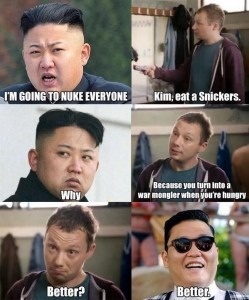
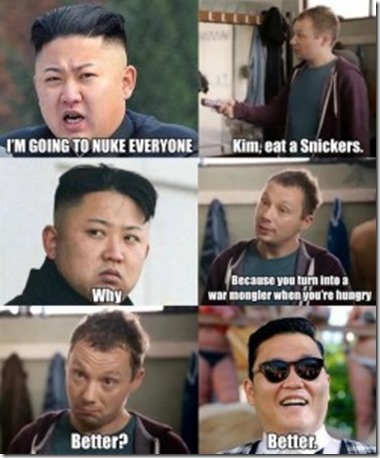
Kim-Jong-Snickers-249x300Yeah, I know what you’re thinking, two guest posts in a row? Christ, Kelly, you’re lazy as hell. In the midst of the biggest North Korea flap in years, you’re at the bar playing Xbox or something.

While that is true, I did get up that piece on the Diplomat. It summarizes my thinking on this current crisis-that’s-not-really-a-crisis and got me promptly accused of being an air-head liberal in the comments. Lovely. I was also pleased to respond to Kim Jong Un’s threat that I should leave the country. And I managed not to explode laughing when a reporter asked me point blank on live TV if Kim Jong Un was ‘just bonkers.’ Was itching to say yes to that one actually. Good times… Never waste a missile crisis, right?

Anyway, here’s my good friend Dave Kang agreeing with yesterday’s guest post query on whether the cable and satellite news services are overhyping this thing. Regular readers will know that Dave is my good friend, and a far better Korea/Asia hand than I’ll ever be. A professor of international relations and business at the University of Southern California and director of its Korean Studies Institute, you really should be reading him if you aren’t already. Here is his Amazon page; here and here are his previous guest posts on this site.

The non-crisis on the Korean Peninsula

In a poll released by Donga Ilbo last week, 4.5 percent of South Koreans think North Korea means to start a war.

In contrast, a CNN poll reveals that 51 percent of Americans think the latest round of name-calling will only end in war, and 41 percent think North Korea is an “immediate threat” to the U.S.

So – either South Koreans are incredibly naïve, or Americans over-reacting. Hmmm…I wonder which it is.

A few comments:

Reading the entire statements by the KCNA would actually give a fairly clear view of North Korea’s position. Most North Korean statements are reported in the Western press with the first clause missing. That is, almost all North Korean rhetoric is of the form “IF you attack us first, we will hit you back.” (Incidentally, that’s what we’re telling the North Koreans, too). If you can ignore the hilarious Communist-style rhetoric about capitalist running dogs and the like, the situation is actually quite stable, because despite their bluster, the North Korean rhetoric is also cast almost entirely in deterrent terms. For example, although widely reported as a threat to preemptively attack the U.S. with nuclear weapons, the full quote from the KCNA April 4 reads: “We will take second and third countermeasures of greater intensity against the reckless hostilities of the United States and all the other enemies… Now that the U.S. imperialists seek to attack the DPRK with nuclear weapons, it will counter them with diversified precision nuclear strike means of Korean style…The army and people of the DPRK have everything including lighter and smaller nukes unlike what they had in the past.” Clearly intended to deter, clearly saying that North Korea will respond if attacked first.

Second – why are we playing this game? North Korean rhetoric should be ignored as the empty threats that they are. Perhaps there could be one or two mild statements from the U.S. reminding North Korea that we can crush them like a grape whenever want. But after that, why are we allowing North Korea to set the tone? Why do we let them make us react? I may be missing something here about this all being an indirect show of force for China, or something clever like that, but still. This is getting ridiculous.

Third, I remain mystified why this is a crisis. I was quite surprised a few weeks ago when everybody got upset. After all, North Korea is only talking – they haven’t actually done anything yet. There has been no attack on the U.S., not even engage in a skirmish over the NLL. So why are we reacting this way now?

Finally, you can never, ever, go wrong being a pessimistic realist. [This is really good theoretical insight, because it allows realism to be nearly unfalsifiable yet sound ‘clear-eyed’ – REK]  I.e., “I don’t know, the situation looks dangerous…power is all that matters in international relations…things can get really bad, nuclear war is just one hair-trigger, slight miscalculation away.” You could be 100% wrong, but nobody will ever accuse you of being naïve. But I want to point out that while it’s important to be careful around the peninsula, deterrence has been extraordinarily stable for the past sixty years. Why? Because we believe what they say – that they will fight back and destroy Seoul; and I am quite sure they believe us when we say we will fight back and end the regime. Far from being one mistake away from the 2nd Korean War, we have experienced numerous shooting incidents in which people died but no all-out war occurred….

Guest Post – Is the Media Coverage of the North Korea Crisis Inflammatory?

I’m going to put something on the Diplomat about this preposterous faux-crisis in a few days, and I’ll re-post that here. In the meantime, go here for the many posts I’ve written about North Korea beforehand. And go here for my recent TV appearances where I ague that a war is really unlikely, because North Korea will lose unequivocally, and its elites will wind up in SK jails and then before the hangman like Saddam. (SK still has capital punishment.)

Given my fatigue with NK, I am happy to invite a guest-post on North Korea from John Corrado. John’s a Korea studies graduate student at Seoul National University. Here is his website, on issues similar to those I cover here. And I do like his basic observation that the news media can get carried away with all the talk about nuclear war in Korea. You’ve probably noticed a point I will develop in the Diplomat: the cleavage between the analyst community and the international media regarding the current peninsular crisis. The analysts say it’s a lot of bluster, while reporters react rather incredulously when we say that. Maybe they know something we don’t; in their own way, reporters are closer to decision-makers than we are. But I also have the sense that all this media coverage is one of the things NK wants from this faux-crisis. No would care one bit about crappy, backward, dysfunctional little NK (it is; I’ve been there) if they didn’t make endless trouble. No one likes to be ignored and consigned to the kiddie table, so NK pulls these shenanigans just so we’ll all pay attention. *sigh* It’s all so inane… Anyway, here’s that guest-post. REK

Continue reading

‘Rodman-gate’: Can ‘Useful Idiots’ please Stop Shilling for North Korea?

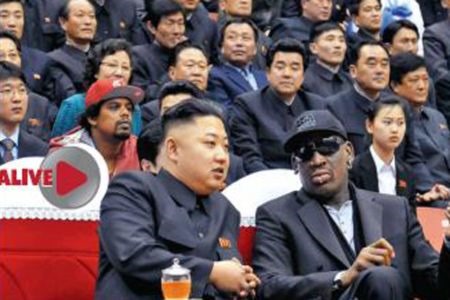
rodman nk

Studying North Korea inevitably means people ask me pretty outlandish stuff. People have asked, if the North really believes long hair is bad for socialism, if that goiter on Kim Il Sung’s neck made him crazy, if Kim Jong Il’s platform shoes meant that he liked disco, and if North Korean women are good looking because a food shortage would mean everyone is slim. (I presume that last one is a reaction to obesity epidemic in the US.) So I tried to avoid this latest outbreak of Norko bizarreness with Rodman. But people keep asking me, so here a few thoughts to the effect that: no one should shill for NK – ever.

Call it yet another chapter in the history of clueless foreigners getting lost in and manipulated by North Korea – what Lenin used to call ‘useful idiots,’ knaves from the West who defended the Soviet experiment, blissfully ignorant of the camps. Who knows what to make of that utterly weird photograph of Rodman in bling and Kim Jong Un dressed like Mao. There are so many contradictions in there, it’s not even worth unpacking.

Continue reading

My Comments to BBC TV about yesterday’s North Korean Nuclear Test

That would be the finest academic haircut in all of Asia… 😦


I spoke this morning on BBC’s Asia Business Report on the North Korean nuclear test. My quick take is:

Yes, it was a terrible idea, but no, it is not surprising. Nuclearization takes time and ‘practice,’ so these sorts of tests are expectable. This one was about half the yield (size) of the weapon dropped on Hiroshima, so they’re getting pretty good at this now. I’m continually astonished at how a near-third world state under heavy embargo nonetheless pulls this off. Wow. What are we missing?

Yes, there’ll probably by a UN resolution, but no, it won’t have any real bite. The reason is China. There’s a near consensus now in North Korea studies that China is the key here. China is the reason sanctions don’t work – because the Chinese don’t enforce them. And it is China that politically enables these childish North Korean stunts by not attaching any real costs of aid or diplomacy to them. That said, one of the reasons for all these NK hijinks is to keep the Chinese out of their business. We all assume the nukes are aimed at Seoul, Tokyo, and LA, but they’re also a nice deterrent to Chinese domination. The nukes signal that even though NK is now an economic satellite of China, it will never be a political one. NK will not become China’s East Germany.

The real question for the future then, is how the democracies among the Six Parties (SK, Japan, the US) can walk China back from support of NK. How do we get China to stop obsessing about retaining NK as a ‘buffer’ against the democracies? How do we get Beijing comfortable with Southern-led unification? When that happens, then Beijing will drift from the North, and the possibility of collapse becomes much more real. But that is probably one to two decades away. Yes, this drama will go on and on and on…

For my travelogue on my trip to North Korea, go here.

The video is simply my phone recording our home TV, so the quality is not so hot. Also, if you’re wondering my eyes are wandering all over the place, it’s because BBC does not provide the image back to the interviewee when you’re on Skype with them. So I am sitting there just looking at nothing – my desktop maybe – trying to find something to do with my eyes. Ah well…

USC-CSIS Conference on Korean Unification (3): DPRK ‘Sovereignty’ is a Sino-Russian Fig-Leaf to Slow Unification and Check US Power

New_KSI_Banner_3

Here are part one and part two of this post. I spoke last Tuesday at a USC-CSIS conference on Korean unification. I learned a lot, and it was very good. If you’re interested in unification, start here with the primary report on which the conference was based. The principal investigators said a final wrap-up report will come at some point, and I’ll put up that link when it arrives.

My comments below are on the papers presented on Tuesday about neighboring states’ reactions to Korean unification. These papers aren’t publicly posted yet, so all the comments might not make sense. But in the interest of completism, I’m putting this up to round out my thinking on this excellent unification project. (For my earlier thoughts on dealing with NK, try this; for my travelogue of my trip to the DPRK, try this.)

My big beef with these sorts of conferences on NK – I go to a lot – is that inevitably outsiders, especially Chinese scholars, start laying down all sorts of guidelines, restrictions, parameters, etc. for unification, as if it’s our right to muck around in this thing. I can understand the national interest in doing so. But we shouldn’t have the temerity to try to legitimate our muddying of the waters in what is really an internal family affair. It would also help a lot if the Chinese would stop talking (not so much at this conference, but definitely at others I’ve gone to) about how Korea needs to respect its wishes, because China is big and important now, post-2008 Olympics. I heard one guy once even say that China is now the ‘veto-player’ on unification. That’s true of course in realist sense, but that sorta cockiness infuriates Koreans who’ve really soured on China in the last decade. I see the same kind of emergent Chinese bullying on unification that Southeast Asian littoral states see on the South China Sea. So I try to call that out whenever it seems necessary.

Anyway, here on my thoughts on Japan, Russia, and China’s role in this thing.

USC-CSIS Conference on Korean Unification (2): ‘One Country, Two Systems’ will not happen

CSIS Korea ProjectHere is part one of this post. The following will make more sense if you start there.

I noted that I am participating, today in Seoul (attend if you can), in a USC-CSIS project on Korean unification. This is the final ‘phase’ of their Korea Project on unification.

I thought I would post my thoughts on the USC-CSIS Phase II report (available here) which provided all sorts of suggestions for reconstruction. It’s required reading if your area is Korea and NK, but I actually disagree with a fair number of the analogies to Iraq and Afghanistan. I think Germany is a better model for what will happen here, and I think a ‘one country, two systems’ arrangement like in greater China is nearly impossible given the extraordinary deep ideological divide, which is also existentially necessary for NK to demonstrate why it must be a seperate, poorer Korean state. So it’s either implosion or stalemate.

Anyway, the rest of my thoughts are after the jump. Having read the CSIS report is not a prerequisite to understanding my arguments, but it would help.

Continue reading

USC/CSIS Conference on Korean Unification (1): it will cost WAY more than people think

Cha_Challenges__110The University of Southern California Korean Studies Institute and the Center for Strategic and International Studies are running a joint Korea Project: Planning for the Long Term (pic to the left). CSIS will hold the last of three conferences in this project at the Asan Institute on January 21st next week. If you are in Seoul, you should go. The agenda looks pretty good. (Contact the Asan Institute.) I’d like to thank USC and CSIS for soliciting my participation..

The January 21 conference is actually the last meeting of the Project. The first meeting asked Korea area experts to look at unification; the second meeting asked functional experts to do the same. This upcoming third meeting will look at regional impacts from unification. I will comment on papers from Russia and Japan. I will put up my thoughts on those papers after the Phase III conference, but for now, I thought I would post my comments on the Phase II conference (by the functional experts).

Basically I argue that  Germany is a better model for what will happen here than either the occupations of Iraq or Afghanistan, or LDCs in transition. Also I don’t buy for one second that NK will enter into a meaningful ‘one country, two systems’ arrangement like in greater China. DPRK change meaningful enough to permit a federation would be so far-reaching, that it would inevitably raise the question why the DPRK  exists at all. Ideological change is an existential threat to the regime: why be a poorer version of SK if you’re in a federation with SK? why not just join up? This is the logic that undid the GDR. So it’s either implosion or stalemate IMO.

Here is the final CSIS report on Phase II (a must-read if you want to research unification); my gloss on that follows the jump. (Here is the much shorter Phase I report.)

Continue reading

My ‘Newsweek Japan’ Cover Story on Korea’s Economy: De-Concentration Needed

NewsweekNewsweek Japan asked me for a long-form essay on Korea’s economy for its December 5, 2012 issue (cover story to the left). Here is the link in Japanese, but I thought it would be useful to publish the original, untranslated version as well. (If you actually want the Japanese language version, email me for it please.)

The essay broadly argues that Korea needs to move beyond ‘developmentalism’ toward economic liberalism, as a lot of Asia does in my opinion. Regular readers of this blog will see themes I have emphasized before. This was intended for their print edition, so there are no hyperlinks included in the text. Here we go:

“As Korea’s presidential election moves into the home stretch, the local economic discussion is sharpening. Inequality, demographic collapse, massive concentration of economic weight in a few mega-conglomerates, weak consumer purchasing power, growing trade friction over intellectual property rights, and a chronically under-powered small- and medium-enterprise sector (SME) are among the major problems this outwardly very successful economy must confront. Unfortunately, none of the major candidates are pushing the deep reform needed to fix these underlying issues. As with China’s leadership transition, things seem so good at the moment that elites are wary of rocking the boat; as with the recent American election, tough choices will likely once again be kicked down the road. In Korea’s case, that means moving away from its ‘developmentalist’ growth model before encountering troubles similar to Japan’s.

Continue reading

North Korea as ‘Kim-Land’: My Op-Ed on NK in the JoongAng Daily

JoongAng Ilbo

Yesterday, the JoongAng Daily printed an column by me about my trip to NK. Here is the link and column is reprinted after the jump. This condenses my earlier thoughts on my trip and adds some political analysis.

In passing, I should say that I find the JA the best newspaper in Korea – and no, not just because they publish my stuff every couple months (although that helps) Smile.

For readers who don’t know the Korean media scene, the JA is like the Economist in Korea – centrist, neoliberal, intelligently hawkish on foreign policy, sane on social issues. This is why I send my stuff to them. The biggest newspaper in Korea by circulation is to the right, the Chosun Ilbo. The third big paper is to the left, Hankyoreh. I find the Chosun ok, but sometimes it can sound like Fox News, and I dislike its obsessive, Korea’s-status-in-the-world-is-rising!!! nationalism. But the far-too-soft-on-Pyongyang Hankyoreh I frequently find downright disturbing, as it comfortably trafficks in the worst conspiracy theories like poisoned US beef in Korea or a cover-up of the Cheonan sinking. So if you are researching Korea, stick to the JA first, and then CI.

(So yes, my politics are broadly center-right, even though I seem to criticize the US GOP relentlessly on this site. One thing I like about SK is that its conservatives are in fact conservative, not radical, as the Tea Party made the Republicans. Generally speaking, I find the SK right to be responsible and moderate most of the time. That’s so refreshing. Don’t you miss having sane conservatives back home?)

Ok, here’s the op-ed:

Continue reading