My Diplomat Interview on North Korea, Syria, and China’s Rise

the-diplomat_logo_en

Frequent readers know that I am regular contributor to the Diplomat web-magazine. On October 10, Editor James Pach interviewed me, mostly about Northeast Asia. Jim is a great guy, and I think these questions helpfully expand on some ideas I have put on the blog recently, especially my recent piece on reining in US presidential wars powers. The original interview is here.

JP: North Korea has put its troops on high alert, restarted its reactor at Yongbyon and called South Korean President Park Geun-hye an “imbecile.” We’re accustomed to the pendulum of ratcheting up and then easing tensions, but this year Pyongyang seems especially schizophrenic. Is this the new leader Kim Jong-un settling in, or are there other factors at play?

REK: This is a tough question given how opaque North Korean leadership decisions are. My own sense is that this is typical North Korean game playing. I made a similar argument at the Diplomat during the spring war crisis. It is true that Kim Jong Un is likely still finding his way. He is too young and too inexperienced in the old boys networks that run NK to easily step into his father’s shoes. But his period of greatest vulnerability was last year. The regime seems to be settling in around him comfortably – to many people’s surprise – so my sense is that this is the Korean People’s Army going through its usual hijinks to justify its massive and massively expensive role in NK life. I thought this too was the reason for the spring crisis, because NK does not actually want a war which they will lose, badly.

Continue reading

My October Diplomat Essay: Was Syria a Bridge-Too-Far for Untrammeled Executive War-Powers? (yes)

Jump to 1:13: That’s best question asked during the GOP debates last year

This is my monthly essay for the Diplomat web-magazine. The original can be found here. I will say upfront that I am not a lawyer, but a political scientist, so I am aware that the legal argument about presidential war powers independent of Congress is fierce. But that interests me less than the absolute (or moral or philosophical) argument for unconstrained presidentialism on the use of force. That is, whether or not presidential unilateralism in the use of force is ‘constitutional,’ as the lawyers would say, is something a dodge. That does not mean it’s right. The Constitution is not perfect and has been amended for things like slavery, women’s enfranchisement, and Prohibition. So ultimately the president should justify ignoring Congress in war-time by some argument consonant with liberal democratic values, rather than an ex cathedra appeal to authority. And I don’t really think it is possible to coherently argue that presidential free-lancing with minimal Congressional oversight and consent is good for democracy. In fact, that strikes me as self-evident, which is why I love that Ron Paul quote in the video (1:13 mark) above. The essay follows the jump and is written in an op-ed style.

Continue reading

My September Diplomat Essay: Relax – Chinese Hegemony in Asia is Unlikely

water_pollulation_shaoxing_zhejiang

The following is a re-up of a piece I wrote for the Diplomat last month as part of an informal back-and-forth series with the National Interest this summer on the US pivot to Asia and AirSea Battle. (Here and here are some of the other entries.) That pic, which has got to be the grossest river in all China, is from here.

In brief, I increasingly think that ASB is a mistake, because it’s almost impossible to read it as anything other than hugely provocative from the Chinese point of view, no matter what we say to them about our peaceful intentions. (Read this, and tell me reasonable Chinese wouldn’t flip out.) It’s a classic example of the security dilemma, but as I argue below, I am not really convinced that we actually need this high-tech, super-fearsome-sounding ASB right up in their face. More generally though, the pivot to Asia – a sharpening of American attention on the region, is probably a good idea. China is vastly more influential on American life than Israel or Iran. But the Middle East and Islam activates belligerent American religiosity so much, that I doubt we’ll really be able to pivot. In any case, the essay follows the jump and is written in an op-ed style.

Continue reading

Walter Russell Mead Defends, Badly, the NSF cuts to Political Science

NSF

I originally put this on Duck of Minerva, an IR theory blog where I also write. But it’s worth putting here too as the US government shuts down over Tea Party intransigence.

I’ve defended Mead before on this site. I think he is a bright conservative who stands out in a sea of Fox News ideological bleh, like NewsMax or Drudge. He has a far better sense of the importance of religion in many people’s lives than academics do, and he has a good feel for western classical history that adds historical depth to a lot of his blogging. I read him regularly, where I recently stumbled on this defense of the coming NSF cuts in political science. Money quote:

Political scientists should know better: university faculties ultimately depend on taxpayers and their representatives for many of the resources they need for their work. This fact of life is truer than ever when health care and other costs are forcing discretionary spending down. Funding for political science is just another budget line item that needs to be justified. Writing obscure articles for peer-reviewed journals that nobody, not even other people in your discipline, will read is not the best way to do that.

And here’s another thought: making departments in social sciences and other disciplines more welcoming to political conservatives and—horrors!—seriously religious people may help build that bipartisan support without which federal funds will be increasingly hard to get.

Continue reading

My July Diplomat Essay: The Korean ‘OPCON’ Soap Opera Rolls on – Hint: just drop it

Thank you for waiting out my summer break. I need summers to get some writing done, but inevitably I didn’t get nearly what I needed to wrapped up. Should you ever hear that argument that college professors slack, because we only teach 2/2 or 3/3, you ought to try writing for these journals. Just read this. That is why we don’t teach 30 hours a week. 

But I am still writing for The Diplomat, a gig I really enjoy. Here is my piece from August on the endless soap opera of the transfer of wartime operational control (‘OPCON’) from the US to the Republic of Korea. (The pic is the US SecDef and SK DefMin.) Why the RoK would even want OPCON back, before unification, is beyond me. It’s a perfect opportunity to buckpass to the superpower security guarantor. And in fact, that is sorta the way the Korean debate is going; they increasingly don’t want it back. Also, it seems pretty clear now that the Koreans aren’t really ready. Too many officers have been playing golf or whatever instead of getting ROKA specs and procedures up to snuff. Anyway, my own sense is to just drop it, because the US and RoK are just going to re-build a version of CFC (Combined Forces Command) that does all the same stuff but is just a little less ‘joint.’ I don’t really see the point then in ending OPCON. If you’re a real mil-tech expert, please tell me in the comments why a new ‘CFC light’ is better than the current arrangement? 

The essay starts after the jump.

Continue reading

Want to Guest-Post on my Website? b/c I need a Summer Break…

Special-Cool-Summer-Drinks

Traditionally over the summers, I take a break; too much blogging eats up research time, and I have an r&r I gotta finish.

But guest-posting is a nice option to fill in some down time. So if you like the kinda stuff I put up, please comment below or email me, and maybe we can work out a guest-post. Please stick to the sorta stuff I normally put here up – Asian security, US foreign policy, Korea, China, Japan, the Middle East.

Or if you need some reading this summer, here are the 5 best international relations books and articles I have read so far this year:

Don’t Come Home, America: The Case against Retrenchment,” Stephen Brooks, John Ikenberry & William Wohlforth, 2013

– yes, you probably already read it, but if you haven’t, it’s really important. I want to be a retrencher, because I think America has become infatuated with empire, but this is compelling case why that instinct is wrong.

Rebooting Republican Foreign Policy,” Daniel Drezner, 2013

– great summary of why I went from voting and working for the GOP (a congressman) in the 1990s, to sheer disgust today at the neo-con/Tea-Party mania that has unhinged traditionally sober and responsible Republican stewardship of US foreign policy

The Sovereign State and Its Competitors, Hendrik Spruyt, 1994

– fantastic ‘Big Think’ historical social science; the kind of product that justifies why we have political science as a distinct discipline; if I only could write historically-informed social science this good…

Comparative Historical Analysis in the Social Sciences, eds. James Mahoney and Dietrich Rueschemeyer, 2003

– if you like history and have never had a method class, this is a great place to start on how to do social analysis with history right

Path Dependence in Historical Sociology,” James Mahoney, 2000

– the single best essay I’ve ever read about how to build a proper causal argument chain; shoulda been assigned when I was in grad school 

Guest Post – Dave Kang: “International Relations Theory and East Asian History”

AHN_HOUSEIt’s always my pleasure to guest-post my good friend Dave Kang. Dave teaches at the University of Southern California, runs their Korean Studies Institute (the pic), and knows way more about the issues of this website than I ever will. So if you aren’t reading his work yet, you should be. Here are some previous guest posts he’s written (one, two, three).

Here is his encouragement that you actually apply international relations theory to East Asia. I can’t agree more. There is far too much superficial think-tank wonkery about East Asia (how many nukes does China have? will Pyongyang test another missile? and so on), and not nearly enough real theory. Dave does that and you should too. So instead of writing yet another essay about the South China Sea, the essays referenced below should be good encouragement to write something richer.

“Thanks to Bob for letting me borrow his website yet again. I have an article “International Relations Theory and East Asian History” that appears in the current issue of the Journal of East Asian Studies, edited by Stephan Haggard. In conjunction with this post, Lynne Rienner will make the article freely available to all for the next 30 days; you can download it here until October 1.

The entire issue is devoted to the international relations of historical East Asia. The special issue features essays by James Anderson, Kirk Larsen, Jiyoung Lee, Seohyun Park, Kenneth Robinson, and Yuan-kang Wang, all exploring different aspects of IR and East Asia in many disparate epochs and areas.

Continue reading

My ‘Diplomat’ Essay on whether these Youth Protests will Spread to Asia’s Democracies

Brazil

Here is a re-post of my July contribution to the Diplomat web magazine. It expands on a brief observation I made a few weeks ago – that a lot Asian democracies have the same characteristics that seem to have driven people into the streets in Brazil and Turkey.

Here is the best critical response I’ve gotten so far. In brief, it argues that my conditions for the revolts are so widely drawn, that arguably lots of states could see these kinds of revolts. That is a good point. And many of the commenters that the Diplomat said something similar – that Cambodia, Malaysia, and Thailand should also have been included in my piece as possibilities. I singled out India, the Philippines, and South Korea. I’m not a big expert in the area of modernization and contestation, so thoughtful comments would be great. Here we go:

Continue reading

My ‘Newsweek Korea’ Cover Story: A Defense of Obama’s ‘Strategic Patience’ on North Korea

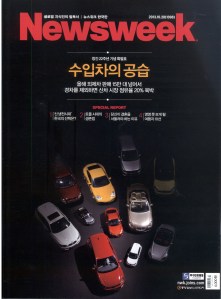
Newsweek Korea cover 2

Newsweek Korea asked me to participate in a cover story debate on Obama’s strategic patience. A friend of mine wrote against it; I wrote in defense. Here is the Korean language text at the NWK website. Below is my original English language version.

In brief I argue that NK is so hard to pin down, that big strategies never work with it, provoke North Korea into lashing out, and raise impossible expectations on democratic decision-makers. So Obama is acting responsibly, IMO, by not promising more than he can deliver and by not giving a reason for NK to act out.

After 20+ years of negotiating on more or less the same topics, it should be pretty obvious that NK is insistent on not being placed in some box by outsiders. It will not be treated as some technocratic ‘problem’ to be ‘solved’ by a conference of experts, like global warming or something. And it will lash out if necessary to remind us of that. Hence, I argue for ‘muddling through,’ and that we should stop expecting our policy-makers to have some great NK strategy that will fix the issue. That’s not gonna happen. We all know that. We just have to wait for China to stop paying NK’s bills. Until then, all the sweeping declarations (‘agreed framework,’ ‘sunshine’,’ the ‘axis of evil,’ the current big idea du jour of ‘trust’) are rather pointless and raise impossible expectations among voters in SK, the US, and Japan. Let’s be a little more honest about what we can expect from North Korea.

Here we go:

Continue reading

Agree with Heinlein’s ‘Citizens vs. Civilians’? then this US Military History is for you: Book Review

Starship-Troopers-starship-troopers-13578603-1024-768

I was asked by a participating member of the H-Diplo/ISSF network to review The American Culture of War. Here is the original link to my review, but it’s off in some far corner of the internet, so I thought I’d repost it here. In brief, I found the book a pretty disturbing rehearsal of right-wing tropes about the military in a democracy, especially from an academic, and there’s no way I’d ever use it with undergrads as Routledge suggests. The underlying moral driver is the ‘chicken hawk’ principle – that those without military experience are not morally qualified to lead DoD and should otherwise defer to uniformed military. At one point the author actually says that, because the US Army ‘distrusts’ Congress, the Army should ‘guide’ Congress. Yikes. Do Americans (and the author) really need to be told civilian authority runs the other way, and that that’s in the Constitution? I find that sort of military elitism democratically terrifying and reflective of the post-9/11 militarization of America that is now the single most important reason, IMO, to end the war on terror.

I would just add the following update: Both the book and review were written before Petraeus’ resignation, but it should come as no surprise that the text lionizes Petraeus. It is therefore a pleasing schadenfreude for the frightening post-9/11 military hero-worship of the US right to be taken down a notch. Here we go:

Continue reading