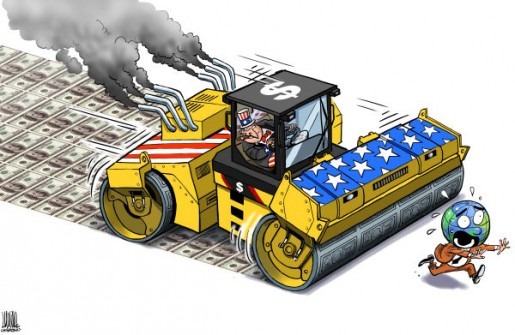
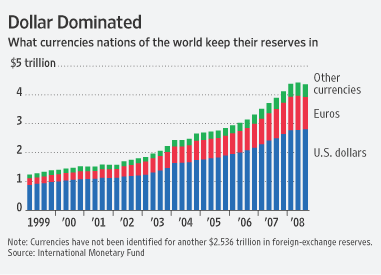
More on US Allies: America’s ‘Exorbitant Privilege’ means it can borrow to Sustain Hegemony Longer than Anyone Ever Expected

P1-AP194B_CHINA_NS_20090323190818

This post expands ideas which were published in my recent JoongAng Daily op-ed.

Two of my posts this week (one, two) on hypothetical retrenchment under Ron Paul got a lot of traffic and comments. Hat-tips go to Andrew Sullivan and Stephen Walt for citing me; if you don’t read Walt and Sullivan already, you should. Given the large numbers of comments, both here and elsewhere, I thought I would try to capture some of the concerns generally. This post focuses on the surprisingly low likelihood of retrenchment; a second, in a few days, will look at specific countries mentioned by commenters.

The OP was intended as an emergency exercise if the US were to face a truly significant crisis that forced retrenchment. The purpose was to ask who are the most important US allies and commitments if we were forced to choose. Right now, the US is not choosing. We are all over the place; if anything, we are taking on more commitments (Iraq, Afghanistan, Pakistan, Yemen, the Asian pivot). As I tried to say in the second post, I don’t think we are about to pull out of Japan or Egypt, but if we get to the point where we really can’t afford globe-spanning hegemony anymore, it would be help to try to prioritize what is genuinely strategically necessary, from what are ‘extras.’ One doesn’t hear this much, except for Ron Paul, whose debate performances motivated the post.

On this point, I should say that the bifurcation of the OP into two parts was not to indicate the those in part 2 should get the axe; it was just a matter of convenience. The point of the OP was to try to force a ranking – who is more important to the US than who? This is why I tried to limit the listees to a conventional ‘top 10.’ To go beyond that tight focus, would get us back into the global alliance sprawl the US is in now.

The above point raises the next, obvious question about whether we are therefore getting to a point of forced US retrenchment. There is a whole declinist literature that emphasizes long-term US problems, like atrocious public finances, too many wars, bad public schools, political gridlock, rising anti-Americanism in the world, etc. Zakaria’s ‘post-American world’ captures are lot of this, and apparently the Chinese believe the US is in decline too. Probably the best I can think of at the moment is Gideon Rachman’s take.

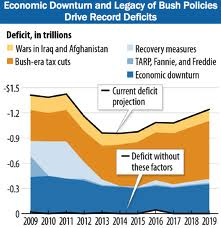
I go back and forth on this myself. The economist in me finds it hard to imagine how the US can borrow $1-1.5T a year and stay on top. We’re borrowing around 9% (!) of GDP per annum, and the IMF calculates America’s debt-to-GDP ratio is 100% already (if you include state debts; it’s 75% now at just the federal level.) I wonder how we can fight so many wars without national exhaustion and diversion of investment from domestic priorities like infrastructure or health care. Signal markers in the decline and fall of empires are heavy borrowing and lots of wars which sounds a lot like us, no?

Continue reading

Say Ron Paul Won…Which US Allies would get Retrenched? (2) Japan?

retrenchment graph

This post series is getting so much traffic, here is a part three on likelihood of retrenchment. Here is part one where argued that America’s 8 most important allies are, in order: Canada, Mexico, Saudi Arabia, Taiwan, India, Indonesia, Israel, and South Korea.

I argued for 3 quick-and-dirty reasons for that ranking, but I got some criticism on these in the first post, so here is some elaboration :

1. National Security: Some places, like SA and Mexico, may not appeal much to Americans, but they are so obviously important, that abandonment would be hugely risky. So yes, SA is a nasty, reactionary ‘frenemy,’ not really an ally at all, but we’re stuck with it. A Saudi collapse would set off both huge economic and Islamic religious turmoil; all the more reason to slowly exit the Middle East and pursue green energy. But until then, I think we have to be honest and say that we can’t really leave the Gulf. But the bar of this criterion should be awfully high. With some frenemies, like Afghanistan and Pakistan, we don’t really need to pretend to be allies actually. We can just get out if have to.

2. Need: In some places, the US can get a lot more bang for its commitment buck, because without us, our ally would likely collapse/lose/fail. Taiwan is the most obvious example. Conversely, other places, like Germany, pretend to need us, because they don’t want to shell out the cash (and we’re so bewitched of our God-given, history-ending, last-best-hope-for-mankind, bound-to-lead neocon unipolar awesome-ness that we let ourselves get taken for a ride).Between Taiwan and Germany, I would place Israel and SK.

3. Values/Symbolism: I don’t like this criterion much, because it reminds me a lot of McNamara, ‘credibility,’ Vietnam, the Munich analogy and all that. But still, there are a few places where the American commitment has taken on an almost ‘metaphysical,’ good-guys-vs-bad-guys dimension. The whole world is watching, and a departure would be seen as a huge retreat from critical values that would bolster dictators everywhere, especially in China and Russia. SK is the most obvious example. NK is so bizarre, frightening, and horrific that while the US commitment isn’t really that necessary anymore, it’s taken on a symbolism wholly out of proportion to events on the peninsula. Taiwan also comes to mind, as does cold war West Germany. Avoiding another such perpetual commitment was one of the important reasons to get out of Iraq. If we’d stayed, we might have have gotten chain-ganged into never leaving our symbol of GWoT ‘success.’ We really don’t need more of that sort thing

So back to the list. Now come the ones that can more easily be retrenched, because either they are wealthy enough to defend themselves, or their value to the US has fallen:

Continue reading

Would Ron Paul Retrench the US from Korea?

retrenchment

Here is part two, and then a third, given just how much traffic this post has received (h/t to Stephen Walt and Andrew Sullivan).

Here is Steve Walt saying nice things about Ron Paul, and Layne has a nice recent piece in the National Interest, and another at ISQ, about looming US retrenchment.  Earlier I argued that I think lots of people in IR now both expect and want some measure of US pullback. The argument is pretty well-known by now – empirically, the US is doing more than it can afford, like the Iraq war (trillion dollar deficits and ‘overstretch’); normatively, we are violating far too many of our liberal values against a comparatively minor terrorist threat (torture, indefinite detention, unoverseen drone strikes). But I don’t see too much on what specifically could be cut if absolutely necessary. The British retrenchment east of Suez in the 70s is probably our best model, but of course, the Brits had different sets of commitments, so it’s not a great blueprint.

So I try below to compile a list of who would/could/should get the axe and who not. Just like the intense competition over the periodic BRACs, one could imagine US allies making their case for a retention of US bases, troops, aid, etc. In one of his speeches, I heard Ron Paul argue that we have 900 overseas bases, so the field of choice is very wide.

I can think of 3 basic criteria for judgment of whom should be cut loose and who not:

Continue reading

What Exactly is the Social Science Citation Index Anyway? or, which Korean IR Journals should You Read?

jcr_medbner_availnow

Yeah, I don’t really know either. I always hear the expression ‘SSCI’ thrown around as the gold standard for social science work. Administrators seem to love it, but where it comes from and how it gets compiled I don’t really understand. Given that we all seem to use this language and worry about impact factor all the time, I thought I would simply post the list of journals for IR ranked by impact factor (after the break).

I don’t think I ever actually saw this list before all laid out completely. In grad school, I just had a vague idea that I was supposed to send my stuff to the same journals whose articles I was reading in class. But given that I haven’t found this list posted on the internet anywhere, here it is. I don’t know if that means it is gated or something, or if my school has a subscription, or whatever. Anyway, I thought posting the whole IR list would be helpful for this site’s readership.

Note that a bunch of them are published in Asia, and 3 alone are about Korea (Korean Journal of Defense Analysis, Korean Observer, and NK Review) – so get to work!

But I have a few questions. First, why does Thomson-Reuters create this? Why don’t we do it? Does anyone actually know what they do that qualifies them for this ? And don’t say ‘consulting’ or ‘knowledge services’ or that sort of MBA-speak. The picture above includes some modernist, high-tech skyscraper, presumably to suggest that lots of brilliant, hi-tech theorists are in there crunching away big numbers (but the flower tells you they have a soft side too – ahh), but I don’t buy it. Are these guys former academics who know what we read? Who are they? Does anyone know? The T-R website tells you nothing beyond buzzwords like ‘the knowledge effect’ and ‘synergy.’ I am genuinely curious how T-R got this gig and why we listen to them. Why don’t we make our own list?

Next, I am not sure if the SSCI and the Journal Citation Reports from T-R are different or not or what. Click here to see the SSCI list; and here is the JCR link, which is probably gated, but ask your administration; they probably have access. There are 3038 journals in the whole SSCI list (!), 107 listed under political science, and 82 under IR. There is some overlap between the last two, but the PS list does not completely subsume the IR list, as I think most of us would think it should. For example, IS is listed only under IR, not political science, but ISQ is listed under both, even though I think most people would say IS is a better journal than ISQ. Also, there is no identifiable list for the other 3 subfields of political science. I find that very unhelpful. More generally, I would like to know how T-R chooses which journals are on the SSCI and which not. It doesn’t take much effort to see that they’re almost all published in English…

Next, I thought the SSCI was only peer-reviewed, but Foreign Affairs and the Washington Quarterly (which I understand to be solicited, not actually peer-reviewed – correct me if I am wrong) are listed on the IR list, and even Commentary and the Nation magazine are on the PS list. Wow – your neocon ideological ravings can actually count as scholarship. Obviously FA should be ranked for impact factor; it’s hugely influential. But does it belong on the SSCI? Note also that ISR is listed on the IR roster, as is its old incarnation, the Mershon ISR. Hasn’t that been gone now for more than a decade? Also when you access the impact factors (after the jump),T-R provides an IR list with its ‘Journal Citation Reports’ that has only 78 journals listed for IR, not 82. So the SSCI for IR (82) does not quite equal the JCR for IR (78). Is that just a clerical error? If so, does that mean the super-geniuses in the futuristic skyscraper are spending too much time looking out the windows at the flowers? I guess if you double-count M/ISR, you get 79, which is pretty close to 82, but given how definitive this list is supposed to be, it seems like there are problems and confusions.

Anyway, I don’t really know, so I just thought I’d throw it out there. Check the IR rankings on the next page.

Continue reading

Korea 1997 & the Greece mess today

Flag-Pins-South-Korea-Greece

Here is a good article on Korea and other near-defaulters or defaulters, and what lessons they might have Greece now. Greece can in fact recover if it leaves the euro, and increasingly, I think both it will and it should. However, one important element Greece should not pass up, is using the crisis to force discipline on the parts of the economy that caused the currency run to begin with. The Korean government was partially able to discipline the out-of-control chaebol who had caused the crisis by wildly over-borrowing on Wall Street in the mid-90s. Koreans hate to hear it, but their political economy got substantially cleaner and less corrupt because of the 1997 brush with default. Greece should do the same; it should not leave the euro just so it can go back to its bad old ways. That would be a catastrophe and turn Greece into a prototypical Middle Eastern patronage state.

Continue reading

7 things I don’t like @ being an Academic

dork

It’s grad school acceptance season, so here are a few thoughts if you are considering the PhD plunge. Try this genre also on the Duck of Minerva, where I also write. Enjoy your last summer to read as you choose, without following a peer reviewer or a syllabus. Such lost bliss… 

Generally speaking, yes, I like being an academic. I like ideas and reading. I like bloviating at length. The sun is my enemy, and exercise bores me. I would really like to be a good writer/researcher. Including grad school, I’ve been doing this now for 15 years, so clearly I could have switched. I am committed. But there are at least 7 things I didn’t see back in my 20s when I had romantic ideas that if I got a PhD, I’d be like Aristotle or John Stuart Mill – some great intellectual with real influence on, what a Straussnik once called to me, ‘the Conversation,’ which I took in my heady, pre-game theoretic youth to be this (swoon).

1. It’s lonely.

I didn’t really think about this one at all before going to grad school. In undergraduate and graduate coursework, you are always very busy and meeting lots of people. You live in a dorm or fun, near-campus housing, you have lots of classes, you hit the bars on the weekends, you go to department functions. Girlfriends/boyfriends come and go. So even if you didn’t like 9 of the 10 people you met, you were meeting so many, that you eventually carved out a circle and did fun stuff that kinda looked like the 20-something comedies you see on TV. But once you hit the dissertation, you are suddenly thrown back on your own, and you really re-connect, or try, with your family, because they’re the only ones who’ll put up with your stress. You spend way too much time at home, alone, in a room, staring hopelessly at a computer screen. You don’t really know what you’re doing, and your committee, while filled with good, smart people who are almost certainly your friends, can’t really do this for you, even though you try to push it off on them.

Continue reading

The World Does its Duty & Conforms to Social Science: More on Korea & Japan

Greatest Movie Line Ever on Academia: “How the Social Scientists Brought Our World to the Brink of Chaos” Hah!


If academia’s taught me anything, it’s that the real world is flawed not theory, and that facts should change for me, not the other way around. As Marxists would say, ‘future is certain; it’s the past that keeps changing,’ and Orwell famously quipped that academics would love to get their hands on the lash to force the world fit theory. (I guess Heinlein agreed; check the vid.) So I am pleased to say that the world meet its obligations to abstraction this week a little: Japan and Korea edged a little closer toward a defense agreement (here and here). A little more of this, and I can safely ignore – whoops, I mean  ‘bracket’ – any real case knowledge…

Last week I argued that Korea and Japan seem like they’d be allies according to IR theory, but weren’t. I wrote, “Koreans stubbornly refuse to do what social science tells them;” obviously they don’t realize that abstraction overrules their sovereignty. I thought this was fairly puzzling, but got an earful from the Korean studies crowd about how I was living in the clouds of theory. I also learned that area studies folks really don’t like it when you throw stuff like ‘exogenous’ and ‘epiphenomenal’ at them. Once they figure what ‘nomothetic’ actually means, they think you’re conning them. D’oh!

So for those of you argued I didn’t know anything about Korea but was just blathering on about theory that had no necessary time-space application to this case, I thought I’d put up this bit from Starship Troopers. It’s hysterical – when PhDs rule the world, apparently the military has to step in to prevent us from running it over a cliff. Didn’t Buckley once say he’d rather the first 2000 names of the Boston phone book run the US government than the faculty of Harvard?

Oliver North Threat-Inflates for the next ‘Modern Warfare’: a new Low for the Military-Industrial-Entertainment Complex

Video Games as the Fear-Mongering Pop Adjunct of America’s post-9/11 ‘forever wars’


Even tea-partying righties should be pretty shocked at this shameless, exploitative (and wildly inaccurate) manipulation of Americans’ post-9/11 paranoia as a marketing gimmick. And you thought 24 was off the air. Well here’s the video game version, all designed to scare you s—less – for cash. When the Homeland Security Department terrified the country 10 years ago by telling us to buy ducktape and sheetwrap, at least they had public safety goals, however confusedly, in mind. But this pseudodocumentarian ‘they’re-everywhere!-no-one-is-safe!’ crap is just to shill some video game. Bleh.

And Oliver North?! Good lord – the guy violated the appropriations clause, the Logan Act, and who knows how much other statute, and should have been in jail next to Frank Colson. Yet this guy is credible for the (apparently) largest entertainment franchise in the world now? Wow. H/t to Kotaku: “What does this say, then, about the market for a game like Call of Duty? Does Activision really believe its core market is so full of gun-crazy, right-wing types that it feels entirely comfortable employing Oliver North as someone to help sell the game?”

Continue reading

Why don’t Korea & Japan Align?

Flag-Pins-Japan-South-Korea

For awhile I was collecting links and such to make an argument about Korea and Japan working together on big issues like China and NK, or finally clinching the much-discussed but little worked-on FTA. Both the realist and the liberal in me wanted to see two liberal democracies working together in a tough environment with similar structural threats. Initially I had written: “This may be the biggest news of the year if it actualizes: Japan is apparently considering real defense cooperation with SK. If you follow East Asian security, this is a revolution. Try here, here and here.” But this is sorta cheating on social science, right? Looking around for any scrap of data to support an outcome we like, even though it isn’t really happening?

Well, I give up. Instead of more normative, but ultimately speculative, essays on why East Asian states should align, found an Asian Union or Community, build a local alternate to the IMF, forge a common currency, take ASEM seriously, etc., I think we should start asking why Asian states cooperate so badly. (My short answer: they’re too nationalist.)

My students bring integration up all the time. Until the euro crisis got really bad, students used to tell me all the time that Asia needs an EU or coordination against the (much-loathed) IMF. And I’ve read lots of term-papers on this. But the more I look at the most important Asian international organization (IO), ASEAN, the more it just doesn’t impress me no matter how much hype it gets (which is a lot out here at the conferences and in business advertising in the media). ASEAN is around 60% of the age of the EU and has done maybe 20% of the integration/cooperation the EU has. I argued in ISR a few years ago that lots of IOs aren’t actually about integration at all, but rather the joint self-defense of weak and/or authoritarian elites (Organization for African Unity, Gulf Cooperation Council, Shanghai Cooperation Organization). But that still doesn’t explain why Korea and Japan are so distant. And now for work, I’m revisiting Walt’s Origins of Alliances. Balance of threat feels pretty persuasive too, but I think it would struggle with the Korea-Japan case, as would the democratic peace.

Continue reading

What’s So Institutional @ Historical Institutionalism?

brrokings

NOTE: The following was actually written before Dan Nexon posted a good piece on exactly the same essay. I’m not sure if that coincidence means anything, but here’s my take:

—————————————–

So I just read Orfeo Fioretos’ “Historical Institutionalism in International Relations” (International Organization 65/2, 2011). It’s very good – erudite and sophisticated, the kind of dense, abstract writing that makes me wonder if I can keep up in our uber tech-y scientistic field. In it (fn. 18), he defines ‘institution’ as “rules and norms that guide human action and interaction, whether formalized in organizations, regulations, and law, or more informally in principles of conduct and social conventions.” Wikipedia has the nice, punchy: “An institution is any structure or mechanism of social order and cooperation governing the behavior of a set of individuals within a given human community.”

So here is my question: What is really ‘institutional’ about these definitions? Aren’t they staying that pretty much an human behavior that occurs more than once can be an ‘institution’? And isn’t that counter to common-language usage?

Continue reading