Robert E Kelly

Political Science, International Relations, East Asia, US Politics…and, yes, the BBC Dad

Robert E Kelly

American North Korea Policy under the Next President 2: Trump – He will just Drop North Korea

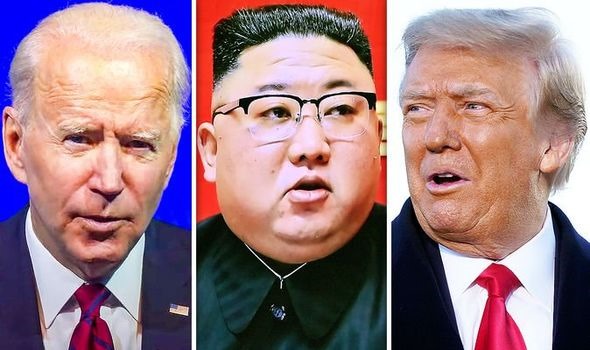
Biden calls North Korean leader a 'thug' but says he'd meet Kim if  denuclearization is agreed - Pacific - Stripes

This is the second part of a series for The National Interest on North Korea policy under the next president. Here is my first essay on Biden and North Korea.

I am of the school that says Trump’s outreach to North Korea was a great big nothingburger. More dovish analysts will tell you that there was a window there for a few years (2018-2019) to forge a deal. I don’t buy that, mostly because of Trump himself – his laziness, disinterest, unwillingness to prepare, and so on.

Instead I think Trump went into this solely for the symbolic imagery and a Nobel Peace Prize. Obama won a Nobel. Trump loathes Obama, so he had to get one too. I think it’s really as simple as that. That’s why there was no deal. The Trump team had not thought through the concessions which would be necessary to strike a deal. The North Koreans were going to ask for way more than just sanctions relief. Trump had nothing greater to offer – and bureaucratic resistance at home would have fought a serious concession like a US drawdown.

So my prediction for Trump and North Korea in a second Trump term is that he will do nothing. Trump has the pictures he wanted. He won’t get a Nobel, and he won’t fight the battles in Washington to offer concessions which NK might actually go for.

The full essay follows the jump:

American North Korea Policy under the Next President 1: Biden–Traditional Washington Hawkishness

North Korea lashes out at Joe Biden - CNN Video

This is a re-post of an essay I wrote for The National Interest recently. They’re running a good symposium on North Korea policy in the next presidential term: how would Trump and Biden differ? This was my submission on a possible Biden victory. My submission Trump is here.

Biden was the easier one to write. Biden is a pretty establishmentarian guy. He respects the foreign policy community. And as Obama’s vice president, we have his foreign policy thinking from that period too.

So it’s not too hard to predict that Biden will revert to a fairly traditional Washington hawkish approach – no more summits or public praising of Kim; working with allies; emphasizing sanctions enforcement and China. If this sounds really unimaginative – the same kind of old-hat you’ve heard from every hawkish North Korea analyst (including me) for decades – then you are right! It is the same old story, but that’s because our options on North Korea are terrible.

For all of Trump’s threats in 2017 and blandishments in 2018-19, he got nothing out of the North Koreans. Neither has SK President Moon Jae-In’s Sunshine Policy redux. So if it’s back to the future with Biden, I am not opposed to that.

The full essay follows the jump:

70th Anniversary of the Korean War: North Korea isn’t Going Anywhere; It’s Pretty Stable (Unfortunately)

abcd

This is a re-post of my contribution to The National Interest’s recent essay round-up on the 70th anniversary of the Korean War. (My essay here; the full symposium here.)

My argument, in brief, is that North Korea is actually quite stable. Hence the answer to the symposium question – would Korea be re-unified by 2025 – is a resounding ‘no.’ Here is a brief Twitter thread which summarizes my argument.

North Korea faces little pressure internally – Kim has consolidated power quite nicely; elites are quiescent; there’s never been a popular revolt – and externally – China is unwilling to cut NK off; nukes give NK deterrence against regime change. The sanctions are tough, but Northern elites have been pushing the costs of them onto their population for decades. They won’t bring down or substantially change the DRPK system.

So we are stuck. We can try to negotiate, and we should, but the last few years’ flailing shows how hard that is. The stalemate is quite persistent.

The full essay follows the jump:

Continue reading

The Floyd Protests: The South Korean Police are Far Less Belligerent than US Departments

upload.wikimedia.org/wikipedia/commons/d/d2/Sea...

This is a local repost of an essay I wrote for The National Interest. Like everyone else, watching the brutality of the US police in the last few weeks has been genuinely shocking. So this essay discusses how a police force with a reputation for brutality during a previous dictatorship came a long way.

This is based on this original tweet thread.

The short version is that the South Korean police haven’t gone through the militarization the US police has. And South Korean police don’t face a heavily armed citizenry, so they don’t need to engage in an arms race against their own people. The result is a disarmed, de-escalatory police culture, which, as an American accustomed to the stormtrooper look and pose of US cops, I find just fantastic. Interactions with the police here are far less fraught and intimidating.

The full essay follows the jump:

A Quick 5-Point Summary of My Thinking on Corona in South Korea, Plus Links

Image result for corona

There has been way too much sensationalism about corona, so firstly, go wash your hands, drink a beer, and relax.

I was traveling for the holidays for awhile, so this is my first blog-post in awhile. Sorry.

My basic take on corona in South Korea is:

a) It is not a national catastrophe, and the foreign media has been too sensationalistic (CNN particularly). Yes, it is uncomfortable and disruptive, but it is not bringing down the state, creating panic on the streets, an apocalypse scenario like you’ve seen in zombie movies, and so on.

b) The big retrospective error will be understood as the SK president’s decision not to ban Chinese travelers. In fact, Moon Jae In still has not done that, which I find totally inexplicable beyond obvious political pressure from China not to do it

c) The disease’s spread is due in part to SK’s basic liberalism. The liberal state cannot coerce people to stay in their homes, take intrusive physical exams, throw them into camps, and so on (barring some really extreme national emergency which corona is not yet).

d) The South Koreans are actually doing a pretty admirable job in dealing with this. The population is broadly complying, and voluntarily so, with the government’s recommendations. There is no rioting, panic-buying, xenophobic explosions, and so on. As an American who was raised on the Reaganite idea that the government can’t do anything right, it is pretty damn impressive to see the deep capacity of the South Korean state and the cooperativeness of South Korean society once fully mobilized. I really doubt Americans will respond with the calm and discipline you see here.

e) The real Korean corona threat is an outbreak in North Korea. The government there is an incompetent mess when it comes to social services, and medicine is primitive for most of the country. So you know what Pyongyang will do with infected people – throw them into concentration camps to die with almost no assistance. It will be a tragedy which none of us will see.

Here is my recent writing:

1. What’s the Corona Outbreak in South Korea Like, update 1

2. What’s the Corona Outbreak in South Korea Like, update 2

3. What the US Should Learn from South Korea’s Experience with Corona

4. Corona in North Korea

5. South Korea’s China-Corona Dilemma

6. South Korea can’t just Lock Up Corona Infectees

Trump and Moon are the most Dovish Presidents Ever on N Korea, and Kim will Still Give Them Nothing

This is a repost of an essay I wrote earlier this month for The National Interest. My argument is that Kim Jong Un is passing up his best chance for a deal for years, maybe decades, to come. Both Moon and Trump are extremely unusual, and favorable, counterparties for the North.

Most South Korean and US presidents have been either hawkish or very hawkish on North. Doves haven been rare – two SK presidents between 1998 and 2008. But neither of them ever went as far or talked as détente-ish as Moon does. Similarly, Trump is a huge outlier for US presidents on North Korea. He has made a far greater and more personal outreach effort than ever before.

And that these two dovish presidencies currently overlap is unique. This is a fantastic alignment for North Korea and almost certainly won’t last. If Pyongyang really wants a deal, this is the time to go for it.

Instead, they have played Trump for a fool – getting the legitimating photo-ops with POTUS while giving up nothing – and been surprisingly cold toward Moon’s repeated outreach. As so often, it’s their way or no way at all.

Expect hawks to cite this behavior in a few years to justify a much tougher line on NK. The missed opportunity between 2018 and 2020 will be seen on the right and center as proof that NK doesn’t want a deal, even under very favorable circumstances.

The full essay follows the jump:

Continue reading

Failing North Korea Talks Once Again Suggest Starting Small

Image result for north korea talks sweden

This is re-post of an essay I wrote for The National Interest a few weeks ago. The argument is one I have made repeatedly – that big-bang, all-or-nothing deals with North Korea are unlikely – because of low trust on both sides – and they represent far too large a leap to take given North Korean cheating in the past. We should scale back our efforts to smaller, cumulative steps which are actually doable. Think where would be now if we had done this for the last 18 months instead of gambling again and again on a huge breakthrough while not making any actual progress.

The problem is that the US and South Korean presidents both want a big-bang deal for domestic political reasons unrelated to the substance of denuclearization talks with the North. Trump wants a Nobel Peace Prize to stave off impeachment and get himself re-elected. He will sign anything because he doesn’t actually care about the deal’s contents. Also, and perhaps as important, Trump is lazy. He doesn’t want to negotiate in depth and detail with NK because he doesn’t know enough to do that and doesn’t want to learn.

SK President Moon wants a big-bang deal because he has pinned his whole presidency to détente with North Korea. All his domestic policies are contentious and are being overwhelmed by the North Korea issue which is absorbing all Moon’s time and energy. NK has a way of overwhelming SK presidents’ time in office, and Moon has worsened that normal time-suck by jumping in with both feet (and getting nothing).

In short, the North won’t go for a big, one-shot deal just because Moon and Trump are desperate at home. If we really want progress, we need to start with small, manageable, transparent swaps. These should involve a limited series of steps on both sides over a limited period of time. This would make post-hoc evaluation easier: after such a swap, we could do an after-action analysis and decide what the next swap should be. With each step, we could enlarge cooperation, building organically and credibly on previous steps. Needless to say, this will take a long time. But it is far more likely to actually work than hoping that NK will suddenly – after 50 years developing nukes – agree to trade them away. They won’t. That should be pretty obvious at this point.

The full essay follows the jump:

Trump’s Impeachment is Good for US Foreign Policy

RTX74MJ5-1024x683

This essay is a local re-post of my essay for the Lowy Institute for this month.

In brief, I argue that Trump, for all his bluster and chaos, has not actually moved the US foreign policy consensus that much. So if he is impeached, we’ll likely get a ‘snap-back’ to more traditional liberal internationalist positions. That would broadly be a good thing, but for the over-interventionism of the traditional foreign policy community. Trump’s departure would mean the end of idiocy like undercutting the World Trade Organization or the Universal Postal Union, attacking US allies, throwing friends like the Kurds under the bus, and cozying up to dictators like Kim Jong Un.

Trump is too uninformed, impulsive, and erratic to represent any kind of meaningful critique of foreign policy liberalism. Some of his supporters try, but it’s most been in vain. There’s no coherent Trump Doctrine, just whatever suits his fancy or serves his political purposes at the time. Nor has Trump created an alternative foreign policy community to the current one. As POTUS, Trump is hugely influential in that community, but he’s leaving no lasting mark because he’s too incoherent and, well, dumb. So if he’s impeached, it’s back to what was, because there is no serious Trumpian alternative.

The full essay follows the jump:

Continue reading

Does Trump Want to Withdraw from South Korea if He’s Re-Elected?

download

This is a local re-post of an essay I wrote this month for The National Interest.

I keep hearing this idea on the lecture and conference circuit in East Asia – that Trump wants to withdraw from South Korea and a second term would open that possibility.

The big problems for Trump, if he really wants to do this, are 1) US bureaucratic resistance, and 2) his own laziness and incompetence. That is, much of official Washington would oppose a SK retrenchment. Just as it did Jimmy Carter’s late 1970s effort to withdraw from South Korea.

But Trump is POTUS in a highly presidentialized system. He might be able to win the battle Carter lost, but Trump would have to really work at it – get on the phone, have face-to-face confrontations with the military, use the bully pulpit against the pundit network who would oppose this. But Trump is so lazy, and so uncomfortable with personal confrontation – this is why he fires people over Twitter – that I doubt he has the focus to push this.

Curiously though, Trump might find a sort-of ally in SK President Moon Jae-In. The SK left has long had an ambiguous relationship with USFK as ‘neo-imperialists’ bullying the ROKG. I doubt Moon’s leftist coalition would push back much if Trump tried to do this.

The full essay is after the jump:

Trump’s August was so Outlandish and Awful that He is Unfit to Remain President

Image result for backdraft burn it all

This is a local re-post of my monthly essay for the Lowy Institute for September.

In brief, I argue that Trump crossed a rubicon in August. He is now clearly unfit to be president. His behavior in August was so unhinged and inappropriate, that a 25th Amendment removal is now warranted. A white collar professional in any similar position of institutional authority – at a bank, school, hospital, military or government agency, etc. – would be removed for Trump’s August meltdown. So should Trump.

This will not happen of course. Republicans in Trump’s cabinet and in Congress clearly know he is unfit. Leaks like Rex Tillerson’s “he’s a f* moron” are common. But Trump voters’ bond to Trump is akin to a personality cult and they actually seem to approve of the chaos he has unleashed. So Washington Republicans won’t act. But still it is worth noting that they should. And why Trump voters have endorsed ‘burn it all’ is just beyond me. An ideological preference for Trump – however toxic and racist – is at least understandable. But what is the value is simply wrecking American governance?

So not only should the president probably be impeached for the obstruction findings of the Mueller Report, he should also be removed via the 25th Amendment for psychological unfitness. Never thought I’d that sentence. Wow.

The full essay follows the jump.