5 Good Things about Korea you should be Thankful for this Thanksgiving


As the great intern-chaser himself once said, ‘I feel your pain.’ One of the things I also miss most about living in Korea is the American holiday season, October – December. There’s a nice feeling of relaxation at the end of a long year, with lots of nice parties, holiday movies and music, culminating in Christmas which was absolutely the center of my life-calendar until maybe high school. Luckily my wife puts up with my nostalgia and makes a huge turkey every year, and we have leftovers for weeks. Awesome. So in that spirit, here are several things you should be thankful here in Hangukistan even though you miss the holidays:

1. There’s very little street crime.

Maybe I say this, because I am an American. But the difference between here and the US is amazing, i.e., fantastic. I remember growing up in the eastern suburbs of Cleveland, and adults telling us explicitly to fill up the gas tank of the car when driving through the city so we wouldn’t have to stop. It was that dangerous. But not here. God, it’s wonderful. Wanna walk home alone, drunk, at 3 am in the middle of the city? It’s perfectly safe.

Five Election-Explaining Clichés I really don’t want to hear this Tuesday

imagesCA14TN02
On Interstate 71, south of Columbus; Ohio’s most famous sign

So it’s election time, which means CNN, etc. will be filled with pundits with only the vaguest credentials – never any PhDs Sad smile – telling you why the outcome inevitably had to be such-and-such. (Retrodiction is so insufferably smug.) And they’ll explain it as if these tired clichés are real insights and not the same flim-flam they pedal every November.

So let me predict the future: here are the five worst clichés you’ll hear Tuesday – the lamest, most recycled, simplistic, and least analytically useful (because they’re so flexible they can explain almost any outcome).

Save yourself hours of Donna Brazile and David Gergen right now; just roll these out at Thanksgiving dinner to impress the relatives:

1. Ohio, or the white, blue-collar voter theory of everything

Every four years the media runs the same easy, generic storyline about my state (Economist 2004, 2008, 2012; FT) that goes something like this: ‘these grizzled veterans of America’s economic dislocation cleave to their guns and religion but increasingly live in suburbs and see their kids work in tech plants outside Columbus or Dayton. The large urban populations of Cleveland and Cincinnati are balanced by the church-going rural voters in the god’s country of southeastern Appalachia…’ Yawn. And it goes on like that for pages. Most of these articles make sure to cite the above picture. And yes, that sign is for real; I’ve seen it. It’s on the same road that leads to the Creation Museum (no joke either – I’ve been there), but thankfully that’s over the river in Kentucky. I guess they go to the dentist even less often than we do.

The thing is, we get all this attention for 3-4 months before every election – but then nothing afterwards. So how much can they can take us seriously as a swing state? In 2004, Rove drove up GOP turnout with the Defense of Marriage Act ballot issue and terrorism. In 2008, Clinton and Obama told us they were going to amend NAFTA and reduce illegal immigration to save our jobs. This year, Romney and Obama promise to defend us against China. If you’re keeping score, that means there should be no homosexual Mexican terrorists driving NAFTA-certified trucks on Chinese tires around Ohio. Ah yes, Ohio, that clichéd, right-wing blue-collar paradise!

Continue reading

3rd Presidential Debate, Foreigner Version: If you’re not an American, you’re Mentally Ill or something

Warning! The lyrics are explicit – but the movie is hysterical


Did anyone else find the third presidential debate just appallingly narcissistic and self-congratulatory? Good lord. Good thing America is around to show you bubble-headed foreigners the way to freedom. I could run through all the offensive, ‘America-is-tasked-with-upholding-the-mantle-of-liberty’ patronizing condescension, but why bother? (Nexon does a nice job here.) I told my students to watch it, and in retrospect, maybe I shouldn’t have. It was so embarrassing, and in class this week I kept trying to explain why we talk down to the rest of the world like this while my students rolled their eyes in disgust.

I keep saying this – running around the world telling people how exceptional and bound-to-lead we are is a great way to alienate the planet and convince them of exactly the opposite – to not to follow us. We’d have a much easier time with the world if we could back off the blustery, Fox News nationalism and actually speak maturely. But Americans couldn’t give a damn about the rest of the world, no matter how much we posture about our world historic role to lead it. Our ODA totals are disgrace for a coutnry as wealthy as we are. We don’t learn languages much. The only time we worry about casualties in the war on terror is when they are own; our clear disinterest for all the collateral damage we have done since 9/11 speak volumes to the rest of the planet.

So instead, here is the debate foreigners heard:

Continue reading

Pop Music Brings a Lot More Readers than Social Science: Follow-up on ‘Kangnam Style’

Korea_Seokguram_Buddha

Now THAT is Korean art – the Seokguram Buddha; I’ve been to see it 3 times

The Internet has slapped down my arrogance. I told myself I wouldn’t write about k-pop, but that post on ‘Kangnam Style’ drove so much traffic, even the Daily Beast, to my site and twitter, that here is a response to all the comments. It’s kinda of depressing how my posts on Asian political economy or what-not get little traffic and a lot of yawns, but K-pop brings huge numbers. It’s like those Facebook posts on something you find interesting that no one bothers to look at, but put up a pic of yourself blotto on a beach, and everyone ‘likes’ it.

1. I am not sure K-pop is really ‘family-friendly,’ as one of my commenters argued. I hadn’t really thought about that, but I guess it’s nice to have light, fluffy lyrics instead of gangster rap or Robert Plant screaming that he’s ‘your backdoor man.’ But if you watch the performances and look at the appearance of these ‘bands,’ it is highly sexualized and teasing – and that is obviously far more important the music itself, which just comes from a music machine. These band members can’t play instruments, but they do look like sex symbols and swing around on poles wearing leather boots like strippers. (*sigh* you see why I wanted to avoid writing about k-pop?) Is that what you want the kids watching? What kind of signal does that send?

Continue reading

‘Kangnam Style’s Irony is Missed b/c of the Publicity Wave

yeah, it’s pretty hysterical, especially when you get the underlying social critique

I try to avoid K-pop on this website, because I find far too many foreigner websites in Korea focus on the silliest, shallowest elements of what is around us – probably because the language is so hard, and so Korean pop culture is the easiest for us to understand. But I keep getting asked, and it is huge hit, so here’s a sociological overreading:

1. Thank god ‘Kangnam Style’ shows a level of irony, self-awareness, humor, and creativity that K-pop normally lacks. That alone is enough to value it, given how shallow, idiotic, and pre-packaged most Korean pop is. K-pop is wasteland IMO. Try this or this, and see how long you before you cringe from the sheer mawkish inanity of it all. Then read this and this (that second one is a little raw), if you still don’t get it. And to their credit, I find most Koreans will admit that K-pop is fairly embarassing non-art if you push them about it. It should also be noted that traditional Korean music is often superb, rich, and authentic; we listen to it at home.

Anyway, none of these carbon-copy ‘k-bands’ like the Wonder Girls or Girls Generation or whatever would ever get considered for the Rock and Roll Hall of Fame (I’m from Cleveland, so I thought I’d add that little plug). K-pop slavishly copies from the boy-band/girl-band model that began in the US 20 years ago and crossed-over to Japan. The hair, the synched dance-moves, the gratingly cutesy presentations, the insipid teen love-story lyrics, the spontaneity-crushing over-choreography – it’s awful, corporate faux-art. None of them can play an instrument; they are recruited solely because they’re hot, and the music-machine does the rest. Bleh…

Mix Munedo and the Kardashians in the Korean language, and you get K-pop.  Korea desperately, desperately needs to de-MTV-ize/de-idol-ize its music scene and get some raging, slovenly, wacked-out desperado-rockers like Meatloaf or Janis Joplin who care about music instead of bling. Instead, it’s hideous, so-repetitive-I-can’t-even-tell-the-difference-anymore synth-pop even Duran Duran would be embarrassed to release, all controlled by corporate hacks with no interest in deviation and who are persistently rumored to sexually exploit their young charges. Like almost everything else in the Korean economy, the music industry desperately needs deconcentration and innovation.

Continue reading

Guest Post: Dave Kang – “Confucian North Korea”

I am on break for the summer, but I am happy to open this space to a good friend and excellent scholar on international relations theory and Asia – David C. Kang, a professor of international relations and business at the University of Southern California and director of its Korean Studies Institute. Regular readers will know that I cite Dave’s stuff a lot. If you aren’t reading him, you should be: here is his Amazon page.

Confucian North Korea

clip_image002

Figure 1. Korean Worker’s Party symbol

It is easy to caricature North Korea as a “bizarre” “land of no smiles” full of brainwashed robots. In the past few years, North Korea has become somewhat prominent in popular culture either as a salacious joke or a freak show of a country. (And yes, I refuse to give you too many links to articles I think are misinformed caricatures). The trope of North Korea as a nation of automatons, grimly marching through each day is very powerful.

It is absolutely true that the regime itself is horrific and reprehensible, and engages in systematic human rights abuses. Indeed, the people of North Korea are the most direct victims of the ruling regime. I am totally for regime change, or a regime that modifies its ways and introduces economic and social reforms that improve the lives of its people. However, wishful thinking has gotten us nowhere, and rather than simply sit back and laugh at North Korea or call it names, perhaps we might explore why the regime has survived as long as it has.

In addition to extensive repression and selective bribery, what is widely overlooked is that the North Korean dictatorship is built on deeply traditional Korean cultural and Confucian roots. In fact, the best way to understand both the regime and its people is to remember that North Koreans are Koreans more than anything else. Far more insightful than any other description such as “communist monarchy,” North Korea is identifiably Korean, and there is a coherent internal logic in much of its way of life. As a result, the regime is more stable and enduring than commonly thought. (The arguments I make here have been made much more cogently by Bruce Cumings and Suk-Young Kim, among others).

Take a look at picture at the top of this page, which is a photo of the official emblem of the Korean Worker’s Party. Although the hammer and sickle are easily recognizable as signs of all Communist Parties from the Soviets to the Chinese Communist Party and others (Figure 2),

Figure 2. Flag of the Chinese Communist Party

clip_image004

North Korea is unique in that there are actually three symbols. What is that middle symbol in Figure 1?

1. Candle?

No. Wrong. C-

2. Paintbrush?

Warmer. What kind of paintbrush?

3. A calligraphy brush they used in olden times to write Chinese characters?

Yes!

It is a Confucian scholar’s brush – perhaps the most direct and vivid symbol of traditional learning, culture, and scholar-elite rule in Korea since the 9th century Silla dynasty first introduced an examination system for selecting government officials.

This is pretty remarkable. The Communist Party everywhere has stood for an utter rejection of the past and tradition as feudal and oppressive, and the basic message from Stalin to Mao has been to destroy the past and totally rebuild society. Yet the North Korean regime, rather than attempting to erase the past, has grafted itself onto traditional Korean traits, and reached back to some of the most traditional iconography possible: a hierarchic and elitist symbol of education, with all the other Confucian connotations that go with it: a ruler who embodies both the country and the “mandate of heaven,” an emphasis on centralized political control, and a clear set of hierarchical relationships that create harmony.

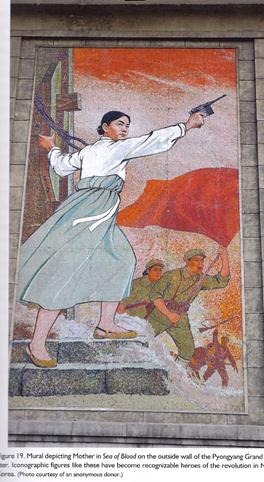
What about the role of women? Figure 3 is prominently displayed in Pyongyang, and depicts a generic and heroic “Mother,” fighting against the Japanese.

Figure 3. “Mother” in Sea of Blood

clip_image006

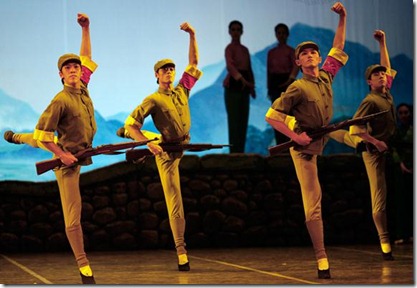
What is interesting about that painting? As with the KWP symbol, it might strike the viewer as somewhat odd that she is wearing traditional Korean women’s dress (“hanbok,”or “choseonot as they call it in North Korea). Compare this with the standard depictions of revolutionary Communist women from China or the Soviet Union – they are all in drab “Mao jackets” that reject and depart from any traditional and feudalistic tendencies (Figure 4).

Figure 4. Chinese revolutionary women
clip_image008

But in North Korea women have been presented with an image that emphasizes their Koreanness – a traditional dress that is far more common in Pyongyang and North Korea than in South Korea. The regime explicitly is telling North Korean women that they are a link to a way of life that is Korean, and the way they dress is the most obvious manifestation of that link.

What about the “cult of personality” and the rise of the grandson? Surely that’s bizarre, right? Not really, in a traditional Korean context. The Confucian emphasis on family places the father as the head of the family. Kim Il-Sung simply placed himself as father of the country, and grafted an authoritarian state onto the existing social and cultural roots. Leadership by a powerful family makes sense in a Korean context. Korea is a clannish country, and the family is the basic building block of social, political, and economic life.

The best way to understand the role of families is by comparison with contemporary South Korea. The foundation of Korean life in both North and South is the clan. For example, most major business conglomerates are family-run, and often the grandson of the founder is now in charge. This is the case even of the biggest companies in Korea. In addition, it may appear to outsiders that Korea is a country with only three last names (Kim, Park, and Lee, hahaha). But all those Kims are actually divided up into dozens of different clans, each connected to a hometown, each with extensive family lineage records, and each vividly distinctive to other Koreans. Thus, there is Kimhae Kim, Seoul Kim, Kyongju Kim, etc. So powerful was the clannish nature of Korea that until 1998, members of the same clan could not legally marry, even if they were separated by tens of generations. Similarly, Kathy Moon has recently argued that the blather over Kim Jong-un’s marriage is mostly misguided: “For Koreans on both sides of the 38th parallel…Unless one is married (and with children), one is not fully an adult. In both Koreas and in dynastic cultures, those pieces are supposed to come in the same box, to be pieced together into a coherent puzzle.” Thus, within a Korean cultural context, multigenerational leadership in North Korea and family as the building block of society is common sense.

Why does this matter? Because the story the North Korean regime tells itself and its people is aimed at domestic audiences, not at international audiences. They are telling a story that — however warped and corrupted — resonates deeply and instinctively with Koreans: North Korean are the true Koreans, and are the only ones remaining true to the essence of being Korean. South Koreans have been corrupted and forgotten who they are. The Kim family is leading the fight against external oppressors such as Japan and America. If the people must endure some hardship in order to maintain a Korean way of life, that’s a small price to pay.

This is one reason I tend to think an Arab Spring or uprising is not likely. Questions of imminent demise overlook the fact that North Korean dictatorship has grafted itself onto deeply traditional Korean culture roots. As a result, the regime is much more stable than some may think. For some people of North Korea, conditions may become so horrific that they choose to try and leave. But far more remain, and they remain not because they are brainwashed and not only because of repression. Many stay because North Korea is their home, where they grew up, where their family and friends live, and it is what makes sense to them.


MBC brings Multicultural Panic to Korea

Xenophobia so sloppy and racist, Glenn Beck himself would blush…

I came late to this controversy, but it merits some quick comment given just how creepy the above vid is.

This ‘report’ was shown in primetime on Korea’s largest TV network, on a holiday when people would likely be home with family (and was then rebroadcast until the explosion of response halted it). While xenophobia is fairly common in the Korean media, this is so nasty – especially at this very late date in the long, tiresome ‘Korean women dating western men’ discussion – that it has gone viral in the expat blog world of Korea. It even got into the Wall Street Journal.

I rarely blog about this sort of thing. As an IR academic, domestic politics and sociology aren’t really my area, and I don’t really see myself as a ‘k-blogger’ or whatever. I don’t like blogging about identity politics in Korea, as I think it is prone to recycled stereotyping that tells us little. And I have broadly argued against our (foreigners) participation in the Korean multiculturalism debate, because it’s their country and they themselves need to decide what they want from us. It’s their choice.

But this is the nastiest race-baiting – primetime, slap-dash unprofessional, on a major network, for a general audience – I’ve seen in my time here. (Full disclosure: my wife is Korean). Casual racism is a widespread problem in Korea, as any foreigner living here can tell you. Wide-eyed kids shamelessly point at you like you are a martian; people stare at your body hair; grade and high schoolers giggle and smirk; the old ladies glare at you on the subway; average folks on their cell phones will pause their conversations to remark, ‘hey, a foreigner just walked by me!,’ as if it’s some kind of major event in their day (presumably they think I can’t understand that, or maybe they don’t care?). It’s all fairly fatiguing (read this for a good example), and that’s for white westerners. I can’t imagine being from Southeast Asia or an LDC here. In fact, Cambodian import brides have been so badly abused, the Cambodian government made it illegal for its citizens to marry Koreans. (This hugely embarrassing and deeply disturbing restriction was scarecely reported by the Korean media.) And when the Korean race hang-up gets wrapped into sex, it breeds genuinely disturbing levels of xenophobia, especially for an OECD/G-20 country that really ought to know better. Hence this vid.

Continue reading

7 things I don’t like @ being an Academic

dork

It’s grad school acceptance season, so here are a few thoughts if you are considering the PhD plunge. Try this genre also on the Duck of Minerva, where I also write. Enjoy your last summer to read as you choose, without following a peer reviewer or a syllabus. Such lost bliss… 

Generally speaking, yes, I like being an academic. I like ideas and reading. I like bloviating at length. The sun is my enemy, and exercise bores me. I would really like to be a good writer/researcher. Including grad school, I’ve been doing this now for 15 years, so clearly I could have switched. I am committed. But there are at least 7 things I didn’t see back in my 20s when I had romantic ideas that if I got a PhD, I’d be like Aristotle or John Stuart Mill – some great intellectual with real influence on, what a Straussnik once called to me, ‘the Conversation,’ which I took in my heady, pre-game theoretic youth to be this (swoon).

1. It’s lonely.

I didn’t really think about this one at all before going to grad school. In undergraduate and graduate coursework, you are always very busy and meeting lots of people. You live in a dorm or fun, near-campus housing, you have lots of classes, you hit the bars on the weekends, you go to department functions. Girlfriends/boyfriends come and go. So even if you didn’t like 9 of the 10 people you met, you were meeting so many, that you eventually carved out a circle and did fun stuff that kinda looked like the 20-something comedies you see on TV. But once you hit the dissertation, you are suddenly thrown back on your own, and you really re-connect, or try, with your family, because they’re the only ones who’ll put up with your stress. You spend way too much time at home, alone, in a room, staring hopelessly at a computer screen. You don’t really know what you’re doing, and your committee, while filled with good, smart people who are almost certainly your friends, can’t really do this for you, even though you try to push it off on them.

Continue reading

Oliver North Threat-Inflates for the next ‘Modern Warfare’: a new Low for the Military-Industrial-Entertainment Complex

Video Games as the Fear-Mongering Pop Adjunct of America’s post-9/11 ‘forever wars’


Even tea-partying righties should be pretty shocked at this shameless, exploitative (and wildly inaccurate) manipulation of Americans’ post-9/11 paranoia as a marketing gimmick. And you thought 24 was off the air. Well here’s the video game version, all designed to scare you s—less – for cash. When the Homeland Security Department terrified the country 10 years ago by telling us to buy ducktape and sheetwrap, at least they had public safety goals, however confusedly, in mind. But this pseudodocumentarian ‘they’re-everywhere!-no-one-is-safe!’ crap is just to shill some video game. Bleh.

And Oliver North?! Good lord – the guy violated the appropriations clause, the Logan Act, and who knows how much other statute, and should have been in jail next to Frank Colson. Yet this guy is credible for the (apparently) largest entertainment franchise in the world now? Wow. H/t to Kotaku: “What does this say, then, about the market for a game like Call of Duty? Does Activision really believe its core market is so full of gun-crazy, right-wing types that it feels entirely comfortable employing Oliver North as someone to help sell the game?”

Continue reading

The US will not ‘Pivot’ much to Asia (2): We don’t really care @ Asia

4478141208_8caeba59d9

That is my Asian pivot.

Here is part one, where I argued that there is no constituency in the US to support an Asian pivot besides the some business people.

2. Connected to the first point is that Americans don’t know much about Asia. Of course, it’s true Americans don’t know a lot about the world generally. We are a superpower, so we don’t have to know about others; others have to know about us. That’s why ‘they’ learn English, and we think Urdu is a country in the Sahara. We are geographically far away, so touring Europe or Asia is very expensive. We don’t (need to) speak foreign languages. But beyond that general ‘ugly American’ stuff, I think Americans are particularly ignorant about Asia. Asia is the most culturally different social space in the world from the US I can think of, with the possible exception of central Africa. Latin America, Europe, Oceania, and Russia are all in, or close enough to, Western Civilization that what we learned in high school civics classes can apply. They look like us (kind of); they eat like us, their languages are fairly similar (Indo-European roots); they dress like us; they worship like us. The tribal cultural gap (how others eat, dress, talk, worship, look, write, etc.) is not that wide .

Continue reading