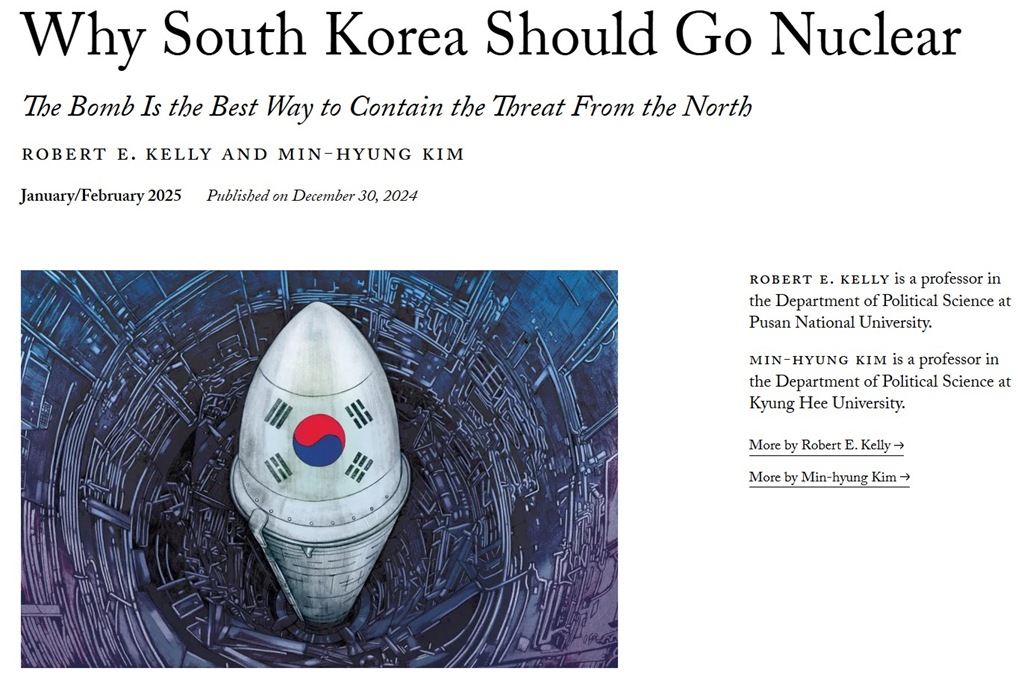
 This post is the original version of an article I published this month in Foreign Affairs on potential South Korean nuclearization with my friend Kim Min-Hyung. I think the editing made the essay more readable, but some topics I wanted to elaborate got edited out.
Specifically, US hesitation against fully and robustly supporting Ukraine against Russia – because of Russia’s nuclear threats – is a model for what will happen to South Korea in a second Korean war, especially when Trump is POTUS.
We have known for years that the Biden administration has repeatedly held back on aid, discouraged certain Ukrainian military actions, balked at giving certain weapons systems, and so on for fear of Russian nuclear ‘red lines.’ Here is yet another example from the last few days. Apparently, the Biden team got Russia out of an even bigger defeat around Kherson in 2022 for fear of a Russian nuclear response. Russia’s nuclear threats have worked well, and they aren’t even as credible as North Korea’s!
A lot people think the Russians are just bluffing, but the Biden team has been super cautious anyway. So in a Korean contingency, where NK nuclear threats are even more credible, our behavior in Ukraine suggests we will respond even more cautiously. Our Ukraine behavior strongly suggests we will slowroll aid to SK and try to avoid full involvement for fear of nuclear escalation.
NK nuclear escalation threats are more credible than Russia’s or China’s, because NK is far more vulnerable to collapse after just a single significant conventional defeat than they are. NK’s military is conventionally obsolete; NK lacks strategic depth; its economy is a shambles; its state is sclerotic and shallow. One big defeat at the DMZ, and it’s all over for NK and the Kims who will be lynched by their own people. Russia by contrast does not face regime collapse and an existential leadership crisis if it loses badly conventionally in Ukraine; nor does China face immediate implosion if it loses in a war over Taiwan. But NK and its ruling family do face immediate existential risk if they lose even one battle at the DMZ. So NK has to threaten nuclear use immediately, and it has to use those weapons if its bluff is called. It can’t issue vague, maybe-sorta threats like Putin has for the last 3 years.
So if Russian not-so-credible threat have successfully gotten the US and NATO to slow-roll aid to Ukraine, imagine how much more successful they will be in Korea where NK’s nuclear threats are far more credible because nuclear escalation is its only chance to survive?
If NK will go nuclear almost certainly, will the US risk nuclear strikes on US targets for a distant, medium-sized ally of mid-range importance to US national security? Probably not – because that also describes Ukraine. Like SK, Ukraine is an exposed, mid-sized ally of middling importance to US security under direct nuclear threat. In both cases, a victory by the US partner would be good, but its loss would not be a huge loss for the US either. It would be more important for regional locals. Specifically, SK’s defeat/destruction by NK (or China) is more important to Japan, India, and Australia than to the US, just as Ukraine’s is more important to Europe than to the US.
Now, you say that SK is a treaty ally of the US, but Ukraine is not. So the US will be willing to risk nuclear war for SK, but not for Ukraine. I find this fantastical thinking. US alliance commitments are credible in conventional scenarios in Korea, but would they really be in a contingency where NK would launch a nuclear weapon against Guam, Hawaii, or even CONUS? Are alliance commitments automatic in nuclear escalation scenarios? I doubt that. De Gaulle realized this point 65 years ago. Maybe Biden would act on the US alliance commitment to SK despite high nuclear risk, but Trump very obviously won’t. In fact, I doubt Trump would even fight conventionally for SK.
Then you object that SK is not a mid-sized partner like Ukraine which could be lost, but a major ally because we need it against China. This would be so if SKs wanted to come with us on great power competition with China. But they don’t, especially not the SK left which is about to take the presidency when impeached conservative president Yoon is removed in the next few months.
So if you don’t think the US is going to risk highly like nuclear escalation for you; and you face a frightening nuclear opponent who routinely threatens you with nuclear devastation; and your alliance patron is about to be governed by an irresponsible, autocrat-admiring con-man, what should you do?
If you think about potential SK nuclearization that way, it’s not too hard to figure out why SK opinion tilts towards nukes.
The original, pre-edited version of my essay follows the jump:
Continue reading →

 Russia is bogged down in a war it can’t win. A weaker-than-expected Ukrainian spring offensive does not change that. Russia’s still lacks a path to victory which remotely justifies the costs and isolation of the war, even if it manages to hang onto some Ukrainian territory.
 This is a re-post of an essay I wrote for


 Robert E Kelly