A Defense of Obama’s Limited Commitment to the Libyan Campaign

libyawar6

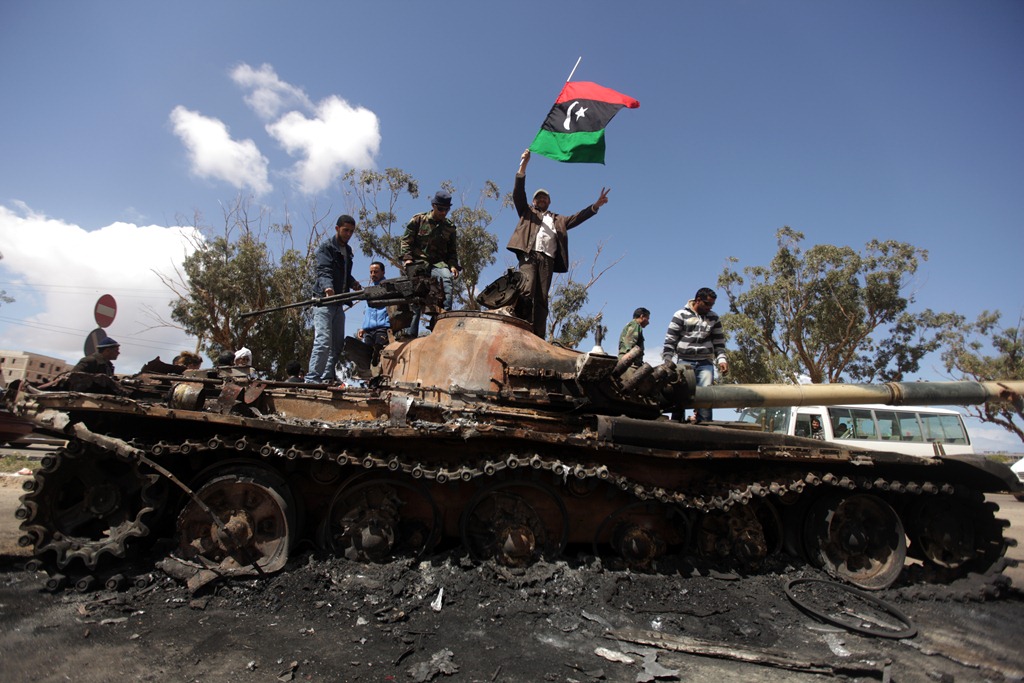
The debate over the extent of US involvement in Libya is heating up, and a predictable cluster of analysts are claiming that we a backing into serious endeavor with no clear strategy, with confused ethics, raising process above substance, etc. I say predictable, because it looks increasingly like the ‘usual suspects‘ of liberal internationalist hawks and neo-cons who helped gin up the war on terror (GWoT) that by almost any benchmark has gone pretty badly astray. The gist of seems to be that Obama is a ditherer so we are drifting through this. Republicans of course will hammer Obama for this.

This strikes me as somewhat unfair (even though all the links above are worth your time and most of the points are fair). So here is a case for the limited, we’re-not-quite-sure-what-we-are-doing, we-hope-the-allies-and-Arabs-will-do-more intervention we just started. (For an R2P defense, try this.)


1. The narrowing time window in Libya forced the West’s hand before a serious strategic discussion could be fleshed out. Ideally, we would have had something like Obama’s serious, months-long deliberation on Afghanistan in 2009. All the big voices could be heard – western militaries and parliaments especially. A public opinion debate in western media could have generated at least some basic consensus among elites and publics both within and across the coalition’s member states. But war of course does not wait for strategists and planners to hammer out all the details, or for long public debates. Just about any basic strategy course will tell you how much unpredictability conflict generates and how actors frequently have to ad-lib and flim-flam their way through these sorts of engagements. New events pop up out of nowhere (Arab Spring); wholly unforeseen consequences suddenly loom (like a Libyan bloodbath); previous ‘certainties’ evaporate as new actors, atrocities, resources, etc. enter the picture (who are the Libyan rebels anyway?). Sometimes, the pressure of time simply cannot be avoided. I argued last week that if Libya were to evolve into a Bosnian-style bloodbath, the West would have to intervene, and fairly quickly. Inevitably that means that the operation will be organized on the fly and be fairly sloppy. Yet the alternative was so much worse. So yes, this thing is a mess, but it’s not too bad so far – let’s be fair – and the alternative of Gadhafi’s Gestapo tactics in eastern Libya is downright chilling. To my mind, western leaders deserve genuine congratulations at this point for pulling together some kind of reasonably coordinated campaign that no one really wanted very fast that has achieved the stated goals of the UN Security Council resolution. That’s not bad at all actually…


2. The US use of force is increasingly de-coupled from anything but presidential decision, but constitutionally, democracies really needed to wait and ‘dither’ a little bit. Andrew Sullivan has made this point very well. The case for ‘dithering’ is actually a good one, because the democracies really should not change into war without some public debate and consultation. Anyone whose studied the evolution of US foreign policy since WWII knows the (and should worry about) the increasing presidentialization of US war-making authority. The US has not declared war since WWII. The US has fought Korea, Vietnam, Iraq 1 and 2, and Afghanistan without formal constitutional authority from Congress (Article 1, Section 8 of the US Constitution). No, this does not mean the US president is becoming a military dictator (read Chalmers Johnson if you think so), but it is unnerving and increasingly undemocratic. So I think Obama did the right thing, by American law, in waiting for a least little while so that their could be some debate in the Congress and US public on this. This would apply to France and Britain as well.


3. The US is overstretched. This should be so strikingly obvious to everyone – except neo-cons I suppose – that is a very good reason to dither and otherwise look for a light, low impact intervention before lots of grandiose rhetoric about Clausewitz and such. This is premature it seems to me. This is not yet a major national mobilization in the West for a huge war. Maybe we can move through this with minimal intervention. We don’t know, but why isn’t it worth a try? If have to really ramp up to pursue a Clausewitzian victory (win big through a massive military strike at the heart of the enemy and get the awful, unpredictable business of war over as fast as possible), we can. But remember that Clausewitz was writing for interstate war traditionally defined. He didn’t think too much about insurgencies or foreign interventions for limited political gains in a revolutionary situation. Clearly invading Libya (‘boots on the ground’) would be a major new commitment when we really can’t afford that, and the likelihood it would backfire is huge. In that sort of environment, bombing to stop atrocities is not such a bad compromise.


4. Kosovo is not such a bad model after all. In 1999, NATO bombed the Serbs into (something like) submission in Kosovo. We helped the Kosovo Liberation Army even the odds, and today Kosovo is not that bad. It’s not great, but at least there is no ethnic cleansing. The conflict had (some) multilateral legitimacy, and while it angered Russia, it did not provoke a new Cold War which a heavier footprint might have. This was organized by most under-appreciated general in recent US history – Wesley Clark (probably because he is a Democrat whom the GOP cannot lionize). If you haven’t read his book on his work in the Balkans, you should. It is the likely model for Libya, even if the GOP thinks it is wimpy, violates Clausewitzian rules, and cedes the initiative to the French and Arabs.


5. Iraq really should give everyone pause and does, very obviously, argue for caution and last-resort thinking, at least for now. Anyone even passably familiar with the US budget should know that US unipolarity is on the ropes. No, the US should not suffer from an Iraq or Vietnam syndrome. But the GWoT has become such a mess, that does anyone really think that US public opinion (not interventionist elites, mind you) want some huge commitment? Yes, Americans and the West want to stop horrific atrocities; the ‘CNN effect’ is real, and we should try where we can (Rwanda should have taught us that). But I can’t imagine that the US voter, who really wants to leave Afghanistan and Iraq, wants to hear about Clausewitz in Libya. We have to balance our desire to help with American exhaustion and reticence after a decade of war. Hence, Obama’s middling approach is actually a fair response to contradictory pressures, it seems to me.


If you consider all these factors – to go in early and hard against Gadhafi (when it would have helped the rebels most, and because America ‘leads’ not ‘dithers’) vs. to stay out altogether (because we have no idea what we are doing and have just thrown this together at the last minute) – I think Obama, Clinton, Sarkozy, and Cameron actually found a pretty good middle course that can basically be summarized as ‘bombing for human rights.’ Yes, that is confused, messy, hardly a rousing call to arms and patriotism, dithering, possibly oxymoronic, and so on. But it balances well all the contradictory pressures listed above, which must be awfully hard this late in the history of the GWoT and Arab Spring. So before we tear them apart on the op-ed pages, let’s at least give them a chance. We will continue to debate this as war goes on; we can change course if we really need to because of new circumstances; and the West (and even the Arab League!) should be proud of itself for having prevented an almost certain bloodbath. That seems like a pretty good record so far.


2010 Asia Predictions: How did I do?

new-year-image


Last year in January, I made  some predictions on Asian security. It is always useful to look back at how one did. I did ok, but one might criticize me  that I predicted too many things would not happen. That predicts the lack of change, which is easier than predicting proactive change. That is true.

But prediction is one of the great goals of the social sciences. Indeed it is our hardest chore, and no matter how much we read, data we collect, or theories we propound, we still don’t seem to do much better than the ‘random walk’ theory. Depressing, but nonetheless worth the effort. So here is a quick review of my record. (For a nice collection of the worst world politics predictions from 2010, try here; thankfully none of mine are as eye-rollingly bad as them.) Here is a nice run-down from CFR on the big (East) Asia events of 2010. Note the differences from mine below.

My review of my 2010 Korea predictions will go up on Thursday. Here are my 2010 Asia predictions in retrospect:

1. There will be some kind of power-sharing deal in Iran before the end of the year.

X!

I really blew this one. My sense 12 months ago was that Iran was really slipping toward some sort of genuinely systemic crisis. Not primarily because of the street demonstrations. Those are relatively easy for dictatorships to contain with nasty head-crackings. In the movies (Avatar), the people overthrow the powerful, but in reality it is usually other powerful who overthrow the powerful. That is, elites usually depose other elites in dictatorships. And that is what I thought we saw in late 2009: the emergence of real splits inside the regime’s elites. Particularly, I thought that the clerics’ growing hesitation on Ahmadinejad’s policy of confrontation with the West might lead to a real cleavage requiring some kind of accommodation. Note that I did not predict a revolution or major change in the regime’s Islamist character. No one really expected that. But I did think that Ahmadinejad needed the clerics for legitimacy in what is still an overtly theocratic state. Looking back, I am fairly impressed at his ability to maneuver these domestic difficult waters, while nonetheless continuing to bluff the West. Yet perhaps the external bluff is the key to that internal success. Perhaps the nuke program insulates him against clerical unhappiness. He can appeal to a Persian populist nationalism with the nuclear issue, which allows him to ideologically outflank the clerics. If this is so, then Ahmadinejad is more enduring then we anticipate.

2. Israel will not bomb Iran.

✔

This is a negative prediction, so it was a little easier. But still, given how much noise Netanyahu and the Israel lobby in the US make on this issue, including regular veiled threats to take matters into their own hands, I do think this deserves some credit. Also, the Wikileaks revelations that Sunni Arab states might look that other way on a bombing add further weight to my prediction’s riskiness. Netanyahu is playing a tough negotiating game with the US, but this one was probably a bridge too far, although I bet the righties in his cabinet are unhappy. Still, Israel really needs the US, and that need will deepen the more it becomes apparent that the Israeli right is the primary force blocking an Israeli accommodation with the rest of the Middle East. And without US approval, unlikely on Obama’s watch, I still think the cost-benefit calculus tilts against an Israeli strike. That said, a strike is more likely this year, because the Iranian nuclear program keeps rolling along and Iran (point 1 above) has not softened.

3. Japan will disappoint everyone in Asia by doing more of the same – more moral confusion over WWII guilt and wasteful government spending that does nothing meaningful to reverse its decline.

✔

This is another negative prediction, and seems like an easy one too, because it just predicts more of the same from a country that has been doing that for 20 years. But placed the context of the DPJ’s (pseudo-)revolutionary election victory of late 2009, it still seemed like a mildly risky prediction at the time. Recall that the DPJ came in saying it would change so much – fixing the ever-sliding economy, improving Japan’s relations with its neighbors, edging away from the US, etc. All that turned out for naught. Some of this was because China seemed to flip out in 2010 (a big positive prediction I really missed – X!). China’s 2010 behavior pushed Japan back toward the US in a way the DPJ probably wanted to avoid. But on the other issues, Japan still strikes me as stuck in a terrible historical funk. It can’t seem to get beyond the fact that the glory days of its developmentalist economy (1960s-80s) are over, and that more Asian-style state intervention now just means more debt. Nor can it seem to figure out, despite the DPJ talk, that the rest of Asia is genuinely freaked out by Japan and pays attention to every change in Japan’s defense policy or utterance by defense officials. Worse, every time some disgruntled righty in Japan say the old empire wasn’t so bad after all, the neighbors go into paroxysms on incipient Japanese re-militarization. My own experience with Japanese students tells me that Japanese are just blind to this (although Japanese academics do seem aware). So my sense was that for all the DPJ talk, there was no real popular interest in a Willy Brandt-style ostpolitik on the history issues. Nor does that seem to have changed in the last year.

4. North Korea won’t change at all.

X! – It got worse!

Who would have thought that the worst state in the world could plumb the depths yet further? Somehow the loopy Corleones of Korea – the Kim family gangster-state – became ever more unhinged and dangerous. My original prediction was aimed at those who thought that Kim Jong Il’s trips to China and China’s growing ‘investment’ in NK might somehow hail a Chinese-style liberalization, at least of the economy a little. To be fair, no one expected NK to morph into a ‘normal,’ somewhat well-behaved dictatorship like Syria or Burma. But there was a mild hope that NK, finally, under the weight of economic collapse and the pressure to show results for the 2010 65th anniversary of the state’s founding, might open a little. I thought that was far-fetched, so in that sense, my prediction was right. But more importantly, I missed that NK would actually go the other way. Instead of possible better behavior, NK went overboard – provoking three major crisis – the Cheonan, the new uranium plant, and Yeonpyeong– in just 7 months. Wow. Wth is going up on there?!

5. The US drawdown from Iraq will be softened, hedged and qualified to be a lot smaller than Obama seemed to promise.

✔/X

This one seems mixed but broadly accurate. It was a gutsier positive prediction, but the evidence is not definitive. I was genuinely surprised when the last brigades rolled out, but then, there are still 50k US troops in Iraq (more than in Korea or Japan, btw). Now that Iraq is off the front pages, and with Obama’s speech that it is all over, no one pays attention much. But we are still running around performing what really should be called combat operations, and Americans are still dying. And in Afghanistan, the Obama people are now openly moving the goal posts from 2011 to 2014 now. While I didn’t predict that, it does fit into my general sense that Obama can’t really end the GWoT quickly as he hinted during the campaign. Instead, it seems likely that it will slowly splutter out.

The North Korean Shelling

Here is the frightening video if you haven’t seen it yet…


So much for the quiet week on blogging because of Thanksgiving. Yesterday NK started shelling Yeonpyeong Island in the Yellow Sea (what Koreans call the West Sea). It’s all over the news of course, but here is a good place to start, particularly on the possibility of a hawkish SK response. Here is a write-up from a more left-leaning Korean newspaper. For a good IR theory take on this, try here. I spoke yesterday on the BBC World Service “Newshour” program about this. Here is the link. My comments begin at 10:10 and conclude at 17:45 (this is ‘chapter 1’ of the listed choices). Here is the podcast (please refer to the download entitled “North and South Korea Exchange Fire 23 Nov 10”).

Here are my thoughts (fuller than my BBC remarks). All the links below connect to my previous posts on NK. Please see them for greater detail which this post summarizes:

1. I am surprised that this has evoked so much concern given that the Cheonan cruiser sinking in March was worse (46 deaths then vs 3 this time). The Cheonan sinking very clearly would entail many deaths, whereas yesterday’s artillery strike was less certain to do that. To my mind, NK is more culpable in the spring than this time, but the rhetoric is more belligerent from the ROKG this time than last. Even though fewer died, this might be explained by a ‘straw that breaks the camel’s back’ logic: SK has just had a enough of these sorts of out-of-the-blue strikes (point 3 below), and this time they are going to hit back regardless of the costs. This incident is also somewhat different from past provocations, because it openly is targeting South land territory, and the North Koreans knew that. The other Yellow Sea skirmishes were on the water. Also, there were civilians on the island – and only one firetruck – so it looks perhaps more egregious than attacking a warship. (Although the Cheonan sinking was wholly undeclared and the Yellow Sea islands have been disputed for a long time, so I still find the greater outrage this time confusing.)

2. NK is almost certainly miffed and unhappy at all the global press SK got for the G-20. This is a way to hit back and play the spoiler of SK’s afterglow. NK did something similar in in 1987, when it blew up KAL 858 in order to discourage SK from holding the 1988 Olympics. In both cases, SK regarded the event as a global coming out. In 1998, the Olympics showed that a previously poor underdeveloped country torn apart by war had bounced back through an astonishing economic miracle (2 decades of double-digit GDP growth) and was wealthy and stable enough to hold a major international event. The contrast with brutalized, still poor NK was obvious.  In 2010, the G-20 was also regarded in SK as a major coming out for Korea as a big economic player inside the elite G-20. And now, NK is even poorer and worse off than in 1988. The comparison is pretty stark. So my kremlinological guess is that NK is once again showing its displeasure and that it is still a major force on the peninsula.

3. NK has a history of these sorts of provocations against SK. These sorts of things are practically ritualistic now. While these things are disruptive (to say the least), they are not actually unpredictable. In fact, they follow a pretty established pattern of NK brinksmanship though asymmetric outlashings at SK from time to time. These strikes show the North’s unhappiness at something in the South (like the G-20 last week) or to bolster the CV of NK insiders (like Kim Jong-un today) jockeying for influence inside a fairly corrupt regime with pretty murky rules and shallow institutions. Just in the last 12 months, North Korea sank the SK Cheonan cruiser in the Yellow Sea (March 26, 2010) and fought a naval skirmish in the same area (November 10, 2009). There were also skirmishes in the same area in 1999 and 2002. So this stuff is pretty common actually.

4. This probably won’t escalate, because the South Koreans have little appetite for war against NK. The sinking of the Cheonan was a far worse provocation (46 sailors died), but the SK military did nothing, because most South Koreans just want to forget about NK. They don’t want their wealthy comfortable democracy trashed in a war with a ruler they consider a quack. So South Koreans just put up with this stuff. Their tolerance for NK pain is quite high, because the costs of war and reunification are frightening. Also, South Korea’s hands are badly tied by the extreme exposure of SK population centers to NK retaliation. 50% of the SK population lives within in 50 miles of the DMZ, and NK has stationed thousands, perhaps 10-20,000, canon and rockets with striking distance of those cities for the purpose of holding SK hostage. So NK can act out all these provocations with little fear of retaliation. It is just too risky for the South to hit back.

5. Finally, the Kim family transition in the North itself generates huge uncertainty. These kinds of strikes demonstrate the NK military’s relevance to all involved – not just in the South, but also China, whom they don’t want to dominate them, and to the leader-to-be, Kim Jong-un. This sort of thing reminds him who is boss in the regime, or at least, who is a competitor for power.

The Tea-Partiers and US Foreign Policy, post-2010 election

tea-party-signs

So Obama took the ‘thumpin’’ that W got back in 2006. I find this unfortunate generally, because I believe the GOP is still unreconstructed from the dark days of George W Bush. Yes, the Democrats are protectionists tied to rapacious public sector unions, but the anti-science, jingoistic GOP is worse. I worked for the GOP on-off throughout the 1990s and cast a heartfelt vote for Bob Dole. But when Bush said Jesus was his favorite political philosopher in 2000, he lost my vote, and things went downhill fast – Iraq, torture, ‘big government conservatism’ (ie, debt), Katrina, Rumsfeld, etc. Yet astonishingly, the GOP learned nothing in the wilderness and got even worse after W – which still confounds me – with the rise of Sarah Palin. She and the Fox News set of Hannity and such strike me as astonishingly unserious; I recall reading that McCain’s people had to explain to Palin why there are two Koreas! With their capacious, uncompromising rhetoric of freedom or American power and awesomeness, I just can’t image them actually doing the hard, compromising business of government.

So on their big day of triumph, that is my ultimate question about the Tea Partiers – American exceptionalists in the extreme – about foreign policy. Consider:

1. Tea Partiers worry about debt, but nothing bloats out government like defense. The combined budget for national security is around $1 trillion, if one includes intelligence, veterans affairs, some relevant homeland security spending, and the Department of Energy’s control of US nukes with the traditional DoD budget. I just saw Rand Paul on CNN. In his acceptance speech he talked about freedom from socialism and crushing debt, but as Andrew Sullivan identified months ago about the movement generally, Paul did not mention what he will cut. And none of them seem prepared to say that Defense really needs to go on a big diet, unless you want to start cutting Medicare/Medicaid/Social Security.

Defense plus M/M/SS are 80%+ of the budget, so something’s got to give. Is the Tea Party ready to chop defense as the Brits just finally admitted was necessary? I don’t see this, given how super-nationalist the Tea Partiers are. Their rallies were filled with endless paeans to the uniformed soldier. But Americans love M/M/SS entitlements too; no one wants grandma to lose her check either, regardless of their feelings about ‘socialism.’ I would love to see a serious debate inside the GOP, like just happened among Britain’s Tories this fall, on how to square guns-and-butter. That the Tea Party simply will not go into the details and grit on this is why I just don’t believe they’re serious. (Try here for ideas on DoD’s needed diet.)  Obama may a ‘socialist’ to them, but I don’t see them proposing what parts of the government to close to save the money. Even WR Mead admits this about the movement.

2. What do the Tea Partiers say about the rise of Asia and the BRICs? Phillip Stephens really nails this, IMO. Obama has tried to push the US to adjust to a world where US power is imperiled by overstretch (from huge debt and two wars) and simultaneously confronted by the ‘rise of the rest,’ ie, the growing wealth and social mobilization of much of the former third world. I don’t mean just China and India either. Lots of places are closing the gap with the US as they get wealthier. Smaller countries too like Turkey, Indonesia, S Korea, South Africa, etc. are all getting wealthier and so more capable of resisting US pressure, forging deals and agreements beyond the US, etc. As I’ve said before, this not the end of American power – only intra-US foolishness like the Iraq War and the debt can do that. But the social and economic modernization of much of the planet through globalization does slowly reduce the US room to maneuver. Hence we have the G-20 now.

Yet I see no recognition of this in the Tea Party, only endlessly repeated neocon/theocon narcissism about America as the greatest country on earth. I really do wish American conservatives would travel more to grasp that they are limits, that God is not an American, that foreigners find this sort of rhetoric deeply insulting, etc. This partly what I meant about the Tea Party simply not being serious. The Tea Parties, so far as I heard and read their stuff, are militant in insisting on Henry Luce-style US exceptionalism. This may make good politics against Obama the non-citizen Muslim, but in the real world, it is is poor training for the serious trade-offs the US faces in a crowded, ‘post-Atlantic’ world, where the US fractions of global GDP and global population are in decline and many foreigners don’t trust us after W.

Shallow, narcissistic talk about how awesome the US is, how it is the greatest force for freedom in the world, or the most amazing place in history is not actually real geopolitical analysis at all. It does nothing to prepare the US electorate for challenges like the Chinese juggernaut, a looming defeat in Afghanistan, a NATO unable and unwilling to fight with the US much at all anymore, climate change, etc. The irony of course is that earlier Republicans did in fact talk seriously about foreign policy. Nixon, Kissinger, Scowcroft, Bush 1 – all spoke realistically about America’s reach. This is exactly what the US needs now given the debt and dysfunction of the GWoT. Hence I like Obama’s more restrained style, such as the Cairo speech. But neoconservatism seems to have replaced realism as the dominant foreign policy ideology of the GOP, and too much of it is easily politicized fantasy to stroke the American ego about our ‘special role.’

Japan is an EU Country Trapped in Asia

japan_us_flag

The Council of Foreign Relations blog, Asia Unbound, is quite good. If you don’t read it, you probably should before you read my stuff. To be sure, CFR is establishment; indeed, it is the very definition of the foreign policy establishment in the US. So it is not exactly the font of challenging new ideas. But still, they are linked into power in way that lonely academic bloggers will never be. And this week’s bit on Japan really got me thinking about how Japan is basically stuck with the American alliance indefinitely, whether they like it or not.

Recall a year ago when the LDP got whipped in the election, that there was lots of talk about how Hatoyama was going to create distance between Japan and the US, how this was a new dawn in the relationship, how the Japanese left would be so much more prickly with the US than the old boys network of the LDP. I was fairly skeptical of this at the time, and I think the recent flap with China over the islands has done a lot to confirm that skepticism.

Japan really has nowhere else to go but the US. It is stuck with us, primarily because it is geographically fixed in a neighborhood where it has no friends. And this opens all sorts of room for the US to push and bully Japan, which leads to regular Japanese outbursts that Japan needs to be independent of the US. (For the most famous, read this.) In fact, Japan is like a post-modern EU country in the wrong place. It should be comfortably ensconced in a post-national intergovernmental framework like the EU, where it could promptly forget about history and defense spending, and worry about how to care for its rapidly aging population – like Germany is morphing into ‘Greater Switzerland.’ But it’s not. Instead, Japan is trapped in modernist-nationalist-historical Asia, surrounded by states that don’t trust it and who want a lot from it that it doesn’t really want to give (historical apologies, imports, engagement, development aid, territorial compromises).

Consider that Japan, like China or Russia, has no friends or allies (save the US), and lots of semi-hostile neighbors:

Russia: Neither side has much interest in the other. There is an island dispute that has blocked normalization for decades. And, of course, Russia has been an erratic partner for just about everyone, not just Japan, since the end of the Cold War. So there is nothing to gain there.

Korea: There is also an island dispute with South Korea, over which even North Korea (!) has supported the SK position. NK kidnapped Japanese citizens in the 70s, and this has remained a permanent fixture in Japanese politics. For the North, Japan is high-up on the hit list; the North has launched missiles over it. Relations with the South are possibly even worse. S Koreans are intensely japanophic. The island dispute (Dokdo) rouses extraordinary passions here. Finally, of course, both Koreas are furious with Japan over its invasion and colonization from 1910-1945 and feel that Japan has never properly apologized.  Given how much S Korea and Japan share – democracy, concern over China’s rise, a US alliance, fear of NK, Confucian-Buddhist culture – they should should be natural allies, but Koreans will tell you with a straight face that Japan wants to invade it again. So forget that.

China: Yet another island dispute plagues the relationship from the start. And like Korea, so does history. The Japanese were even harsher in China than they were in Korea. The Rape of Nanking was brutality on par with the Nazis, and the Japanese used biological warfare against the Chinese as well. As the CFR post linked above notes, anti-Japanese street protests are becoming a regular part of Chinese politics now. A Sino-Japanese reconciliation would require astonishing, Willy Brandt-style statesmanship that the immobilist Japanese political system is wholly incapable of delivering.

Southeast Asia/India: Things get a little easier here, if only because it is further afield. But the ASEAN states too suffered under Japan in WWII, and like China and Korea, don’t feel that Japan has engaged in the appropriate historical reckoning. Only India is a possible serious Asian ally of the future because of mutual concern for China and the lack of historical-territorial problems.

Bonus problem – Economic Decline: As if this unhappy neighborhood weren’t trouble enough, add in Japan’s bizarre economic malaise. When China, Korea and the Soviet Union/Russia were a mess a generation ago, Japan could strut in Asia, but now these competitors are closing the gap while Japan stagnates. That just makes all the frictions that much harder to manage. China is so big, it can afford to miff the neighbors, but Japan no longer has this luxury.

In short, a weakening Japan so infuriates it neighborhood, that the US is all its got left. Given Japan’s paucity of options, the US has lots of room to bully and push Japan. But it must ultimately give in, because it’s position in Asia alone would be terrible – isolated, suspected, friendless. So bad is Japan’s position, that the US could effectively bring down the Hatoyama administration over something as minor as Futenma.

This is not meant to be an endorsement of US wedge politics against Japan. But it should certainly explain why its 20-year old complaint about US dominance has led to nothing, just like Gaulle’s petulant withdrawal from NATO ended in ignominy when the French finally gave up on ‘expectionalism’ and rejoined last year. It’s nice to be two oceans away from the competitions of Eurasia…

Cheonan Sinking Changes Nothing: Kor. Inst. of Defense Analysis (1)

menubar_toplogo

Another week, another North Korea conference. It amazes me just how much we (in Korean IR) talk about this issue. It is a never ending thrill-ride. And it is not just academics. I meet military, intelligence, even literature and photography experts (deciphering NK propaganda) from the US, SK, and Japan regularly. If you thought the GWoT created a defense-intel-IR gravy train in the the US, try Korea’s never ending circus on what to do about NK. It’s a cottage industry military-industrial-academic complex all of its own. Honestly, I wonder if we’ll all miss NK when she finally goes. Shamelessly, of course, I too am a part of that circus. Part of me understands obviously. The US doesn’t live next to the wackiest, more dangerous state on the planet. But still, I am amazed just how much of my time goes into this issue because of the simple fact of teaching IR in Korea.

So this week, the Korean Institute of Defense Analysis (KIDA) held its conference on what has changed since the sinking of the Cheonan in March. Here is my previous thinking on this. Here is the ROKG final report on it, clearly blaming NK. KIDA is a great institution, with really high-quality material and a super SSCI journal. So off I went to talk about this with the usual suspects of intel, military, diplomacy, academics, and the rest.

So now, 6 months out, tempers have cooled. No one is talking about air-strikes anymore. So what have we learned?

1. We didn’t learn much about NK. We already knew that NK is erratic, prone to savage, but limited outbursts, shamelessly denies everything, and uses external military-intel actions for internal in-fighting purposes. The tree-cutting incident, the cabinet bombing, the KAL bombing, and Cheonan sinking all show these characteristics, as well as the smaller incidents like the sub penetrations or Yellow Sea skirmishes.  So yes, the regime may be attributing this to the new boy-king, Kim Jong-Eun,for internal promotion purposes. But while that is important, it is not new. We didn’t see much we haven’t seen before.

2. Regarding the cause, we still don’t really know. I tend to agree that Jong-Eun (Kim III) is being given some accolades to establish him. But the larger structural cause is the steady factionalization common in late-stalinist systems. We saw internal jockeying among elites and interest groups in the USSR in the 80s, and in China in the early 70s. My read of the Cheonan sinking is that it is a message from the NK military to everyone else – the party and civilians in NK, including Kim III, the ROKG and military, the US, etc. – that it is a major, if not the central, actor to be reckoned with in peninsular affairs. There is no deal to be had without the KPA’s approval, and they will shoot up SK facilities every once in awhile to remind us all of that fact.

3. The Cheonan sinking told us more about SK than NK actually:

3a. We learned that SK has a very high threshold for NK pain; ie, that South Koreans don’t care much about NK and just don’t want to hear about it. There was no outburst of popular anger at NK. No call for air or naval strikes, much less war. Like the Chinese insistence that maybe the Cheonan just hit a rock or the Russian notion that it hit a mine, South Koreans too just want to put their head in the sand and not know the truth. Everyone just wanted it to go away as soon as possible. No one wants to recognize that NK did this, because it is so nasty, it screams for retaliation. Consider if Iran sank a US warship in the Gulf, or if Pakistan shot down an Indian jetfighter. The rhetoric would have been sharp and the responses swift. Here, nothing happened. No one, but for the SK military perhaps, wanted a strike-back. So it all just faded to black, and we are back to where we’ve always been – NK asking for aid, rumors about the 6 party-talks again, a focus on nukes, more talk of succession. The Cheonan changed nothing, because SK doesn’t it want it to.

3b. From this minimal willingness to risk escalation, we can conclude that SK has become a status quo power effectively in the peninsula, despite its formal (ie, constitutional) claim to the whole Korean landmass. SK has labored tremendously to build its consumer society-trading state, and it does not want that wrecked by NK. While most observers would say that NK has more to lose in a war – the regime leaders are terrified they will be hanged in the end – South Koreans clearly don’t see it that way. Instead they see their wealthy democracy getting trashed to save poor people they scarcely know, possibly including the use of nukes on their own soil. For this, they are willing to pay this price of a few Cheonans now and then. 6 months ago, most of us would have said something like the Cheonan would be a redline. But here we are over it with little change, so the question arises, just how far can NK go?

3c. We also learned how deep anti-Americanism runs in SK. To the astonishment of just about every mi-guk-in I know in Korea, something like 1/3 of Koreans believe the US sank the ship. And another third or so, think the sinking reveals the incompetence of the Lee administration. This just floors me. It tells me SK is so desperate to avoid escalation, they’ll believe anything. And how the Lee administration could realistically have been expected to defend against something like this is just beyond me. The case for NK blame is so obvious – yet so disruptive to regional stability – just about everyone – the SK public, the Russians, the Chinese – want to pretend otherwise, and NK denials dovetail perfectly.

4. Finally, the Cheonan tells us just how willfully unhelpful China and Russia really are. Russia’s primary foreign policy goal is to be perceived as a great power, because it can only barely claim that status now. Crises which get Russia invited to the top tables of world politics are therefore to be kept going as long as possible. Russia’s interest is the perpetuation of the stalemate, not its resolution. Regarding China, the news is even worse. When forced to choose between the two Koreas, China chose the North (foolishly); China refused to admit that the North sank the ship. This more clearly pushed NK into China’s embrace, making it ever more likely that China will keep the North alive for awhile yet, and that when unification does happen, China’s role will be more intrusive, including perhaps demands for a buffer zone or unified Korea’s finlandization.

Part 2 is here.

Korea is not such a bad Model for Iraq…


I thought the Wednesday speech was quite good. Obama reached out to the right by repeatedly speaking of the armed forces’ sacrifice. Simultaneously, he made it clear what his priorities are – Afghanistan and domestic nation-building. At this late date, it is hard to argue with the wisdom of getting out of Iraq. It was such a misadventure, that it is probably best to get it over as soon as possible and move on.

On the other hand, I worry that the progress made at such expense might dissipate if the withdrawal is too hasty. The logic of sunk costs says that we should not ignore what progress there has been in Iraq, no matter how awful the decision-making up to this point. Future decisions need to be based on future projected costs, and I wonder if the costs in Iraq can’t be much lower than they were. I wonder if the end of next year is too rapid. This is why I liked Paul Wolfowitz’ op-ed last week arguing Korea as a model for Iraq. The American commitment to Korea paid off in the (very) long-rung, and lots of folks at the beginning thought it was a waste. Maybe this can be the case in Iraq. If the costs of an American stabilizing commitment in Iraq can be kept down and the footprint light, it might, just might, help create a positive pay-off for this wild ride…

Walt of course immediately went after him, and Walt is right to be skeptical of almost anything Wolfowitz says at this point – it’s as much CYA for the history books as commitment to Iraq for many neocons at this point. But I do think Wolfowitz was intellectually convinced of the benefit of the war, from the beginning. He wasn’t one of those Beck-Palin-types who is simply supported it because of raw, America-right-or-wrong patriotism and now can’t back out.

Korea is intriguing example for Wolfowitz to use because it does seem to have worked so well, which you will note that Walt does not question. Korea was a mess for the first decade of the US commitment and only slowly pulled itself together. Yet it undeniably did, and now it is clearly a boon to the US in a tough region. Simultaneously, the US commitment there has slowly decreased in cost, and as Korea got wealthier, it had been able to carry more of the cost. The problem was that this took 4 decades!

The Korean parallel holds for a little bit of Iraq. It is in an important region where the US lacks a good local ‘spoke.’ And the risks of Iraq backsliding are obvious, and it seems like the Iraqis are now worrying that the finally-occurring US withdrawal increases the likelihood of slippage. Iraq does have development potential, given its oil reserves and educated middle class.

But the risks are so high, that maybe Walt is right. It is a good question when a superpower should just give up. Bacevich bitingly says Iraq is just hopeless for the US, and there must be a time when we recognize the defeat is cheaper than victory. In Korea, it took decades for the return to show-up on the 1950-53 investment. That seems so far away, and the possibility that was unique and irreplicable in Iraq seems so high, that maybe Obama and Biden are right and we should just get out as soon as we can. I just don’t know…

Off to China… 2) The ‘Peaceful Rise’ Thesis

image029

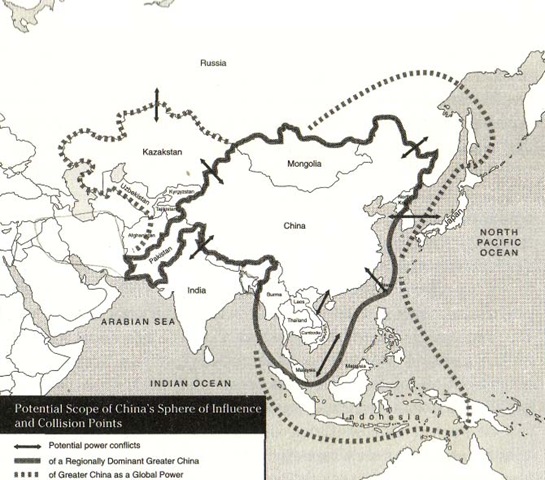
Part one of this post is here. I found this very provocative map here. For the official claim that China’s rise to global power is to be peaceful, read this. For the best academic argument for China’s peaceful rise, try this.

Hawks and realists tend to see China through the lense of history. Lots of other powers have risen in the past to challenge established powers, and usually conflict ensued. Everyone says that peace is preferred and war unnecessary, but in the end, jealous, bitterness, and the ideological pleasures of domination take hold. Minor conflicts grow and worsen; at some point, a hot war or protracted cold war begins. You could throw this model onto Germany (twice), the Punic-Roman competition, Japan’s 19th century rise at China’s expense, the USSR’s rise in the 40s and 50s, etc.

By contrast liberals and especially constructivists  look more at China specifically. Instead of seeing her as just one more hegemon with the same characteristics as others, China’s unique features because a causal possibility for peace. Here is a quick-and-dirty summary:

1. China is getting rich in the current world economic order (epitomized by its membership in the WTO), so why would she rock the boat? Right now she is gaining wealth and prestige, while dumping public goods/security provision on the US military (especially in Afghanistan, which war helps her more than us). Given this great benefit, a peaceful rise makes sense.

2. China has a history in the Sinocentric world order of treating the smaller peoples around it with some generosity. (I actually disagree with this empirically, but so be it.) The idea here is that the Chinese tributary system, especially of the Ming and Ching, only relied on violence when absolutely necessary. Much of Chinese pre-modern hegemony was based in ritual and moral suasion. So future Chinese hegemony in Asia will look back to this model rather than the Nazi or Roman ones in Europe.

3. Globalization has made a collision less feasible and valuable to the riser. This is a Thomas Friedman argument, rather similar to the one made before WWI by Norman Angell. The idea here is that globalization makes war less useful as a tool to pursue national interest and may in fact be remaking the idea of national interest altogether. In this new flat world, war is an anachronism of the nation-state era. The costs of war in the interconnected era are higher, because wars break all these international trade and financial connections that have made China so rich. Also, the benefits of war have declined, because in net-world, holding territory is not really a valuable economic commodity anymore.

4. Globalization and modernization are changing China into a status quo power, possibly prepared to accept US leadership. This is the cultural variant of the argument above. Here the idea is that as China joins the world to get rich, she will also learn from the world to be nicer. This was basically the gamble of the Clinton administration – economic modernization would entrain political liberalization – when it agreed to PMFN 15 years ago.

5. The Chinese elite have seen what happens to other, aggressive risers, and they have learned. This is a Ned Lebow learning argument, and the one I find most persuasive (probably because Ned was on my comps committee in grad school). The idea here is that the rise and fall of powers need not be some mechanical process, as if these states are robots. Instead, later hegemons and risers can learn from earlier ones. Ideally, they learn to avoid the mistakes of the past risers who collided and provoked wars.

6. Chinese made a policy choice to rise peacefully, and we should believe them. Call this the naive argument. One would accept at face value what the Chinese say. Words have meaning; pacta sunt servanda. So if the Chinese say they will rise peacefully, we should take them at their word and not fall back on pre-set notions of realism that permit blithe ignorance of anything the Chinese have to say.

7. The Chinese are nice. This is the most cultural and sino-specific of all the arguments I have heard. It is the one I heard the most last weekend in Beijing. Basically it says ‘we Chinese are different. We are nice and not belligerent. If you see us as a threat, that is your problem, in your head. Instead of telling us we will be mean and nasty someday soon, why don’t you come to China now and see how nice we are.’ As ridiculous as it sounds, I find this one somewhat persuasive. I have generally tilted against the peaceful rise school, but my time in China really gave me pause…

Off to China… 1) The ‘China Threat’ Thesis

China_Decal

Here is part 2, on China as a ‘peaceful riser.’

I am in China right now for the first time for a conference on Asian security (what else?) at the Chinese Foreign Affairs University. I will post impressions on my return. A standard methodological quip in the social sciences is that you should never generalize about a country until you at least flew over it, so I guess I am paying my dues.

So I thought it might be useful to lay out the big running debate about China: whether it will be nasty as it gets more powerful, or will it play in the established global rules of things like the WTO? This is the ‘China threat’ vs the ‘peaceful rise’ school. I lean toward the former, but maybe going there will change my mind…

1. China’s internal politics are repressive: Falun Gong, democracy dissidents, Muslim Uighurs, Tibet. Why would you expect a regime that treats its own people that way to be nicer to the ‘foreign devils’ (the 19th century mandarin term for western traders) ? Why would you trust a regime that shoots its own people? When Iran and Zimbabwe do it, we worry. Why not with China? China is not a democracy.

2. While China is rising, it is vulnerable. It is benefitting enormously from the US/WTO-lead trading order. So of course they will say they want to rise peacefully. They won’t shoot themselves in the foot. They see how Germany’s belligerent rise in the late 19th century got it encircled and crushed in WWI. They aren’t stupid enough to say they want changes, but we shouldn’t be stupid enough to believe them either, especially given point 1 above.

3. China has a historical legacy of xenophobia and cultural supremacism. You can overcome history of course; the Germans did. But the Chinese aren’t there at all, and its historical reservoir of national myths clashes badly with just being ‘one more country.’

4. As countries grow and get wealthier, their perceptions of their national interests change, ie, grow. So yes, today, the Chinese do want to rise peacefully, and maybe they are sincere. But eventually, as its sense of its global role grows, and as the scope of its interests grow, it will become pushier and probably more belligerent. This usually happens when countries grow to new prominence. Britain in the 19th century intervened all over Asia. The US got more involved in Latin America and the Pacific. The USSR dabbled in all over the place during the Cold War. Maybe China is different, but the historical record of big states developing new ‘needs’ and ‘appetites’ is pretty clear. Expect it here.

5. What will they want after they get rich? James Fallows’ work at the Atlantic suggests that China just wants to get rich, and that’s true, but what happens after they get there? As states become richer and more influential, their perceptions of their national interests expand – particularly as states trade more and import resources more (as most rising states must). It is all but inevitable that China’s global footprint will expand as it already has in Central Asia, Africa, and the South China Sea. This does not mean it must be belligerent, but it does mean that there are more possible loci of conflict. The sheer size of China and its reach will insure friction and collisions – just as it did with the British Empire, the USSR, and the US.

Add to this China’s rather toxic internal politics. China is hypernationalist (the replacement ideology after Tiannamen), mercantilist, and repressive. I see nothing benign in that mix. If you were China, wouldn’t you be chafing at the bit, having to listen to Bush or Hillary lecture you about human rights and your exchange rate? And once the first missile lands on Tibet, all the talk of peaceful China will fly out the window. My first-cut schtick on the US and China is in galleys at Geopolitics for publication this fall; here it is in brief. For China’s muscle in the Northeast Asia, try here and here.

In short, I lean toward the view that China is a rising power likely to collide with the US, because its range of interests will expand as its power expands. In 20 years, when China has a bigger navy, it will suddenly ‘discover’ national interests in the South Pacific or Indian Ocean. Rome, Britain, the US, the USSR all went down this path. It is worse, because China has the Sinocentric history of informally dominating its Confucian neighbors. And the regime ideology is still fairly illiberal – mercantilism, hypernationalism, internal repression.

Illiberal Zionism Update: Beinart Nails It

images


Peter Beinart is exactly the sort of liberal necessary to win the GWoT. He correctly realized that the American right is not credible in its claims to defend Western liberalism against salafi illiberalism, because too much of the GOP base is too illiberal now and sees the GWoT exactly as Bin Laden does – a theological clash of civilizations – only they are on the other side. The increasingly Christianized and fundamentalist (Protestant mostly) GOP wants to ‘win’ the GWoT as a triumph of Christianity and/or American power. They are, as Walter Russell Mead correctly notes, ‘Jacksonian Zionist,’ not liberal. No Muslim, correctly, will believe US power to be neutral, serving universalist liberalism, when Bush needed to be told that the GWoT had biblical justification and Sarah Palin insists that Israel be allowed to do whatever it wants in the Occupied Territories.

In the same vein, he makes a good case here for the growing illiberalism of Zionism and the increasing inability of liberal countries to support its religio-nationalist, rather than liberal, opposition to Islamism and Arab authoritarianism. I made exactly the same point a year ago. (It is always nice to be confirmed in one’s prejudices I suppose, but Beinart does a better job of it than I did.) Sullivan adds his usually biting and gloomy commentary.

All sides seem to be sliding toward a clash of civilizations paradigm. All the more reason for the US to focus on the battle of ideas against salafism and get out of the Middle East in the medium-term…