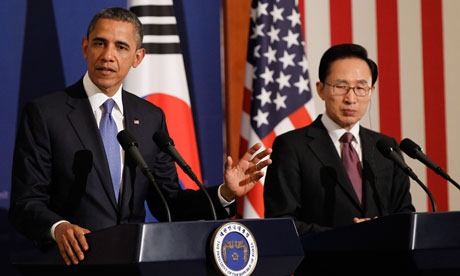
The Diplomatasked me for a short piece on what South Korea would like from the new US president, as part of a general forum – including Shen Dingli from Fudan on China and Adam Lockyer from Sydney on Australia – on Asia and the US election. I have reprinted my essay below, and here is the whole forum. It’s worth a read, and Lockyer’s disbelief at tea party rhetoric should once again be a wake-up call that American global leadership is not an entitlement of our ‘exceptionalism,’ but something we must earn through seriousness and responsibility. I’d like to thank Zachary Keck for soliciting my participation:
1. At the elite level, the ROKG (Republic of Korea government) probably wants a standard reaffirmation of the US- Korea alliance from whomever wins.
My sense from the media and my students and colleagues is that South Koreans are not really paying much attention to the US presidential race. (Neocons take note of such treachery!) Neither Romney nor Obama have much to say except for typical boilerplate on SK – defending freedom, resisting tyranny, close friend of America, yawn. In fact, I am not sure SK’s even been mentioned. And no one likes NK, so that is an easy issue to posture on too. (In fact, I am surprised Romney didn’t take the opportunity in the chest-thumping third presidential debate to accuse Obama of appeasing NK.)
Amazing how the Simpsons is still pretty funny after 25 years…
In the interest of full disclosure, I thought I’d list the reasons why I voted the way I did. I know conservative media regularly accuse professors of politicizing the classroom, but an honest discussion of why one chooses the way one did can also be useful exercise of citizenship. (See Drezner for an example of what I was thinking of.) So with that goal, not demagoguery, in mind, here we go:
1. The Tea Party Scares Me
This is easily the most important reason for me. Regular readers of this blog will know that I vote in the Republican primary and write regularly about the Republican party, but almost never about the Democrats. (Even in Korea where I live, my sympathies are with the conservatives.) I don’t see myself as a Democrat. I see myself as a moderate Republican, like Andrew Sullivan or (less so) David Frum. Unfortunately, the Tea Party has made the GOP very inhospitable for moderates.
Given Romney’s propensity to blow with the ideological wind rather than stake a claim somewhere, I think it is likely he’ll get bullied by the hard right once in office. Following Kornacki, my problem with Romney is not his ideology – because I don’t know what that is – but the party from which he stems, run, as it is, by increasingly radical, Christianist, southern right-wingers. I find it simply impossible to vote for a party so contemptuous of science, so willing to violate church-state distinctions, so committed to a heavily armed citizenry, so obsessed with regulating sex, so strutting and belligerent toward the rest of the world, so unwilling to compromise on taxes to close the deficit, etc. Hint to the RNC: the rest of the country is not Dixie; please stop dragging us down this road. This southernization of the GOP in the last 20 years has made it harder and harder for me to vote for national Republicans, even though I vote for them a lot in Ohio. Not surprisingly, I find Andrew Sullivan’s conservatism quite congenial.
On Interstate 71, south of Columbus; Ohio’s most famous sign
So it’s election time, which means CNN, etc. will be filled with pundits with only the vaguest credentials – never any PhDs – telling you why the outcome inevitably had to be such-and-such. (Retrodiction is so insufferably smug.) And they’ll explain it as if these tired clichés are real insights and not the same flim-flam they pedal every November.
So let me predict the future: here are the five worst clichés you’ll hear Tuesday – the lamest, most recycled, simplistic, and least analytically useful (because they’re so flexible they can explain almost any outcome).
Save yourself hours of Donna Brazile and David Gergen right now; just roll these out at Thanksgiving dinner to impress the relatives:
1. Ohio, or the white, blue-collar voter theory of everything
Every four years the media runs the same easy, generic storyline about my state (Economist 2004, 2008, 2012; FT) that goes something like this: ‘these grizzled veterans of America’s economic dislocation cleave to their guns and religion but increasingly live in suburbs and see their kids work in tech plants outside Columbus or Dayton. The large urban populations of Cleveland and Cincinnati are balanced by the church-going rural voters in the god’s country of southeastern Appalachia…’ Yawn. And it goes on like that for pages. Most of these articles make sure to cite the above picture. And yes, that sign is for real; I’ve seen it. It’s on the same road that leads to the Creation Museum (no joke either – I’ve been there), but thankfully that’s over the river in Kentucky. I guess they go to the dentist even less often than we do.
The thing is, we get all this attention for 3-4 months before every election – but then nothing afterwards. So how much can they can take us seriously as a swing state? In 2004, Rove drove up GOP turnout with the Defense of Marriage Act ballot issue and terrorism. In 2008, Clinton and Obama told us they were going to amend NAFTA and reduce illegal immigration to save our jobs. This year, Romney and Obama promise to defend us against China. If you’re keeping score, that means there should be no homosexual Mexican terrorists driving NAFTA-certified trucks on Chinese tires around Ohio. Ah yes, Ohio, that clichéd, right-wing blue-collar paradise!
Warning! The lyrics are explicit – but the movie is hysterical
Did anyone else find the third presidential debate just appallingly narcissistic and self-congratulatory? Good lord. Good thing America is around to show you bubble-headed foreigners the way to freedom. I could run through all the offensive, ‘America-is-tasked-with-upholding-the-mantle-of-liberty’ patronizing condescension, but why bother? (Nexon does a nice job here.) I told my students to watch it, and in retrospect, maybe I shouldn’t have. It was so embarrassing, and in class this week I kept trying to explain why we talk down to the rest of the world like this while my students rolled their eyes in disgust.
I keep saying this – running around the world telling people how exceptional and bound-to-lead we are is a great way to alienate the planet and convince them of exactly the opposite – to not to follow us. We’d have a much easier time with the world if we could back off the blustery, Fox News nationalism and actually speak maturely. But Americans couldn’t give a damn about the rest of the world, no matter how much we posture about our world historic role to lead it. Our ODA totals are disgrace for a coutnry as wealthy as we are. We don’t learn languages much. The only time we worry about casualties in the war on terror is when they are own; our clear disinterest for all the collateral damage we have done since 9/11 speak volumes to the rest of the planet.
REK, Ed.: Regular readers will know that I like Dave’s work a lot. He’s been a good friend and mentor to me in this area. I am pleased to post a longer, fuller version of a book review he wrote for CSIS. My thanks to CSIS as well. If you aren’t reading Dave yet, you should be.
“Is America listening to its East Asian allies?: Hugh White’s The China Choice”
For all the recent attention on increasing tensions between the U.S., China, and East Asian countries, regional balance of power dynamics remain muted. The past few years have seen increased Chinese assertiveness, which has led many to expect that East Asian states will flock to the side of the U.S. This has not proven to be the case, however, and Hugh White’s thoughtful and bold new book, The China Choice: Why America Should Share Power, provides some clues as to why not. White argues that neither China nor America “can hope to win a competition for primacy outright, so both would be best served by playing for a compromise.” White concludes that the best policy would be an explicit “Concert of Asia” in which the U.S. and China agree to treat each other as equals and create two clear spheres of influence. White is probably right that a U.S. balancing strategy in East Asia is unlikely to succeed – yet a concert of Asia with two clearly defined spheres of influence would appear fairly similar in the eyes of East Asian states. East Asian countries are clearly hoping to find a pathway that avoids taking sides, and the best approach for the U.S. to take is a strategy that helps them achieve that goal.
Yes, it’s partisan, but it’s a somewhat useful deconstruction
First, I included the above video to reference a point I tried to make last week – that Romney flip-flopped so much in the first debate that I no longer have any idea what he thinks about the big issues of campaign. I just wish I knew wth Romney wants to do with the presidency. There has to be some purpose, some reason to vote for him, and I can’t find it. Someone tell me in a few coherent, specifics-laden paragraphs why I should vote for him? Not why Obama is a bad president – I know that already – but why Romney should be president. Honestly, I don’t know, which makes his presidential run look like a vanity project or something.
Second, did anyone else think that the vice-presidential debate once again broadcast to the world that our foreign policy is dominated by the Middle East? It was all about Iran, Syria, Libya, and Afghanistan. Obviously, these are all important places and issues. But it doesn’t take a lot of foreign policy training to know that Russia’s ever-more erratic course under Czar Putin, a possible euro-EU meltdown, or China are a lot more important to the US’ future than a bunch of small, poor fractured states in the Middle East. But no, let’s argue once again about Israel, Iran, terrorism, Iraq… Good grief. There are other issues out there!
Everyone remembers this – except Romney voters apparently…
George W Bush practically built his re-election effort against John Kerry on the idea that even if you disagreed with him, you consistently knew where he stood on stuff. That commercial above is famous. And the US right in general loves that sort of macho grandstanding on behalf of American will in the face of wimpy, carping detractors – usually Europeans, academics, and liberals, ideally combined. Remember ‘freedom fries’?
Palin and McCain struck the same pose in 2008 (‘I would much rather lose a campaign than a war’), and so did lots of Tea Party candidates in 2010 and in the 2012 GOP primary. Remember when Perry even said, “I’ll be for water-boarding until the day I die”? And Fox talks like this all the time, as if Hannity were the last bastion of American bootstrap ideals against a rising tide of liberals, illegal immigrants, and Muslims. So if the Tea Party right loves this ‘let’s-go-down-with-the-ship-on-behalf-of-principle’ posture, how can one possibly support Romney after he flip-flopped all over the place in the first debate last week?
It increasingly looks like Romney is gonna lose. Intratrade now puts that likelihood at 75%. So it’s my understanding from the American politics subfield of political science, in which I took exactly zero courses in grad school, that the state of the economy is supposed to be the great determiner of American elections. But somehow Romney can’t seem to win despite 8+% unemployment. So I’ll take that as a methodological opening for wild speculation – namely my own – masquerading as rigorous theory.
Given my masterful background in this field, which includes watching Mr. Smith Goes to Washington, still getting Fox News in my cable package even though I don’t live in the US (stop chasing me!), and having been a Congressional district slave staffer (Republican) 15 years years ago, here’s my take. And no, I have no great proof to back up these instincts, but as George W Bush’s decision-making style taught me, my gut is enough, and ‘data,’ or whatever you ‘academics’ call it, is for wusses. “We’re an empire now; we make our our reality,” and here’s mine:
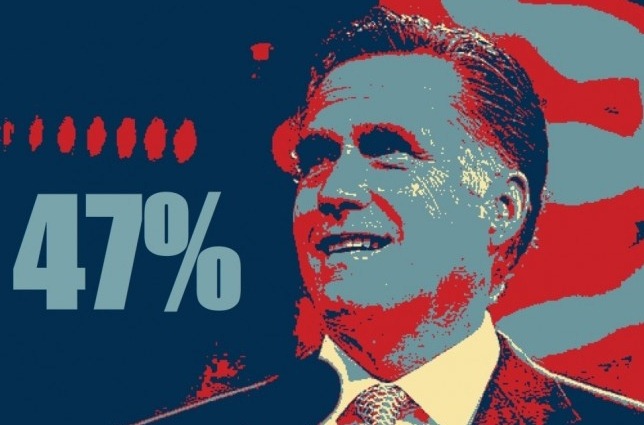
Wow. The polling after this just collapsed. The desperate ‘me too-ism’ of Fox News in response spoke volumes about how destructive that leak was. Scrounging up any dated recording of Obama also saying something dumb (or not) and then trying for 2 weeks to balloon it into an ‘affront to all Americans’ to stir indignation was just embarrassing. I wonder if O’Reilly and Hannity can say to Roger Ailes or Rupert Murdoch once in awhile, that some conspiracy-mongering is just too ridiculous even for them. If some old, vague Obama comment on ‘redistribution,’ which the government has been doing for almost a century, is now cause enough for GOP ‘outrage’ (ever noticed that Fox is always ‘outraged,’ btw?), then they’re effectively repudiating more than half the budget. Even in the GOP, I don’t think eliminating redistribution is majority opinion, and there’s no way the electorate will go for that, as it essentially re-writes the social contract on something - a basic safety net – that most American simply assume now. Maybe Romney should apologize? I dunno; politicians do it in Asia sometimes. But doubling-down on that remark, as he has, is a sure-fire loser.
I got bogged down with NK for awhile, so I missed a chance to comment on the RNC and the US election more generally. I have some thoughts after the break, but a Democrat friend of mine wrote the following, which is a pretty good first draft of the GOP’s problems, I think, in this election cycle:
“On the whole, I found the Republican convention disgusting and not simply because I disagree with their policies. They substantively are disconnected from the problems of the average person. They offered nothing which will help average people and, what they do offer, is bereft of details. They said nothing – NOTHING – about the two wars they started and the one that is still ongoing. (They do however feel we should have wars, or at least brinksmanship with several other countries.) They have no narrative connecting who they were just four years ago with who they think they are now.
The narrative they do present is a fantasy beyond what even Republicans of a prior generation would present. They stand in a publicly-built convention center preaching nothing but disdain for the role of government. They parade women, Latinos and an African-American secretary of state who talk about the ‘bootstrap’ mentality of their parents with no mention of the giants of civil rights and the role of government which reformed the bigoted society which their beloved founding fathers gave us. That reformation – more than their parents – allowed the likes of Condoleezza Rice to be where she is today.
Ok, this has gotta be my last response to the many comments from this sprawling series (one, two, three, four, five) of posts on ranking US allies. Thanks for all the interest. Who knew Canada was so interesting or Canadians so passionate?
I’d like to thank Stephen Walt (whose blog I think is the best in IR) for linking this debate, and Andrew Sullivan for linking me twice. If you aren’t reading Sullivan yet, you’re at the wrong website. Thanks too to all those Canadians who came out of the woodwork to defend its boring relevance. Finally, who could fail to thank a website disturbingly entitled f—-dgaijin.com?! (Yes, that’s the actual name; check it out for yourself; at least these guys know where we resident-foreigners stand in the East Asian racial food-chain – at the bottom.)
So here are some final thoughts on the many comments, but especially Walt and Sullivan:
1. I accept the arguments from several commenters that Turkey should be on the list. So here is a final list, a ‘top 12’ of US allies in order: Canada, Mexico, Saudi Arabia, Taiwan, India, Indonesia, Israel, South Korea, Japan, EU/NATO, Egypt, and Turkey.
2. I was please to see that Sullivan flagged – not necessarily approved, but just noted – my argument for Indonesia as America’s most important bridge to the Muslim world. I realize this is kinda off-beat, given that the ME is what dominates our perceptions of Islam and where Islamist pathologies are worst. (Here is a critic, a neocon perhaps, calling me ‘delusional’ for ranking Indonesia this way.) So here is a quick defense, more or less along the lines of what Secretary Clinton said a few years.
Indonesia is a syncretic model of pluralist Islam and politics; I think this is pretty widely accepted. No, it’s not as modern and liberal as we might like, but by the standards of the region, other developing countries, and the OIC, it is a paragon. Let’s be honest about that. It could easily be far, far worse (think Pakistan), which is why I find it unfortunate that we don’t pay attention much. We should not let the perfect be the enemy of the good, and a friendship with Indonesia doesn’t mean avoiding tough issues, just like engaging China doesn’t mean we should ignore human rights and other similar issues.
So in its own imperfect, struggling way, Indonesia represents the future of political Islam (speaking very broadly to be sure), not the past, which is a lot of what the ME represents and what Arab Spring is trying to break. If the flat-earth religious elites of places like Iran, Pakistan, or Saudi Arabia are allowed to dominate the global conversation on Islam, more conflict is likely. By contrast, Indonesia offers a possible model for Islam to live with both democratic politics and religious pluralism. That we should vigorously support such an effort, through some kind of alignment, strikes me as so self-evident, that I am amazed that we never talk about this.


 – telling you why the outcome inevitably had to be such-and-such. (Retrodiction is so insufferably smug.) And they’ll explain it as if these tired clichés are real insights and not the same flim-flam they pedal every November.
 Robert E Kelly