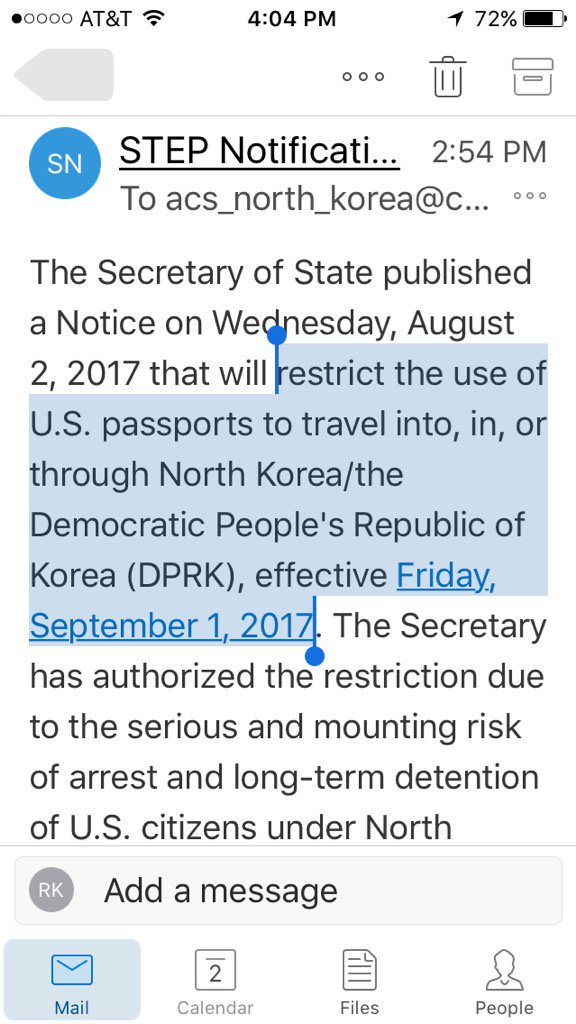
The North Korea Travel Ban is Probably a Good Idea at this point

This is a repost of an essay I wrote for the Lowy Institute recently on the travel ban preventing Americans from going to North Korea as of September 1 this year. The picture is the US State Department mailer to this effect from a few days ago on my iPhone.

Basically my argument is that the ban is a good idea at this point given how many foreigners Kim Jong Un seems to be snatching during his reign. The numbers have gone up, and although I went to North Korea as a tourist myself and have recommended it in the past, I no longer do so, especially for Americans. It’s just way too dangerous now.

Otto Warmbier’s death is the last straw, as I figure it was for Tillerson. At the time of his death, I thought a travel ban might well be the next step. I still find it curious that Kim Jong Un did not let Warmbier leave earlier. The tourist trade brings in needed dollars, and Pyongyang is already complaining about the US halt. They easily could have let him go when he fell into a coma and then just pretextually snatched the next idiot US tourist who drank too much to replace Warmbier. But they held onto him to the point where they’re responsible for his death. Pointless. Just shows once again how awful North Korea really is.

My full essay on the travel ban follows the jump:

Continue reading

North Korean Nukes are almost Certainly for Deterrence and Defense

8114998_origThis is a local re-post of an essay I wrote for The National Interest this week.

I feel like a broken record. I keep saying this – they’re not going to use them offensively, we don’t need to airstrike (at least not yet), we have learned to live with Russian, Chinese, and Pakistani nuclear missilization, the North Korean leadership is rational enough to know that using these things against a democracy would bring extraordinary retaliation. So yes, it really, really sucks that North Korea has these weapons, but we can adapt, as we have to other countries’ nuclear missilization. We don’t HAVE to start a potentially huge regional war over them right now. If we must, we always can. But let’s not get carried away that North Korea is going to nuke the US out of the blue, so we should airstrike them right now. That is HIGHLY unlikely.

But journalists keep asking me if we’re going to/should bomb North Korea, and US officials keep saying stuff like this. So here we go again:

Continue reading

More on NK Nukes: It took the Cuban Missile Crisis before the US Adapted to Soviet Nuclear Deterrence

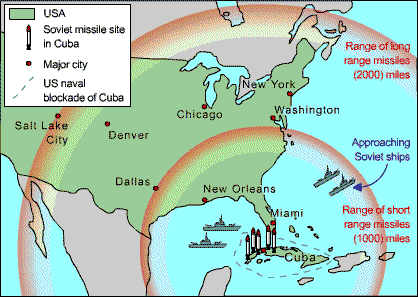
9e67b42f03919f5ba59a4be37287fcb8dd8f17e0This is a re-post of something I wrote last month for The National Interest on US adaption to other countries’ nuclearization. In short, we adapted badly at first – Cuba – and then learned to live with proliferation even though we didn’t like it and did the best we could to halt it.

A repeat of the Cuban Missile Crisis over North Korea is what I fear most from the US toward North Korea in the next five or ten years. We will decide that North Korea is too batty and gangsterish to trust with nuclear weapons, and we’ll pick a fight. How the North Koreans will react – will they believe China will stand with them? – nobody knows. The Soviets felt that missilizing Cuba evened the score with the US which could easily strike the USSR at the time. The North will think the same – that they are entitled to nuclear deterrence for national security, which perception a Cuban-style crisis will reinforce in them. Then will come a showdown.

But most people agree North Korea will never give  up its nukes, and most people also agree that North Korea is quite rational. So it is quite unlikely that North Korea will launch a nuclear ICBM at the US without provocation. It sucks that North Korea has nukes, but we have learned to live with Soviet/Russian, Chinese, and Pakistani nukes. The big question is can we live with NK nukes when so many Americans seem to think the North Koreans are insane.

The full essay follows the jump:

Continue reading

There will be No US Airstrike on N Korea; SK will Veto it

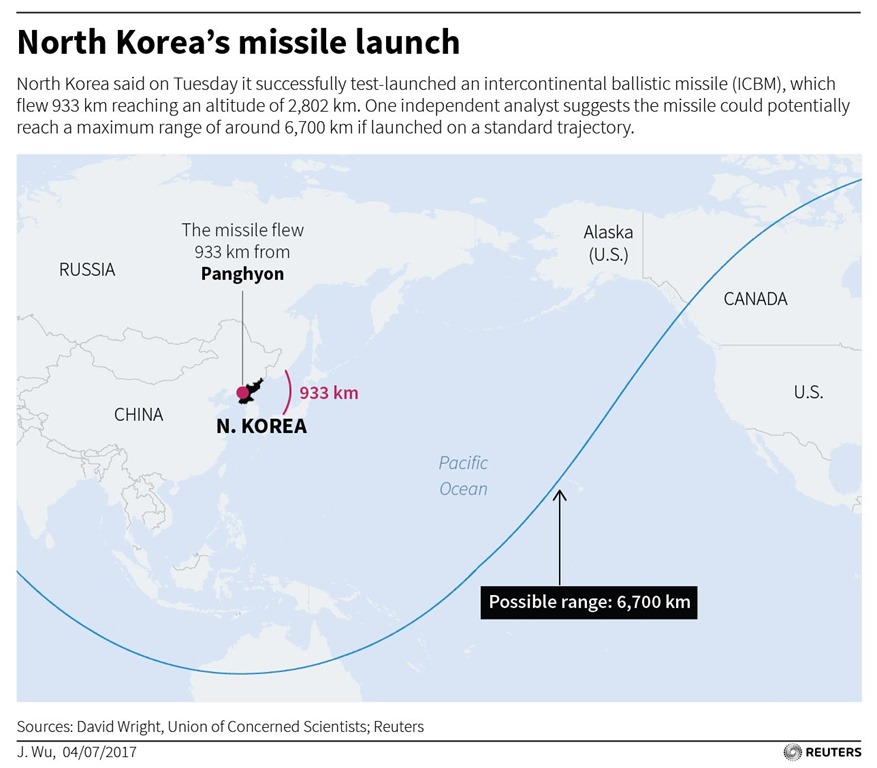
northkorea-missiles-reuters-graphicThis is a local re-post of a piece I just wrote for the Lowy Institute. Mostly I wrote this as a response to all the cable news chatter we’ve been hearing all year about how the US should consider air-striking North Korea. I have been saying for awhile that we won’t do it and that US policy-makers should  stop bluffing something they’re never going to do.

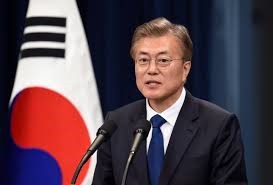
There are lots of reasons why bombing North Korea is a terrible idea. But there’s one obvious reason we won’t do it, and that’s because South Korea will never approve. South Korea would bear the brunt of any Nork retaliation, and we can’t very very jeopardize hundreds of thousands of people without asking them first. And Moon Jae-In, the president of South Korea will never agree. He is well-established dove on North Korea supportive of engagement for 20 years now. He’s extremely unlikely to suddenly embrace a course he’s fought against almost his entire career, and certainly not for a belligerent, posturing buffoon like Donald Trump. So let’s all come back to reality and start thinking about what will work – missile defense, China, sanctions, perhaps negotiation. But bombing is ‘off the table’ for at least 5 years (the duration of Moon’s presidential term). That’s an easy prediction.

The full essay follows the jump.

Continue reading

US-South Korea Alliance Survived Presidential Partisan Differences Before

download

This is a local re-post of an op-ed I wrote this month for The National Interest. There’s been a minor freak-out on the right since Moon Jae In got elected. He’s a communist; he’s gonna sell out SK to Pyongyang; the alliance with America might break. Good grief. Enough with the hyperventilating. Even if he was a communist at heart, he couldn’t govern that way because he only won 41% of the vote. He doesn’t have the political space to govern as some far lefty. And realistically, he’s just a social democrat: he wants to raises taxes, expand the public sector labor force, and clean up the air. That’s hardly a marxist revolution.

I do think that there is a possibility of a real split at the top though. It is easy to see Trump and Moon loathing one another. So this essay notes how previous US and SK presidents of different political beliefs stumbled through. The short version is that there is a lot of depth to the US-SK alliance. So much actually, that it almost makes presidential changes irrelevant, which is not exactly democratic if you think about it. But the point is, that the alliance will likely survive.

The full essay follows the jump:

Continue reading

6 Reasons Why We Probably Won’t Bomb North Korea

images

This is a local re-post of an article I wrote for The National Interest a few weeks ago.

Even though we are bombing Syria now and Trump wants to look tough and presidential, I do not think we will bomb North Korea. We’ve thought about it for years and always demurred. Trump, for all his bluster, has not changed the long-standing reasons for not attacking, so I still think we won’t do it. Maybe Trump really is erratic and unpredictable, but I’d bet McMaster and Mattis are telling him a lot of the same stuff suggested below – the huge risk of war, Seoul’s vulnerability, trashing of the relationship with China and so on. Are we ready to gamble all that on strikes that might not even work?

The full essay follows the jump:

Cancelling TPP, Protectionism Not Necessary for a Restrained Foreign Policy

Image result for tpp

This is a local re-post of an essay I wrote for The National Interest a few weeks ago. Basically I argue that a restrained political and military foreign policy does not imply an isolationist or protectionist economic foreign policy.

This strikes me as an important distinction. There is a lot talk that Trump’s election implies a less interventionist foreign policy, that the white working class doesn’t want to fight neocon wars anymore. I am sympathetic to that. But a greater caution in military choices does not have an economic correlate of withdrawing from free trade, or picking foolish fights with allies. Restraint is neither economic protectionism, nor bashing allies Trump-style. Those tow together are more like isolationism.

As I say on this site regularly, the concern of foreign policy ‘restrainers’ is not to abandon American allies, but to get them to take their own defense more seriously. But I see no reason to extend that to trade. Greater protectionism will simply drive up prices for the white working class at Walmart, while re-shoring a few jobs at most. Recall that it is technology that wiped out smokestack jobs in the Midwest, not China. Worse, protectionism has a powerful long-term negative impact on security. States which seal themselves off start to fall behind technologically. That impacts military tech too, as one can see in the communist states during the Cold War. It is critical for American military pre-eminence that it remain a free-trade economy that regularly absorbs the most recent technologies, no matter how much dislocation they bring, no matter where they come from.

The full essay follows the jump:

Continue reading

Obama did about as well in E Asia as could be Expected: One Last Defense of Strategic Patience

I know the only thing people want to talk about now is Trump, but here is a parting review of Obama in Asia. I wrote this a few weeks ago for the Lowy Institute. All in all, I’d say he did about as well as you could expect.

Yes, he didn’t prevent North Korea from getting a nuclear weapon and missile, but no one knows how to do that barring kinetic action which is off the table because of South Korea’s ridiculous decision to place its capital, and allow it to flourish, just 30 miles from the border. And no he didn’t slow China’s rise, but no president could do that without kinetic action either. And that’s even crazier than bombing North Korea.

There are no good solutions to our challenges out here, just as there were none to communist power in the 1950s. Hawks calling for ‘toughness’ and ‘leadership’ should remember that rollback was a catastrophe (in the Korean War) that almost ignited WWIII. We then settled for hanging tough’ until communist power imploded, which it did. The contemporary Asian analogue of hanging tough is Obama’s ‘strategic patience.’ Everyone criticized it, but no one has a better option that isn’t hugely risky. So stop complaining about strategic patience until you’ve got a better, genuinely workable idea.

The full essay follows the jump.

Continue reading

Restraint and Burden-Sharing to Revive US Alliances, not Tear Them Down

Image result for restraint

This is a local re-post of an essay I published with The National Interest last month.

My concern is to separate the idea of greater US caution and self-discipline overseas from faux-complaint that this is ‘isolationism.’ Just because the US is more cautious in its use of force, or more demanding of its allies, doesn’t mean the US is abandoning them. Indeed, pushing them to do more, spend more, think more strategically about their own security is a way to revive US alliances, to make the US alliance framework less unipolar, richer. and more fully capable. I don’t see why this is so often derided as isolationism

Will Trump do this? Probably not. For a moment there, it seemed like he might embrace a foreign policy of restraint, but his hawkish cabinet picks and proposed DoD build-up suggest that is unlikely.

The full essay follows the jump.

Continue reading

Year in Review, 2016: Top 5 Events of Northeast Asian Security

Image result for trump abe

If that thrilling post title doesn’t pull you away from It’s a Wonderful Life or Sound of Music, I don’t know what will.

This essay is a local re-post of my op-ed posted with the Lowy Institute this month. The pic is President-Elect Donald Trump in his first meeting with Japanese Prime Minister Shinzo Abe. It well captures what a banana republic amateur hour set will be running the US shortly, which makes Trump the number one Asian security story of the year. That is Trump with his daughter and son-in-law business partners, but no US-side translator or Japan expert, because heh, what really matters is getting Trump Tower Tokyo built…

My top 5 security events for the region in 2016 follow the jump, but honestly you’re probably a lot more interested in my picks for the worst TV show and movie of the year.

Continue reading