If Iran Can Stalemate the US, What About China?

I just put up some thoughts at 1945 magazine on Iran’s surprising success against the US – or more specifically, its suprising ability to stalemate the US despite the enormous power imbalance – and what it means for US power projection elsewhere.

The most important lesson almost certainly regards China, because it is the one state which might genuinely defeat the US in direct peer conflict. Iran has stalemated the US, not defeated it. But China might actually be able to defeat the US on the battlefield, and the likelihood of that is growing. In fact, Phillips O’Brien is so pessimistic after US flailing and stockpile overuse that he just wrote “I for one, do not believe that the US military will be capable of fighting a major war for years.” Yikes!

The big takeaway has to be that Iran used anti-access/area-denial technologies to deny the Strait of Hormuz and Iranian coast to the US Navy. Lots of cheap drones, mines, and missiles made it too risky for the US navy to either operate near Iranian territory or run the Strait to demonstrate that it is open to civilian traffic. The US Navy has too few ships and they are too ‘exquisite,’ so it simply cannot carry sustained battlefield losses. (The political damage to Trump of losing a ship to Iran is another factor, but not directly on operational constraint like a small sized force is.)

So if you’re China, you just learned how the US navy can be backed off your coast, stalemated, or even – given China’s far greater military sophistication over Iran – defeated. China will ‘flood the zone’ – swarming heavy, slow US surface ships with lots of cheap munitions. And given that the US has few and very large bases in East Asia (Guam, Kadena, Osan, and so on), it will be easy to strike or hold hostage those ports-of-call. I finish the essay:

China will almost copy the Iranian playbook, using cheap, automated, and voluminous air and sea assets to drive back or sink America’s large, slow surface fleet. China’s ability to do this will be orders of magnitude better than Iran’s. The egregious overuse of American exquisite assets in the Persian Gulf demonstrates just how unready the US is to fight this new kind of cheap drone warfare.

The US policy takeaway, by the way, is to build a larger, less hi-tech fleet of smaller ships. Read the rest here.
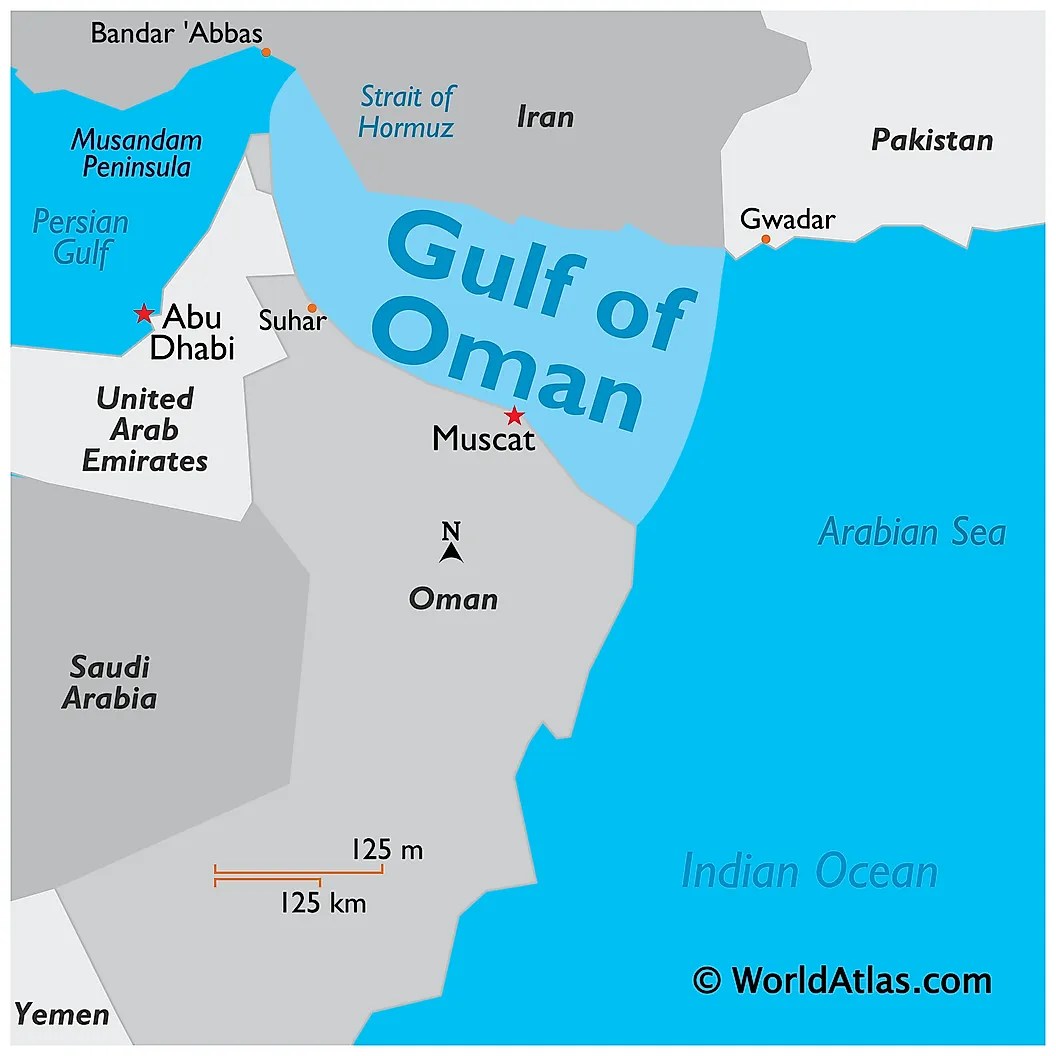

A US Blockade of the Gulf of Oman is a Desperation Move to Avoid Invading Iran

The US Blockade of Iran’s Strait of Hormz’ Blockade will Occur in the Gulf of Oman

So Trump is now going to ‘blockade a blockade’? Seriously? Does anyone think that is going to work? I don’t think so is what I wrote at 1945 this week. Please go there for my full argument.

I am not sure Trump even knows how this blockade will work. I guess this idea is that what little traffic does come through the Strait of Hormuz will now be blocked into the Gulf of Oman by the US Navy waiting in front of the India Ocean. Won’t this just lead to exploding gas prices, again? Shortages of helium and fertilizer, again? The stock market crashing, again?

I guess Trump could cut deals with individual countries or even individual ships to let them through our blockade line. That’s the kind of grift Trump excels at. But that is exactly what the Iranians are doing – imposing tolls. We are decrying that as a violation of free navigation. So we can’t do that without looking absurd and hypocritical.

And the questions keep coming: What happens if a country tries to run the blockade? Do we shoot at it? What if it is a big country like China or India? Are we going to imprison their crews? What if it is friendly country? How long would the US Navy have to stay on station to enforce this blockade? Stuff like embargoes and sanctions take a long time to generate big effects, so I could see us staying there for months. Do we have the infrastructure regionally to sustain all that? Isn’t the US Navy already overstretched?

I see this as Trump trying to find some off-ramp which lets him declare victory without invading Iran. The idea is that the US blockade will cause huge global pain which the world will blame on Iran, and that will force Tehran to the table.

I doubt this will work. Iran cares about ideology a lot, and facing down the Great Satan, as they have over the last 6 weeks, is worth the pain. Besides, the whole world already blames Trump for this conflict as an unncessary war of choice. They are more likely to blame this newest American belligerence on Trump yet again.

In the end, Trump can’t win – re-open the strait, definitively denuclearize Iran, and change the regime – without invading on the ground to definitively defeat Iran. I have been arguing that since this war started (here, here, here), and I still think that claim is correct. Airpower, and now seapower, are not enough. So this blockade is yet another desperation manuever to avoid an invasion but not embarassingly TACO.

Iran: I Thought Trump would Try a Limited Ground Assault Rather than TACO

El Vaquero tacos, the best tacos in Columbus, Ohio (where I live in the US)

I am pretty surprised Trump just capitaulated in Iran this week. Wow. I figured the embarrassment of losing a war would be too much for him and that he would escalate at least to a limited ground invasion on the Iranian side of the strait of Hormuz before throwing in the towel.

That’s what I wrote about in 1945 this week. I figured a limited incursion would not stay limited. We would almost certainly get sucked in deeper, because the Iranians would attack any enclaves we took, which would require us to go further into the country to suppress those attacks. Mission creep loomed. Small missions growing into big ones supplemented by escalating airpower sounds an awful lot like Vietnam.

That post got overaken by events, but I still think its analysis of a ground war is correct. Lots of other analysts were saying the same thing. So I would like to think that all that pushback helped dissuage Trump.

Trump will declare victory, but this was obviously not one. We came off clownish, reckless, and ultimately dangerous, which is pretty much the defintion of Trumpian foreign policy. The Iranian clerical regime is still in power. It knows now that it can close the strait at will and demand cash. Its nuclear material is still in-country, and it will likely sprint for nukes once the war is truly over. The only way to really prevent Iran from dominating the strait and going for nukes was a ground invasion to insure regime change. That likely would have been a disaster on the scale of Vietnam.

So we should be happy that Trump did not make the mistake LBJ did in 1965 and which Bush made in 2003. But a limited error which does not spiral into a larger error is still an error. And that’s what this war was.