Unknown's avatar

About Robert E Kelly

I am a professor of political science at Pusan National University. I write mostly on international relations in East Asia.

Is American Global Primacy Just Too Expensive?

200px-Flag_of_the_United_States_svg

One of the reasons I started a blog was because I get pulled into some excellent email chains that deserve to see the light of day. Here is a nice debate between me and a good friend (whose IR background is more law; mine is security and political economy). He thinks the costs of US empire’/dominance/unipolarity are too high to the US, and that we should start pushing burdens onto the allies more – an idea as old as the Nixon Doctrine. I agree in principle, but in practice, the allies won’t do it, the world will slide into multipolarity, and become more dangerous I think.

Friend:

An Empire At Risk. I share all of Niall Ferguson’s concerns, but he is focused, at least in this article, on a military decline as the ultimate effect of our profligate ways.  I say – so what?  I would like to see a US that spends less on the military and is less focused on policing the world. Let’s hear it for Germany, Sweden, Norway, Japan, etc. – countries that direct their resources toward their people and not an extravagant defense establishment and adventurism. In the world today, the US has had to invent a global enemy – ‘terrorism’ or a boogie man China – to justify its fantastically large military. Security today is not as the Neo-Realists traditionally portray. The great powers are not likely to return to the days of the 1930s any time soon.

Me:

Ferguson is always a good read, although ten years ago he said the US was the “colossus” bestriding the world as the new Rome. That didn’t work out too well…

You’re right that the US military needs to go on a diet. After 9/11, the military got everything they wanted including lots of c— we don’t need (F-22s, missile defense, Future Combat System). But the larger point is correct. The ultimate backstop of the liberal global economy is the US military. The more powerful the US is, the less it makes sense to compete against it. Unipolarity encourages bandwagoning and hedging at worst, not open balancing. If the French, Russians and Chinese get their wish for multipolarity, watch security dilemmas in places like northeast Asia, the Middle East, and Central Asia move into defection spirals of arms-racing. Unipolarity correlates well with systemic peace, and a liberal unipole is even better. Switzerland can claim the moral highground of neutralism and abdication, and no one cares. If the US does it, the world will change.

Friend:

We have two basic disagreements.  First, I don’t share your concern about SD and spiraling arms races.  I am a believer in Jervis’ security community, though there are areas outside of it, a great power war is highly unlikely. Peripheral wars have gone on, are going on now  – even with ‘unipolarity’ – and will go on regardless of US military might. Moreover, it is rather speculative that US unipolarity will prevent the consequences you describe as the number of cases of unipolarity is quite small.

Regardless, and second, the problem with maintaining unipolarity is someone has to pay for it.  Why is it the burden of US citizens to maintain this blessed (if often fractured) liberal economic world order of peace and prosperity?  The British are sending an extra 500 troops to Afghanistan and they are one of the better allies there. Everyone knows the current US fiscal deficit is unstainable so, to fund unipolarity, Americans must give up public health insurance, infrastructure investment, and basic government funded research, fight inflation, suffer a depreciating dollar, yada yada, while the rest of the developed world has social safety nets and high-speed trains. If the world becomes more complicated without US unipolarity, if other liberal, peace-loving democracies must step up in a multipolar world, that’s fine. Americans deserve to have their wealth spent on their needs (cancer research comes to mind. Cancer touches everyone of us and will probably kill you and me. Compare what has been spent on that to just one year of defense spending – it’s shocking). 

Me:

1. You don’t think that the regional security dilemmas in places like Northeast Asia or the Middle East would inflame if the US retrenched? I can’t agree. If the US leaves the ME, Israel and Iran will be at blows. In Asia, China and Japan, and India and Pakistan and China would start racing furiously. I think even the Chinese think so, judging by what I have heard from Chinese scholars at conferences out here. Unipolarity has strong causal effects for peace.

2. Here I agree with you partially. But the US DID afford hegemony for awhile. Not even Vietnam broke US power: http://asiansecurityblog.wordpress.com/2009/04/09/careful-with-that-decline-of-the-west-riff-weve-heard-it-before/. In fact, under Clinton, the budget was balanced, the debt was declining, the US was respected, and our foreign policy requirements were reasonable. Sullivan called the 1990s a ‘silver age’ for the US in his book the Conservative Soul. The real problem is that Bush misread unipolarity as omnipotence. Bush and his buddies wrecked US power through conscious choice. It was not the structure of unipolarity itself that bankrupted the US; it was W. Try here.

Friend:

I don’t believe in US isolationism.  Of course, complete disengagement from Asia and the ME would be destabilizing.   Multipolarity is not isolationism. The US should remain a balancer and diplomatic force.

But, I don’t think NE Asia countries would race furiously even with a large US draw down.  I think here we differ because my view is more informed by commercial liberalism and the waning of war among developed countries as a cost-effective or even plausible solution to problems (constructivism).  Though it doesn’t surprise me that Chinese scholars would promote the idea of a spiraling arms race and war if the US draws down – of course the party line is let the US carry our security water while we build our economy.  There view is that the US presence makes every feel OK while China grows.

Sub-Asia and the ME are different, I agree. 

As I mentioned, there are areas outside of the ‘security community,’  but I am not that concerned about arms races there.  India and Pakistan have been racing and warring for years and the world survived without a great power holocaust. Nuclear weapons provide a certain stability there, as does US even- handedness in arms sales to Pakistan and India. Stability can also come from balancing. 

The ME also has a long history of localized arms races and wars and while it has been tense and economically destabilizing at times, we have managed (until recently) without US  military entrenchment there.  The US has balanced through its support of Israel and relationships with ‘moderate’ ME powers.  The prospect of a war in the middle east are less than they ever were (unless the governments of moderate powers topple to extremists) and that is largely because of war exhaustion and peace efforts going back to camp David. Iran is a problem but do you really think a middle east war will result?

I know the world is a dangerous place but I not worried about regional powers balancing themselves – I prefer it because of cost issues for the US. The US should remain engaged and a balancer but not the balancer. If wars break out, that is bad but it’s not like the last 20 years of US unipolarity have been peace and prosperity.  Before Iraq and Afghanistan, there were the Balkans.

I can only say here that today is not the 1960s or even the 1990s.  You know that US economic preeminence, allowing it to afford lots of guns and butter, was an a rare confluence of factors. Those factors have largely receded and are rapidly diminishing.  The 1990s was an economic bubble as we learned in 2000.  Moreover, your domestic agenda (and maybe Sllivan’s) is apparently smaller than mine.  Clinton may have balanced the budget  but he didn’t deliver health care, infrastructure investment, ya da ya da.  (In fact, Clinton, for all his talents and opportunities, was a waste of space.)  So, I don’t view the 1990s as an example of our ability to do it all.  The 1960s is a better case but not a realistic one today. The price of unipolarity: http://www.msnbc.msn.com/id/34263381/ns/us_news-life.”

Obama’s Pragmatism toward North Korea

NK Flag

Yesterday, I participated on a panel at the South Korean Institute for National Security Strategy. The conference was entitled “Prospects for the Situation of the Korean Peninsula and the North Korean Nuclear Issue in 2010.” I think I have been to this conference already about 10 times already in the last 18 months, but if you lived next to the last and weirdest stalinist slave state, with nukes now to boot, you’d probably go over and over the topic endlessly too. My session was entitled “The US and China’s Policy toward the Korean Peninsula and North Korean Issues.” I was a discussant for Brian Myers’ paper “On the New Pragmatism of America’s North Korea Policy.” Brian teaches at Dongseo University here in Busan, and I find his work on NK increasingly persuasive. Here is his most recent intelligent op-ed in the New York Times. Here is the Korean news story on the conference; I looked like I just got punch or something…

Here are my comments on his paper:

“My read of this paper is that is broadly correct. I agree with Brian that NK is highly unlikely to ever surrender its nuclear weapons, because they are central to regime legitimacy. They are more than simply a tool of security or extortion; they are central to the regime’s raison d’etre after the collapse of communism and the decisive NK defeat in the intra-Korean competition in the last 20 years. With the global effort for communism over and defeated, and with South Korea’s obvious success, a self-evident question is why NK even exists anymore. If the East Germans gave up in the wake of communism’s failure and West Germany’s success, why does not NK also? Brian correctly notes that regime ideology has changed more openly toward militaristic nationalism, perhaps even semi-fascism, to compensate, and nuclear weapons are central to the overt nationalist/racialist mission of defending Korea against Yankee imperialism.

I have a few further comments.

1. Brian makes the intelligent observation that although President Obama has moved beyond ideology, various opponents of the United States have not. While this seems fairly obvious to the rest of the world, it comes as a surprise in Washington. The assumption of unipolarity and American dominance is so accepted by the US that the only change needed to bring change to the world is change in Washington. That is astonishing American arrogance, and speaks especially to the ridiculous expectations raised by Obama’s character – expectations which the president did a lot to build as a candidate by constantly referring to his election as the ‘start of a new era’ in history. Only Americans talk that way about the US, and Brian is right to point out that expert opinion about NK is usually in fact expert opinion about the US.

2. Brian makes the argument that Pyongyang means what it says. Northern ideology is a serious exposition of regime beliefs, not a cynical ploy. This is a controversial position, because most NK watchers, as Brian notes, believe the opposite. NK ideology is perceived as so bizarre and so obviously fraudulent – NK has never been self-reliant, e.g., despites decades of juche – that it cannot be taken seriously. As Brian notes, diplomats like Madeline Albright and journalists like Selig Harrison all act on this implicit belief.

Brian is right however to point out that dictatorships – especially right-wing ones – usually mean what they say. Hitler, Mussolini, Franco, Osama bin Laden, the mullah theocrats in Iran, various clerical fascists in Latin America, and the Taliban have all told the whole how they see it and what they wanted to change. Brian’s claim is that NK is doing the same, and that we should listen actively. In IR theory, we refer to this position as ‘second-image.’ In other words, regime beliefs overwhelm international structural pressures to determine a state’s foreign policy. That sounds correct to me and better fits the empirical record of the Kim regime than the cynical approach. Particularly the move toward song-gun, recent crackdown on marketization, and the extraordinary efforts to build and hold nuclear weapons suggest that Brian’s read is more accurate.

3. Brian’s most serious criticism is of the Western and South Korean expert or ‘epistemic community’ on NK itself. He unpacks a series of the reigning assumptions of NK kremlinology and argues that they are wrong, in some cases very badly. He also asserts that the NK has used access to it as a manner of bribery of would-be experts in the West. This is the most explosive argument of the paper, as it implies that well-known NK watchers such as Bruce Cumings or Selig Harrison have been coopted, deceived by pleasantries from Kim Jong Il, or othwerwise pull their punches in order to insure their visa. This is a pretty serious charge, but it seems like a fair concern. It is certainly a good idea from Pyongyang’s point of view. If visas and access can be used a marketing tools, why not? The USSR and Kmer Rouge did the same thing, and certainly Bruce Cumings book – North Korea: Another Country – feels awfully generous to a regime we know has killed hundreds of thousands, if not millions, of its own people in its history. By inviting experts from the West and telling them what they want to hear – that regime ideology is bunk, that the North really just wants a deal, etc – NK sows enormous uncertainty in the West between its public and private statements. But this is hardly surprising, as keeping its various opponents uncertain and confused a long-standing tactic of the regime. If Brian is correct that the regime has no concern to negotiate in bad faith, then hoodwinking experts with access and pseudo-off the record commentary makes perfect sense.

If that is the most controversial argument, I think the most rich is Brian’s argument that NK is a racist-nationalist-militarist regime. Deciphering the true ideology of NK is something of a cottage industry in the social sciences. Bruce Cumings has famously argued that NK is a neo-Confucian dictatorship. IR theorists tend to see it as the last bastion of Cold War stalinism. Neo-conservatives generally see it as a gangster/terrorist/rogue state. And Brian argues that NK is something approaching native Korean fascism. Elsewhere Brian has written that NK is extraordinarily ethnocentric, that even during the Cold War its socialist-internationalist allies perceived little internationalism at all. This ‘ontology’ of NK is a crucial debate. It would help the scholarly and policy community enormously if the expert community on NK could resolve this internal ideology question.”

The US Conservative Meltdown in One Sentence

250px-Sarah_Palin_portrait

So yes, we all know that Palin is a balloonhead. Even the conservative-realist Foreign Policy gave thanks on Thanksgiving that Palin has no access to US foreign policy making. I have given up reading the reviews. I don’t think anything could seriously convince me to read the book.

But Sam Tannenhaus really captures how Palin both channels and reflects the larger problem of right’s increasing abdication of seriousness about government altogether:

“On the campaign trail she discovered a power greater than public office: the power of celebrity,” writes Matthew Continetti, an editor at The Weekly Standard and the author of “The Persecution of Sarah Palin,” a book that combines besotted advocacy with an assault on the liberal media that “tried to bring down a rising star.”

“Greater than public office”: this phrase distills an emerging doctrine on the right, as its long-standing distrust of federal bureaucrats and costly programs careers off into full-scale repudiation of governance itself.


Yes, the logical end point of tea-parties, Fox News, the ‘Palin-as-serious-contender’ fantasy, the ‘Obama-as-Hitler’ trope, Rush, Beck, and all the rest of the 2009 conservative implosion is the growing recognition by the rest of the country that the right is not only unfit to rule, but increasingly unable to.

(Tannenhaus’ good book on recent US conservatism is here.)

The Delicious Irony of al Qaeda’s Looming Bankruptcy


One of the many ironies of Islamic fundamentalism – besides the most obvious of killing for God – is its dependence on money despite its overtly nonfinancial religiosity, and its theological commitment to wrecking capitalism.

Hah! So much for all that piety and devotion to Allah; better go sell some more heroin to southeast Asian drug lords.

FP has a nice bit on al Qaeda’s rocky finances, which raises the obvious question no jihadi would ever address – why should an aggressively religious-ideological organization require money at all?

The answer of course is just as obvious. Most ‘warriors for God’ are in it for the cash; God is just nice ideological cover. Lots of pirates, separatists, militias, and other brigands in Southeast Asia (Philippines especially) and Africa use Islamism as cover for pretty standard mafiaosi thuggery. If the Taliban ran out of drug money, how many of its ‘devoted’ warriors would show up the next day? In fact, we learned just how few, when the drug money temporarily dried up after the Northern Alliance victory in late 2001. It took about 5 years for the Taliban to get back on its feet, because it was broke. But aren’t martyrs looking to go to heaven supposed to fight for free? I guess not.

And how about using capitalist tools (fundraising, shadowy bank accounts, paychecks to fighters and video producers) against capitalism itself? Doesn’t the use of the tools bring those very pollutions into the heart of the jihadi effort?If capitalism brings ‘westoxification’ and ‘Jewish financial hegemony’ – hence the targeting of the World Trade Centers – how does one reconcile using it openly?

The answer is just as obvious – one can’t –  which tells you just how intellectually bankrupt Islamism, even in its softer forms, really is. Muslims, like everyone else, can be seduced by money. They are just as tempted to willfully misread their own private interest as aligned with their religious requirements. This must be a revelation to absolutely no one save the radical imams of the Middle East. In 1202, the fourth crusaders, supposedly off to save the Holy Land for Christianity, took a left turn to plunder other (byzantine) Christians for the cash instead. How nice. And what an obvious parallel to Saddam Hussein paying the families of Palestinian suicide bombers in the 1990s.

Further, the Muslim world is just as tied into the global economy as everyone else. You can’t ‘escape’ capitalism or the market, just like you can’t ‘escape’ gravity or the tides. Just ask the Soviets; 75 years of titanic effort and bloodshed still couldn’t keep Russians from trading on the black market for bluejeans. The non-western paradise Islamists want is just as illusory and ridiculous as the Aryan pre-modern paradise the Nazis wanted to build in Russia. If even al Qaeda has to use ‘Jewish’ money and capitalism to fight exactly those evils, then there’s no way they will win – no matter how many financial centers they blow up. The world has moved on; Islamists are on a fool’s errand to find a myth that never really existed anyway

More Troops – What a Surprise… Do the Kagans EVER Say Anything Else?

logo

Am I the only one who finds that the Kagans are relentlessly, almost ideologically, committed to US build-ups overseas, and the regular use of military power and military-related tools generally? I just read the WaPo op-ed from last week. It tells me nothing I haven’t heard from them whether on C-Span, Lehrer, or from their various websites/think-tanks for years. Certainly, Afghanistan may be worth the build-up they counsel. My own thoughts are deeply divided, so it’s not obvious that they are wrong in the op-ed. Nor are they incorrect that military leverage is the ultimate backbone for the exercise of national power. I agree there too. And I know they are a lot smarter, better travelled, and have better access than me. So I do read them usually.

But increasingly I don’t feel like I need to. I already know their answer – more soldiers, and more ‘will’ or ‘backbone.’ As Greenwald has said, these guys seems like robots. They always seem to suggest that more US force is the answer. If Russia misbehaves, we should threaten it implicitly and let southeastern Europe into NATO. On China, belligerence is the obvious way to save Taiwan. Iran should be bombed. Iraq was a great idea. Etc, etc.

It can’t be this easy. There are other tools of national power and influence – diplomacy, aid, sanctions – and these are wildly underfunded. (Compare the DoD and State budgets; the former is funded by 25-30x the latter. And forget about USAID.) I realize that soft power or whatever you want to call it is ‘soft.’ It doesn’t work too well. But counsels to war or war-like build-ups/advisors/military aid, etc, have their own massive costs that I never seem to hear about that from them or other ‘neo-cons’ (if that is where the Kagans lie). Walt has a nice 2- piece on the huge costs this sort of counsel implicitly carries. You can’t just war and war – it guts democratic freedoms at home, turns you into an imperialist abroad (whether you want to be or not), and breaks the domestic fiscus. (Not to mention that your country becomes responsible for a great deal of death and destruction, regardless of the cause it serves.) Do the Kagans ever blink for a moment when they read about the trillion dollar deficits for the next decade? I am sure they do. They are pretty bright. But is their answer simply to reflexively demand domestic program cuts to prop-up defense spending at the $6-700 billion level indefinitely? Again it just can’t be that easy.

Happy Thanksgiving…..and if You don’t Love Charlie Brown, You Should Leave Sarah Palin’s ‘real America’!

Happy Thanksgiving. I love the holidays, especially the Peanuts’ videos, so enjoy at least the clip.

And if you don’t love these specials, then Sarah Palin is right: you aren’t a real American! You are probably palling around with terrorists in some elite, liberal ivory tower in San Francisco. Hah!


Lessons for Asia from the Collapse of Eastern European Communism

OLYMPUS DIGITAL CAMERA

So this month is the 20 year anniversary of the Berlin Wall’s collapse. Most of the retrospective focus, naturally, on Europe. But here are a few thoughts for Asia:

1. National unification with communist basket-cases is ridiculously expensive. Germany has dumped a staggering 1.2 trillion euros into East Germany, but the east is still only 9% of GDP with 20% of the population. The South Koreans are downright freaked out by these sorts of numbers. The Korean situation is worse than the German one. The GDR was a more functional economy than the DPRK is today, and its people far less brutalized and abused. West Germany was a wealthier and more politically mature country than South Korea is today. So the costs (economic and social) to the South will be higher than they were to the West, at the same time that the South’s ability to pay for and manage (political capacity) them is lower than the West’s.

2. Have no illusions about just how bad communist governance really is. Before the Wall came down, all sorts of western liberals, neo-marxists, social democrats,etc. hemmed and hawed about the economic and human rights performance of the communist bloc. We constantly heard hopeful rhetoric about how Yugoslavia was a possible model, that East Germany was an ‘advanced’ economy, that the Czechs/Poles/Hungarians were putting a ‘human face’ on socialism, that communism might somehow turn a corner and become what Western academics wanted it to be. Open sympathy with the egalitarianism of communist theory lead far too many otherwise intelligent leftists to constantly forgive Soviet-style governance, to indulge the Koestler-esque notion that the bloodbaths and privation were just ‘transition steps,’ and give credence to shallow excuse-notions like ‘real existing socialism.’ (This willful leftist blindness about the East Bloc also helped birth US neo-conservatism.)

In the end, it was pretty much as right-wing Cold Warriors feared though – lots of repression, lots of misery, an ‘egalitarianism’ of brutalizing poverty side-by-side with a pampered, hidden elite, plus an ecological catastrophe to boot. When the Wall came down, the captive populations sprinted as fast as they could to the West. No one wanted socialism, a ‘third way’ for East Germany, or the foggy notions of communist equality so dear to the western left.

And the same will happen when NK, Vietnam, and China begin to unravel. When NK opens finally, the inside will look much, MUCH worse than we ever thought, and defenders like Bruce Cumings will be ashamed they ever defended the camps, family executions, forced labor and all the rest.

3. Autocracies can learn. China has very clearly learned from the Soviet implosion, as Kim Jong Il did from Ceausescu. This is critical in explaining why the PRC and DPRK keep hanging up, despite the 1990s optimism they would implode. This runs counter to the conventional wisdom that autocracies don’t adjust well because information flows are highly politicized and communication tightly controlled and regulated. (In other words, bad news does not make it up the food chain, and dogmatic elites don’t want to hear it anyway.) Azar Gat even thinks that China is the new model for IT-age autocracy.

4. Communist autocracies collapse rapidly. This lesson is most applicable to NK, as China is not really communist anymore and is reasonably stable. And Vietnam too is trying the China path, albeit more haltingly. But the DPRK is hanging tough on confucian stalinism, with all the explosive potential that suggests when the change finally does come. South Koreans frequently talk of a gradual reunification, a slow integration in which a North/South Korea federation would be like China and Hong Kong – 2 systems, 1 country. I find this highly unlikely. Stumbling reform like China or Russia in the 90s is likely insofar as radical change can be demonized as a foreign/western plot. But in Korea, the nationalist card will be neutered, because unhappy North Koreans will simply look at SK and say, why can’t we live that way?

This is what happened in East Germany in 1989/90. East Germans had little time for western stability notions of gradual integration, or GDR intellectuals’ notions that a reformed East Germany could somehow find a third way between capitalism and communism. Quite the opposite. East Germans rushed to unity as fast as possible to get all those things so long denied and so tantalizing close – legally protected freedoms like human rights and travel, and nice products like telephones and good quality cars. Once unleashed, the nationalist passion was impossible to stop. The momentum for unity in 1989/90 rolled a like snowball going downhill. It got bigger and faster, and no one could stop it without massive, illegitimate intervention. Helmut Kohl had historic insight and audacity to ride this tiger rather than fight it.

Korea would do well to prepare for unity on such fast-moving, erratic terms. The Kim NK regime is so illegitimate, so hated, so obviously awful and unsuccessful, that it is extremely likely that change will produce an explosion of popular desire, first in the North and then throughout the peninsula, for rapid unification regardless of the economic or diplomatic costs. In fact, South Koreans should welcome this likely explosive popular enthusiasm, because its intense nationalism and tremendous speed will help deter the Chinese from seriously intervening to slow or otherwise structure Korean unification.

No More ‘Realignment’ Talk – US Politics is actually quite Competitive

KARLROVE

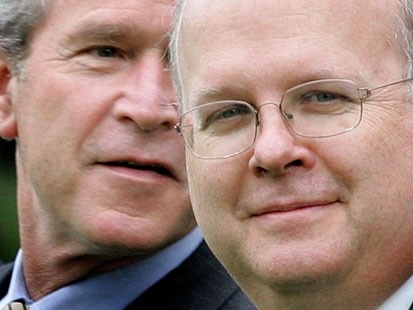
American politicos and pundits love to see a ‘realignment’ in almost every election. After 2002 and especially 2004, Rove told us all about a ‘rolling realignment’ toward the GOP. Bush was building a durable Republican majority, based on a populist, Christian-Jacksonian mobilization and the ‘Ownership Society.’ Values voters were energized, and the GOP base was bigger than the Democrats’. Rove was the ‘Architect.’ What a load of bunk that turned out to be…

And then last year, the Democrats made the same sorts of claims about 2006 and 2008. Obama told people his election was the beginning of a new era. Instead of activist Christians realigning US politics to the right, now it was the growing nonwhite population and the youth who would give Obama a reliable center-left coalition. Michael Lind particularly makes these sorts of arguments a lot. Now Krauthammer tells us this was also a fantasy.

Previous pseudo-realignments occurred in 1988 and 1994. Bush 41’s election supposedly gave the GOP a ‘lock’ (remember that one?) on the White House, and then Gingrich was going to ‘revolutionize’ Congress’ role.  Both the lock and the revolution ended just 4 years later.

All this strikes me as overheated punditry trying to reach for some ‘Bigger Story’ in every election. Most journalists and academics like to deal in big ideas and structures. Who wants to say that candidate X won because heavy November snow in swing-state Ohio drove down candidate Y’s turnout? There is a lot more randomness than we probably want to admit. Yes, there are big structures in US electoral politics, but there are also clearly a lot of local effects. Kerry probably should have won in 2004, given the Iraq mess and the closeness of the 2000 election, but he was an awful candidate. The so-called transformational presidencies of Reagan and Obama were hardly massive landslide elections; in August of 1980 and 2008, both elections were a dead-heat. Gulf War victor Bush 1 should have beat a weak, second-tier governor in 92, but out came Perot to throw the whole thing up the air.

The point of these examples is to suggest that while there are big structural forces that persistently shape elections (unshakeable black support for the Democrats, e.g.), a lot more of the electorate is in play than we admit, especially in retrospect when we desperately want to find ‘Big Explanations’ and ‘Important Trends.’ Further, it is quite healthy actually that the electorate is so competitive. Polarization of the voters into two sharply divided and political consistent voting blocs is a recipe to divide the country against itself – as we saw with the Red-Blue divide of 2002-2006.

I think the search for realignments in every election comes from two journalistic desires. First, journalists probably want to think their work is tapping into something big and important. Who wants to write about how a sex scandal or loopy political family member cost someone an election? It is far more exciting to say things like the end of the Cold War, globalization, ‘postracialism,’ etc. drove an election outcome. Journalists probably want to be purveyors of big ideas and make a philosophic, rather simple day-to-day, contribution. Hence every election is scrutinized with a desire to find a big meaning. Then you can write books like this or this. This is probably a worthy instinct, but I have the sneaking suspicion it is rooted in a journalistic craving for academic/philosophic prestige (to be a public intellectual), particularly against academics, who professionally deal in big ideas and like to disparage bad social science as ‘journalism.’

Second, I think the realignment schtick helps create a comforting sense of predictability about US politics, and also justifies why we listen to journalists to begin with. This makes the exciting but clearly erratic US democracy feel more certain when we talk about it, and more importantly, ‘experts’ need that predictability if they are going to be experts. Cookie Roberts is already the flakiest commentator on TV, but no one would ever listen to her if she did not have the pseudo-certainties that come from these biannual ‘big explanations.’

Of course, there are big explanations, and the work of EJ Dionne and M Lind is actually quite good. But my sense is the realignments are usually of certain subgroups who don’t represent enough of the electorate to make elections really predictable. We know, e.g., that something like 1/3 of voters make up their minds on election day, and that name-recognition drives a huge amount of the House vote. But certainly specific blocs of voters have realigned. Civil rights is an obvious example. It drove blacks permanently to the Democrats, and rural white Southerners to the GOP. But simultaneously other groups have de-aligned in the last 50 years, and this gets a lot less attention. Jews and Catholics are good examples. Both were mainstays of the FDR coalition, but now they are so much in play that it is probably oxymoronic to speak of a Jewish or Catholic vote. Neither Israel nor abortion has created a meaningful GOP ‘capture’ of these groups. Women too are hardly a Democratic bloc; feminism has only at best a weak appeal.

So instead of trying to find a Bush- or Obama-driven realignment in the last 10 years, why not note that both had success in battleground states, and that the number of swing-states is actually fairly large now? And how about also mentioning how this is healthy for the republic? It keeps politicians on their toes and forces them to reach out to different communities and build bridges. This is good.

Ft. Hood, the Unpursued Possibility of Mini-Terror, and the Failure of al Qaeda in America

r3205516650

I have been teaching terrorism since 2003, and again and again, I have asked where is the mini-terror campaign against American infrastructure and civilians?

Al Qaeda has a well-known penchant for mega-terror. 9/11 is an obvious example, as was the attempted sinking of the USS Cole in 2000. Other foiled plots included wild efforts to blow up multiple hijacked planes over the ocean, and this year’s more varied mega-efforts.

Yet this has always struck me as strategically foolish for al Qaeda after 9/11. Post-9/11, the US is pursuing al Qaeda all over the place. Institutional security, hardening of civilian infrastructure,and homeland defense are all vastly improved. It is much harder to hijack a plane or blow up a building now. Mega-plots are hard to organize. They are complex and expensive. They require more staff, more preparation, etc. With so many moving parts, it is easier to catch and unravel them, especially given the long build-up time necessary and the greater western vigilance post 9/11. The 9/11 plot was a one-off opportunity; its very completion eliminated such an opportunity for future plotters by insuring a major subsequent security beef-up. It benefitted from the low scrutiny and attention given to terrorism pre-9/11. Insofar as it permanently heightened western awareness of suspicious activity, it has become significantly harder to pull off mega-terror since then, at least in the west.

Given this western police awareness and sensitivity to big plots, why doesn’t AQAM (al Qaeda and associated movements) pursue mini-terror, like Fort Hood or the Virginia Tech shootings? Terrorism is well-known as an asymmetric tactic, so if western agencies are keyed into mega-plots, why not adjust and go the low route?

A mini-terror campaign would focus on the softest of western civilian infrastructure, as it does in Israel – malls, shops, buses, restaurants, etc. The sustained mini-terror campaigns of Hamas and Palestinian Islamic Jihad were brutally successful at destabilizing Israeli society in the 1990s, as the Bader-Meinhof gang was in the Germany in the 70s. If I were an enterprising young terrorist looking to make my mark (think Abu Musab al Zarqawi), I would take these urban war tactics right to the US. Consider:

1.  how easy it is to enter the US illegally; something like a million people a year do it.

2. how easy it is to buy a gun, legally or not, in the US.

3. how many people Nidal Hasan (Ft. Hood) and Seung-Hui Cho (Virginia Tech) killed and wounded simply with pistols.

4. how many old people, children, and pregnant women go to your nearest shopping mall, and how obese the guards look.

5. the crippling, popular paranoia 2 or 3 such mall massacres would create in the US (imagine the Fox News response!).

This scenario seems so blindingly obvious to me, it cries out for explanation why it is NOT happened: three or four OBL-wannabes slip across the Mexican-US border, paying the vast human smuggling networks operating in northern Mexico to get them over. They then hit a gun show in Texas, because gun show gun sales require no background check. They then head off the nearest shopping mall. Learning from Cho, they chain or block the ground-level exits. They then walk in and start shooting. In 20 minutes they could kill 100+ unsuspecting, unprepared, slow-moving people. A few of these massacres would then create a massive populist outcry to treat US Muslims as we did the Japanese during WWII. And this is exactly what AQAM wants – the clash of civilizations right in the heartland of the infidel.

Given that this has never happened, especially when it would be so easy, a serious research project is waiting to be written. The answer is not simply that US Muslims are well-integrated. That did not prevent the 9/11 hijackers from penetrating the US, nor did it stop Hasan this month. I think a better answer is that of John Mueller – that the Islamic terrorist threat may in fact be wildly overblown. If it is this easy to kill so many Americans and stir up mass islamophobia, then the only reason it hasn’t happened is because there a lot fewer radical Islamist suicide killers than we think. This a guess though; this question needs a real researched answer.

The Ft. Hood Shooter and the Dual Loyalty Question

1-091112 

As has been noted, too much of the commentary on the Fort Hood shooting has avoided the fairly obvious, albeit very politically incorrect, explanation. Clearly Hasan, who yelled ‘Allah akhbar’ during the killings, was murdering out of jihadist-fundamentalist intent. These were the same last words heard from Flight 93 over Pennsylvania. Given that the US has a Muslim population of at least 2 million (the data are hotly contested), it is hardly unlikely that all US Muslims remain untempted by the binladenist call. In fact, given Europe’s thorny problems with jihadism, it is remarkable how little of this has happened in the US.

This does not mean, of course, that all Muslims are radicals or that some sort of ‘green scare’ is necessary or whatever. But that is a straw man used to deflect serious discussion. We should also not use ‘islamophobia’ as a racist slur to prevent a serious investigation of Hasan’s motives and a national discussion about the integration process that so spectacularly failed in his case. If anything, the initial US reaction was so adamantly worried about this possibility, that the analysis, for all its good intentions, has obviously missed the real reason. It is politically correct to suggest stress and syndromes and such, but it is also rather dishonest.

Hasan actually fits a fairly well-known profile of Muslim bombers and fanatics who have emerged from the West. They feel deeply alienated by the GWoT. They worry that it targets Muslims, not terrorists, and that the GWoT is really a Judeo-Christian crusade against Islam. They feel deep conflict between their ties of citizenship and religion. Frequently they are socially isolated, and their vague discontent is catalyzed and metastasized by some radical cleric or website. Olivier Roy has done a lot of good work on the alienation Muslims living in the West feel, and how that alienation can drive extreme cases into terrorism. Try here and here. This profile fits the 9/11 hijackers, the Scottish airport assailants, and the London bombers.

The issue we seem to loathe finger for multicultural PC reasons is the ‘dual loyalty’ problem, but it so clearly obvious here that it cries out for discussion. It should be blindingly obvious that most people hold multiple identities or roles and that these will conflict. They do so in our lives everyday. Our roles as professionals at work collide with our responsibilities to our families. But if we apply this strikingly obvious logic to race/religion/nationality questions, it simply becomes taboo in US.

Because the US is an immigrant country, this logic creates terrible tensions. So we have admirably tried to ignore it, but turning away doesn’t mean it goes away. Indeed, what softens that dual loyalty problem is integration over time – the Americanization that comes from living in the US for several generations. Just about everyone’s grandmother gets off the boat with deep ties to the Old Country. The parents straddle the Old and New Country with proficiency in both languages. The grandkids don’t speak the old language at all, indulging only silly multicultural fantasies of ‘finding their roots,’ even though anyone from the Old Country would immediately tag them as an American. By the great-grandkid’s generations, the Old Country is a misty myth, and the great-grandkid’s spouse is likely to be of another ethnicity anyway. Hence, Americanization.

As Samuel Huntington notes, the requirements of US citizenship are comparatively light. This means just about anyone can join the US national community. It also ensures a certain level of cultural frisson that simply would not be tolerated in many other countries. Clearly simply handing someone a flag or a driver’s license does not insure Americanization, nor, does even the military uniform of Hasan (a great surprise, that, actually). Far more likely is time and sociality. Mixing, learning, speaking the language, interaction, slowly wears away the sharp conflict of identities and helps each individual informally reconcile possibly competing loyalties.

Islam however does raise particular issues of integration, as Islam frequently defines itself as a ‘way of life,’ rather than simply a ‘go-to-service-on-the-weekend’ religion that most Americans profess. Insofar as Islam indulges totalist visions of religion as an all-encompassing lifestyle, the pluralism and tolerance necessary for living in the West may not come easy. (For a similar problem, consider the unique status of the Amish.) This seems to be Europe’s great problem. America’s Muslims seem to have made their peace with pluralism better. That needs to be explained; there is a good dissertation there.