Robert E Kelly

Political Science, International Relations, East Asia, US Politics…and, yes, the BBC Dad

Robert E Kelly

The Inter-Korean Stand-Off Needs Political Resolutions, Not ‘Peace’

U.S.-South Korea AllianceThis is a re-up of an essay I wrote a few weeks ago at 1945.com on the debate over an ‘end of war’ declaration in Korea. The debate has passed, but it was pretty hot in December and January, when Moon was pushing pretty hard for it.

My big concern about the end-of-war declaration was that no really knew what it means. If it were a treaty, it would be called a treaty and would be binding. But since it is not, would it be binding? No one really knows.

It is highly unlikely that North Korea would alter its behavior because of it, so I think the drive behind was: A) Moon’s desire for some kind of legacy after 5 years of hyperbolic but failed diplomacy with the North, and B) grounds for the activist left in South Korea to say that the US and UN should leave South Korea and that UN sanctions should be rolled back

If the South Koreans want us to leave, then of course we should. But I wish Moon’s coalition were more honest about why they sought this thing. The Biden administration dragged its feet until Moon finally dropped it. It is painfully obvious that Biden does not trust Moon after he played Trump (to meet Kim by suggesting he’d win a Nobel) and is just waiting for the next POTROK.

Here’s that essay:

As the presidency of Moon Jae-In in South Korea winds down, Moon has pushed hard for an ‘end of war declaration’ (EoW) over the still legally unfinished Korean War. Last week, I argued in this magazine that this declaration is curious approach. The inter-Korean armistice is pretty stable, and when it is broken, it is North Korea which does the breaking through its frequent border provocations. Also, legally, no one really knows what this declaration would do. A treaty is the well-established tool for ending wars; an EoW declaration is a diplomatic neologism. It is not clear if this declaration is intended to replace the armistice or a potential treaty, or supplement them in some unknown way. Or perhaps it is just symbolism.

For the rest, do here please.

South Korea’s Very Limited Re-Opening

clip_image003This is a local repost of an essay I wrote last week for The National Interest

I wrote it in response to growing interest in the US in ‘re-opening.’ South Korea is further along the corona timeline than the West, and it dealt with corona very well. So if there is any economy ready to re-open, you would think that it is South Korea’s. Except that that is not really happening.

It’s true that restaurants are re-opened, that you can eat in them in proximity without a mask, and that masking generally is declining a bit. But not much. And most things are still closed – schools, concerts, museums, aquariums, marathons, whatever. And the government here is not talking about mass opening at all like the US discussion, especially on the right. In fact, it’s the opposite. The South Korean government keeps saying this will be a long slog, at least for the rest of the year.

The full essay follows the jump: Continue reading

Controlling Corona Meant South Korea’s Election was Not Dominated by It

Commentary: Coronavirus? Not a problem for South Korea elections ...This is a re-post of an essay I wrote for the Lowy Institute a few days ago about the recent South Korean legislative election.

This was written before the vote, so it is not a commentary on the results. My concern here instead was to illustrate that democracies can in fact run elections during this pandemic without some Wisconsin-style choice of vote-and-risk-corona or stay-home-and-forego-your-franchise. That was absurd, and the GOP’s disturbing willingness to make voting hard during a pandemic is an embarrassment bordering on authoritarianism. Here are some pics from when my wife went to vote; you can see that it was not some kind of death-trap.

For my thoughts on the results, try this and this. Basically, the right got buried and really needs to figure out what it stand for going forward besides anti-communism. Also, I am uncomfortable that this is yet another missed opportunity for a national referendum on President Moon Jae-In’s outreach to North Korea. Obviously, corona was unanticipated, but it pushed off the agenda the most important, revolutionary policy of the Moon government. That is unfortunate.

The full essay follows the jump:

Continue reading

The Floyd Protests: The South Korean Police are Far Less Belligerent than US Departments

upload.wikimedia.org/wikipedia/commons/d/d2/Sea...

This is a local repost of an essay I wrote for The National Interest. Like everyone else, watching the brutality of the US police in the last few weeks has been genuinely shocking. So this essay discusses how a police force with a reputation for brutality during a previous dictatorship came a long way.

This is based on this original tweet thread.

The short version is that the South Korean police haven’t gone through the militarization the US police has. And South Korean police don’t face a heavily armed citizenry, so they don’t need to engage in an arms race against their own people. The result is a disarmed, de-escalatory police culture, which, as an American accustomed to the stormtrooper look and pose of US cops, I find just fantastic. Interactions with the police here are far less fraught and intimidating.

The full essay follows the jump:

A Quick 5-Point Summary of My Thinking on Corona in South Korea, Plus Links

Image result for corona

There has been way too much sensationalism about corona, so firstly, go wash your hands, drink a beer, and relax.

I was traveling for the holidays for awhile, so this is my first blog-post in awhile. Sorry.

My basic take on corona in South Korea is:

a) It is not a national catastrophe, and the foreign media has been too sensationalistic (CNN particularly). Yes, it is uncomfortable and disruptive, but it is not bringing down the state, creating panic on the streets, an apocalypse scenario like you’ve seen in zombie movies, and so on.

b) The big retrospective error will be understood as the SK president’s decision not to ban Chinese travelers. In fact, Moon Jae In still has not done that, which I find totally inexplicable beyond obvious political pressure from China not to do it

c) The disease’s spread is due in part to SK’s basic liberalism. The liberal state cannot coerce people to stay in their homes, take intrusive physical exams, throw them into camps, and so on (barring some really extreme national emergency which corona is not yet).

d) The South Koreans are actually doing a pretty admirable job in dealing with this. The population is broadly complying, and voluntarily so, with the government’s recommendations. There is no rioting, panic-buying, xenophobic explosions, and so on. As an American who was raised on the Reaganite idea that the government can’t do anything right, it is pretty damn impressive to see the deep capacity of the South Korean state and the cooperativeness of South Korean society once fully mobilized. I really doubt Americans will respond with the calm and discipline you see here.

e) The real Korean corona threat is an outbreak in North Korea. The government there is an incompetent mess when it comes to social services, and medicine is primitive for most of the country. So you know what Pyongyang will do with infected people – throw them into concentration camps to die with almost no assistance. It will be a tragedy which none of us will see.

Here is my recent writing:

1. What’s the Corona Outbreak in South Korea Like, update 1

2. What’s the Corona Outbreak in South Korea Like, update 2

3. What the US Should Learn from South Korea’s Experience with Corona

4. Corona in North Korea

5. South Korea’s China-Corona Dilemma

6. South Korea can’t just Lock Up Corona Infectees

Trump and Moon are the most Dovish Presidents Ever on N Korea, and Kim will Still Give Them Nothing

This is a repost of an essay I wrote earlier this month for The National Interest. My argument is that Kim Jong Un is passing up his best chance for a deal for years, maybe decades, to come. Both Moon and Trump are extremely unusual, and favorable, counterparties for the North.

Most South Korean and US presidents have been either hawkish or very hawkish on North. Doves haven been rare – two SK presidents between 1998 and 2008. But neither of them ever went as far or talked as détente-ish as Moon does. Similarly, Trump is a huge outlier for US presidents on North Korea. He has made a far greater and more personal outreach effort than ever before.

And that these two dovish presidencies currently overlap is unique. This is a fantastic alignment for North Korea and almost certainly won’t last. If Pyongyang really wants a deal, this is the time to go for it.

Instead, they have played Trump for a fool – getting the legitimating photo-ops with POTUS while giving up nothing – and been surprisingly cold toward Moon’s repeated outreach. As so often, it’s their way or no way at all.

Expect hawks to cite this behavior in a few years to justify a much tougher line on NK. The missed opportunity between 2018 and 2020 will be seen on the right and center as proof that NK doesn’t want a deal, even under very favorable circumstances.

The full essay follows the jump:

Continue reading

Does Trump Want to Withdraw from South Korea if He’s Re-Elected?

download

This is a local re-post of an essay I wrote this month for The National Interest.

I keep hearing this idea on the lecture and conference circuit in East Asia – that Trump wants to withdraw from South Korea and a second term would open that possibility.

The big problems for Trump, if he really wants to do this, are 1) US bureaucratic resistance, and 2) his own laziness and incompetence. That is, much of official Washington would oppose a SK retrenchment. Just as it did Jimmy Carter’s late 1970s effort to withdraw from South Korea.

But Trump is POTUS in a highly presidentialized system. He might be able to win the battle Carter lost, but Trump would have to really work at it – get on the phone, have face-to-face confrontations with the military, use the bully pulpit against the pundit network who would oppose this. But Trump is so lazy, and so uncomfortable with personal confrontation – this is why he fires people over Twitter – that I doubt he has the focus to push this.

Curiously though, Trump might find a sort-of ally in SK President Moon Jae-In. The SK left has long had an ambiguous relationship with USFK as ‘neo-imperialists’ bullying the ROKG. I doubt Moon’s leftist coalition would push back much if Trump tried to do this.

The full essay is after the jump:

Without Strategic Change, a Korean Peace Treaty would be a Formality

Image result for korean peace treaty

This is a repost of an essay I wrote for The National Interest a couple weeks ago. The gist of it is that there a lot more hurdles to a Korean War peace treaty than many people realize. That is why it hasn’t happened yet even though it seems pretty intuitive, if not obvious, given that the war has been de facto over sine 1953.

The two big reasons are:

1. A peace treaty potentially undercuts the legal ground for the UN/US structure in South Korea. This, most have long thought, is a big reason the North wants it. If there is formal peace in Korea, what is the US military still doing there? The South Korean left might accept this logic, but the right will not. This is why SK President Moon Jae-In can’t get this idea past his own people. There is not enough consensus for it.

2. A peace treaty may well violate the South Korean constitution, which denies North Korea’s existence. Moon may not even be allowed to sign such a document, which is pointless without SK participation. Worse though is that a peace treaty formalizes and locks-in the division of Korea indefinitely. Again, the South Korean left and SK youth may not mind that, but I don’t think that is enough for the South to formally surrender unification on Southern terms. That woo would be another huge political fight.

The full essay follows the jump:

Would Unified Korea Keep the North’s Nuclear Weapons? Perhaps to Pursue a Neutralist Foreign Policy

Image result for north korea nuclear weaponsThis is a local re-print of an essay I published at The National Interest a few weeks ago.

The basic idea is that a unified Korea, even one unified under Southern leadership, has much stronger incentives to keep the North’s nukes than most people seem to think.

Generally, everyone seems to think that a UROK (united Republic of Korea) will give up its weapons to the American or, maybe, the Chinese. Or maybe destroy them. But keeping them would be a great way to keep a UROK out of the looming great power contention in northeast Asia between the US, China, Japan, and Russia.

If you are tiny Korea – the shrimp among whales – you want to stay out of the way when these big boys fight. That will be tough given Korea’s geography right in the middle, but nukes would be a really great way nonetheless to insist.

Also, nukes are a great way to defend sovereignty generally against all interlopers, even if there is no regional hot war. Even after France became friends with Germany after WWII, it still built nukes to make sure Germany never invaded it again. A UROK would almost certainly think the same way about its neighbors given their history kicking Korea around and manipulating it.

I am not sure. A UROK still allied to the US would come under a lot of pressure to denuclearize. But the probability of retention is way higher than most people think.

The full essay is after the break.

Continue reading

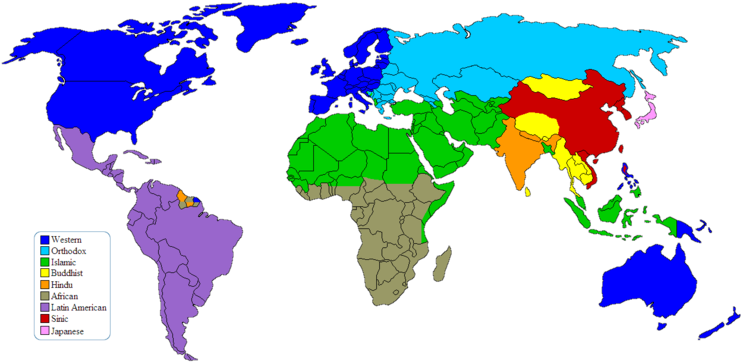
Trump’s ‘Clash of Civilizations’ with China: Huntington’s Model doesn’t even work in East Asia

Image result for clash of civilizations map

This is a re-post of an essay I wrote for The National Interest a week ago.

Basically my argument is that even if you are a hawk on China and see it as an emerging competitor or even threat to the US, the clash of civilizations framework is a weak analytical model by which to understand Sino-US tension.

The big problem is that Huntington builds his civilizations everywhere else in the world around religion, but in East Asia he can’t, because that would make China and Japan – who are intense competitors – allies in a Confucian civilization. Making Japan and China allies would be ridiculous, so Huntington can’t use Confucianism as a civilization, even thought that so obviously fits his model for East Asia. Hence, Huntington falls back on national labels, identifying separate ‘Sinic’ and ‘Nipponic’ civilizations. This ad hoc prop-up of the theory undercuts Huntington’s whole point of arguing that national distinctions are giving way to civilizational ones and that therefore we should think of future conflicts as between civilizations, not nation-states. Well, apparently East Asia didn’t make that shift; conflict here is still nationalized. So

There are other issues I bring up as well, but that’s the main problem. Please read the essay after the jump…

Continue reading