The Tea-Partiers and US Foreign Policy, post-2010 election

tea-party-signs

So Obama took the ‘thumpin’’ that W got back in 2006. I find this unfortunate generally, because I believe the GOP is still unreconstructed from the dark days of George W Bush. Yes, the Democrats are protectionists tied to rapacious public sector unions, but the anti-science, jingoistic GOP is worse. I worked for the GOP on-off throughout the 1990s and cast a heartfelt vote for Bob Dole. But when Bush said Jesus was his favorite political philosopher in 2000, he lost my vote, and things went downhill fast – Iraq, torture, ‘big government conservatism’ (ie, debt), Katrina, Rumsfeld, etc. Yet astonishingly, the GOP learned nothing in the wilderness and got even worse after W – which still confounds me – with the rise of Sarah Palin. She and the Fox News set of Hannity and such strike me as astonishingly unserious; I recall reading that McCain’s people had to explain to Palin why there are two Koreas! With their capacious, uncompromising rhetoric of freedom or American power and awesomeness, I just can’t image them actually doing the hard, compromising business of government.

So on their big day of triumph, that is my ultimate question about the Tea Partiers – American exceptionalists in the extreme – about foreign policy. Consider:

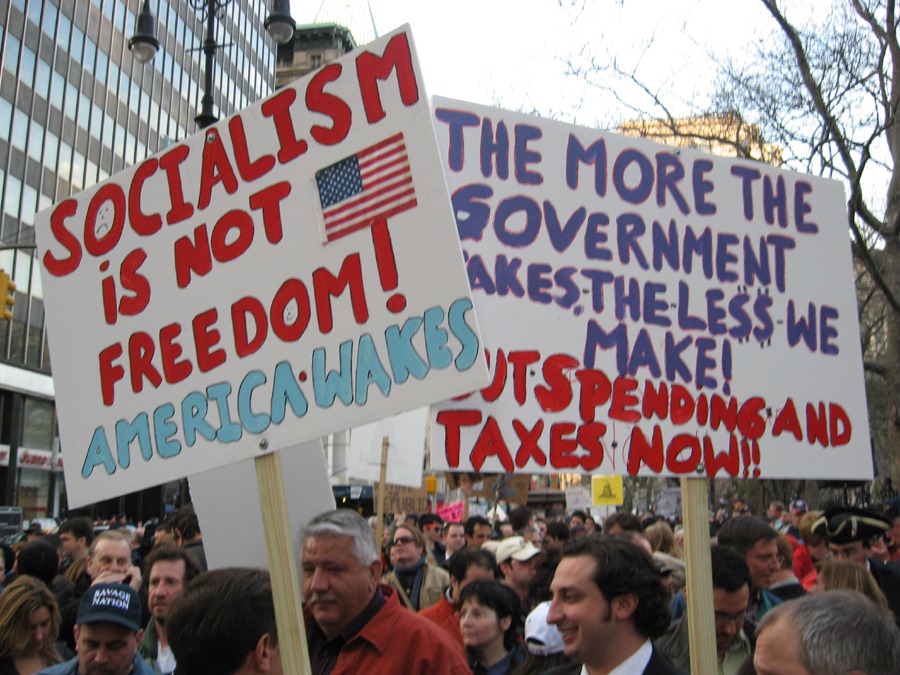
1. Tea Partiers worry about debt, but nothing bloats out government like defense. The combined budget for national security is around $1 trillion, if one includes intelligence, veterans affairs, some relevant homeland security spending, and the Department of Energy’s control of US nukes with the traditional DoD budget. I just saw Rand Paul on CNN. In his acceptance speech he talked about freedom from socialism and crushing debt, but as Andrew Sullivan identified months ago about the movement generally, Paul did not mention what he will cut. And none of them seem prepared to say that Defense really needs to go on a big diet, unless you want to start cutting Medicare/Medicaid/Social Security.

Defense plus M/M/SS are 80%+ of the budget, so something’s got to give. Is the Tea Party ready to chop defense as the Brits just finally admitted was necessary? I don’t see this, given how super-nationalist the Tea Partiers are. Their rallies were filled with endless paeans to the uniformed soldier. But Americans love M/M/SS entitlements too; no one wants grandma to lose her check either, regardless of their feelings about ‘socialism.’ I would love to see a serious debate inside the GOP, like just happened among Britain’s Tories this fall, on how to square guns-and-butter. That the Tea Party simply will not go into the details and grit on this is why I just don’t believe they’re serious. (Try here for ideas on DoD’s needed diet.)  Obama may a ‘socialist’ to them, but I don’t see them proposing what parts of the government to close to save the money. Even WR Mead admits this about the movement.

2. What do the Tea Partiers say about the rise of Asia and the BRICs? Phillip Stephens really nails this, IMO. Obama has tried to push the US to adjust to a world where US power is imperiled by overstretch (from huge debt and two wars) and simultaneously confronted by the ‘rise of the rest,’ ie, the growing wealth and social mobilization of much of the former third world. I don’t mean just China and India either. Lots of places are closing the gap with the US as they get wealthier. Smaller countries too like Turkey, Indonesia, S Korea, South Africa, etc. are all getting wealthier and so more capable of resisting US pressure, forging deals and agreements beyond the US, etc. As I’ve said before, this not the end of American power – only intra-US foolishness like the Iraq War and the debt can do that. But the social and economic modernization of much of the planet through globalization does slowly reduce the US room to maneuver. Hence we have the G-20 now.

Yet I see no recognition of this in the Tea Party, only endlessly repeated neocon/theocon narcissism about America as the greatest country on earth. I really do wish American conservatives would travel more to grasp that they are limits, that God is not an American, that foreigners find this sort of rhetoric deeply insulting, etc. This partly what I meant about the Tea Party simply not being serious. The Tea Parties, so far as I heard and read their stuff, are militant in insisting on Henry Luce-style US exceptionalism. This may make good politics against Obama the non-citizen Muslim, but in the real world, it is is poor training for the serious trade-offs the US faces in a crowded, ‘post-Atlantic’ world, where the US fractions of global GDP and global population are in decline and many foreigners don’t trust us after W.

Shallow, narcissistic talk about how awesome the US is, how it is the greatest force for freedom in the world, or the most amazing place in history is not actually real geopolitical analysis at all. It does nothing to prepare the US electorate for challenges like the Chinese juggernaut, a looming defeat in Afghanistan, a NATO unable and unwilling to fight with the US much at all anymore, climate change, etc. The irony of course is that earlier Republicans did in fact talk seriously about foreign policy. Nixon, Kissinger, Scowcroft, Bush 1 – all spoke realistically about America’s reach. This is exactly what the US needs now given the debt and dysfunction of the GWoT. Hence I like Obama’s more restrained style, such as the Cairo speech. But neoconservatism seems to have replaced realism as the dominant foreign policy ideology of the GOP, and too much of it is easily politicized fantasy to stroke the American ego about our ‘special role.’

Japan is an EU Country Trapped in Asia

japan_us_flag

The Council of Foreign Relations blog, Asia Unbound, is quite good. If you don’t read it, you probably should before you read my stuff. To be sure, CFR is establishment; indeed, it is the very definition of the foreign policy establishment in the US. So it is not exactly the font of challenging new ideas. But still, they are linked into power in way that lonely academic bloggers will never be. And this week’s bit on Japan really got me thinking about how Japan is basically stuck with the American alliance indefinitely, whether they like it or not.

Recall a year ago when the LDP got whipped in the election, that there was lots of talk about how Hatoyama was going to create distance between Japan and the US, how this was a new dawn in the relationship, how the Japanese left would be so much more prickly with the US than the old boys network of the LDP. I was fairly skeptical of this at the time, and I think the recent flap with China over the islands has done a lot to confirm that skepticism.

Japan really has nowhere else to go but the US. It is stuck with us, primarily because it is geographically fixed in a neighborhood where it has no friends. And this opens all sorts of room for the US to push and bully Japan, which leads to regular Japanese outbursts that Japan needs to be independent of the US. (For the most famous, read this.) In fact, Japan is like a post-modern EU country in the wrong place. It should be comfortably ensconced in a post-national intergovernmental framework like the EU, where it could promptly forget about history and defense spending, and worry about how to care for its rapidly aging population – like Germany is morphing into ‘Greater Switzerland.’ But it’s not. Instead, Japan is trapped in modernist-nationalist-historical Asia, surrounded by states that don’t trust it and who want a lot from it that it doesn’t really want to give (historical apologies, imports, engagement, development aid, territorial compromises).

Consider that Japan, like China or Russia, has no friends or allies (save the US), and lots of semi-hostile neighbors:

Russia: Neither side has much interest in the other. There is an island dispute that has blocked normalization for decades. And, of course, Russia has been an erratic partner for just about everyone, not just Japan, since the end of the Cold War. So there is nothing to gain there.

Korea: There is also an island dispute with South Korea, over which even North Korea (!) has supported the SK position. NK kidnapped Japanese citizens in the 70s, and this has remained a permanent fixture in Japanese politics. For the North, Japan is high-up on the hit list; the North has launched missiles over it. Relations with the South are possibly even worse. S Koreans are intensely japanophic. The island dispute (Dokdo) rouses extraordinary passions here. Finally, of course, both Koreas are furious with Japan over its invasion and colonization from 1910-1945 and feel that Japan has never properly apologized.  Given how much S Korea and Japan share – democracy, concern over China’s rise, a US alliance, fear of NK, Confucian-Buddhist culture – they should should be natural allies, but Koreans will tell you with a straight face that Japan wants to invade it again. So forget that.

China: Yet another island dispute plagues the relationship from the start. And like Korea, so does history. The Japanese were even harsher in China than they were in Korea. The Rape of Nanking was brutality on par with the Nazis, and the Japanese used biological warfare against the Chinese as well. As the CFR post linked above notes, anti-Japanese street protests are becoming a regular part of Chinese politics now. A Sino-Japanese reconciliation would require astonishing, Willy Brandt-style statesmanship that the immobilist Japanese political system is wholly incapable of delivering.

Southeast Asia/India: Things get a little easier here, if only because it is further afield. But the ASEAN states too suffered under Japan in WWII, and like China and Korea, don’t feel that Japan has engaged in the appropriate historical reckoning. Only India is a possible serious Asian ally of the future because of mutual concern for China and the lack of historical-territorial problems.

Bonus problem – Economic Decline: As if this unhappy neighborhood weren’t trouble enough, add in Japan’s bizarre economic malaise. When China, Korea and the Soviet Union/Russia were a mess a generation ago, Japan could strut in Asia, but now these competitors are closing the gap while Japan stagnates. That just makes all the frictions that much harder to manage. China is so big, it can afford to miff the neighbors, but Japan no longer has this luxury.

In short, a weakening Japan so infuriates it neighborhood, that the US is all its got left. Given Japan’s paucity of options, the US has lots of room to bully and push Japan. But it must ultimately give in, because it’s position in Asia alone would be terrible – isolated, suspected, friendless. So bad is Japan’s position, that the US could effectively bring down the Hatoyama administration over something as minor as Futenma.

This is not meant to be an endorsement of US wedge politics against Japan. But it should certainly explain why its 20-year old complaint about US dominance has led to nothing, just like Gaulle’s petulant withdrawal from NATO ended in ignominy when the French finally gave up on ‘expectionalism’ and rejoined last year. It’s nice to be two oceans away from the competitions of Eurasia…

Is there Halloween in Korea? Alas, no…

I still love Charlie Brown 30 years later…


It’s Halloween, so here is something semi-serious – if US holidays show up in Asia, is that proof of cultural Americanization?

One of the things I miss most in Korea as an expat is the US holiday season. In terms of fun, parties, color and festivities, nothing beats the three-month run of Halloween, Thanksgiving, Christmas and New Year’s. Interculturally then, it is always interesting to see how much of this washes into other countries, given the endless debate about Americanization, globalization as cultural American imperialism, and all that.

In that vein, readers from the left might be glad to hear that little of that occurs in Korea. US holidays are generally un-celebrated here. While Korea is christianizing rapidly, Christmas has not even come close to the annual fun-time blow-out it has become in the US. It is still a religious holiday, not the cultural and shopping event it has evolved into in the US. (Ironically, religious conservatives who disdain the commercialization of the holidays might like the Korean attitude.) And Halloween has come mostly as an odd American event that is seen as somewhat fun, but kind of strange. When I explain Halloween to Koreans – Hallow’s Eve as the last night for evil spirits’ rampage in old Christian tradition – most Koreans find it fairly ridiculous. And all those new Korean Protestants don’t seem to know that story either.

Because of the big US presence in Korea for decades – first political-military, then commercial, increasingly now religious (American Protestantisms are pretty successful here) – you do have an awareness of US holidays, and some celebrations. But interest in this among Koreans generally serves Koreans’ interest to demark themselves from their fellows as cosmopolitan, worldly, and traveled. Ie, if you’re a Korean who celebrates Halloween with some resident expats, then you are ‘linked-in’ to the US culture in a way other Koreans are not, and that is a mark of social prestige. It is ‘cool’ to be able to say you celebrated Halloween with some white guy, kinda like it was to own a pair of blue jeans in the USSR.

In practice, then there is no trick-or-treating at all. Koreans mostly live in high-rises anyway, so trick-or-treating would be a weird, vertical affair requiring constant one-floor trips in the elevator. Horizontal neighborhoods filled with lights and people ambling about don’t really exist here. There are Halloween parties though. Korean clubs have them, but I have heard they are pretty strange events – just like a regular night at a club, only with some people in weird make-up. (Technically, there is no race-line for club attendance, but there are Korean clubs where foreigners would just never go in practice.) Ultimately though, it is the expat bars that try the hardest. They have costume contests and catch the spirit pretty well. The best expat bars are mixed; ie, Koreans come too. My impression though at these has always been that Koreans in attendance find the whole thing pretty bizarre and don’t get it at all.

So enjoy your Halloween. You are lucky to have the real deal…

When to Just Give Up on Territory Disputes: Palestine, Kashmir, Dokdo?

imagesCA5GWV6N

One of the most basic tenets of almost all IR theorizing is that states are territorial, literally, and obsessed with holding, if not expanding what space they have. Even if you aren’t Alexander the Great or Napoleon, out to conquer whatever is there, you still want to hold on to at least what you have. Territory is a fundamental requirement of statehood (ask the Kurds), and more is better given land’s inherent scarcity. The logic for this is simple. There is only so much real estate in the world. Barring extreme scenarios like suddenly easier land reclamation (from the sea) or interplanetary colonization, space on earth is finite. So the race to control space is by definition a zero-sum game (the Scramble for Africa). If I have it, then you don’t. The more you have, the more secure you are from others (the further away they are), the more people you probably have, the more resources you are likely to find under the ground, etc.

And this logic is backed up by loads of empirical evidence. The Japanese fight individually with Russia, Korea, and China about islands. The USSR and China fought a border war, as did the PRC and Vietnam. The US Union invaded the Southern Confederacy. The Israelis and Palestinians seem ready to kill each other over inches of barren desert. I recall reading somewhere that after the Israeli withdrawal from the Sinai, Egypt sued Israel in the World Court over several hundred feet of extra space Israel wanted to hold for a hotel or something. (Egypt won.) And the above map makes clear just how severe the territorial dilemma can be for micro-states like Israel. (Do not take the source of the map as my endorsement of Israeli policy in the occupied territories; I chose it just because it makes my point well.) No state wants to be dismembered, and lots of blood in history has been spilt trying to expand one’s land space (imperialism).

But Israel’s endless troubles holding the Palestinians, much less converting the Palestinian space and people into exploitable resources rather than manpower and money sinks, or India’s endless quest to quell and hold Kashmir, raise a good IR theory question: when is it time to just give up and take less? I am not sure if this question has been researched much because we worry, obviously, more about expansionism and irredentism than voluntary cession. But there are some good examples of this also. This article got my thinking how Sudan’s Arab elite has simply decided to throw in the towel after 25 of years of civil war with the south. 15 years ago, Ethiopia’s government decided to do the same with Eritrea. And Britain, I think, secretly hopes the Northern Irish Catholics will outbirth the local Protestants and vote for republican unification, hence ridding Britain of the endless Irish question. In Korea, I frequently argue that Korea needs Japan more than Japan needs Korea, because NK is so scary, unification with it will be so expensive, China is so big, and the US is in relative decline in Asia. Hence, it would make national security sense for Korea to try to come to some kind of deal on its island dispute with Japan (the Liancourt rocks [Dokdo]). Better relations with Japan would help Korea prepare for the Chinese challenge and bolster it in the stand-off with NK. Nor is there anything of value on Dokdo (it’s a bunch of rocks, like most of the West Bank too) and because it is uninhabitable, control of Dokdo has no implications for division of the sea or seabed. In short, the benefits of a deal are high.

So there is a cost-benefit analysis at work here. At some point, an enduring, costly stalemate may just not be worth it. I can see a few reasons why:

1. Your country is already pretty huge, or the land disputed is comparatively tiny. If I were India, I think I would be pretty close to giving in on Kashmir. India is huge, both geographically and demographically already. How much does Kashmir really matter when you already have 1.3 billion people ? For Israel though, the problem is much more acute. The IDF has argued for years that the West Bank adds ‘strategic depth’ to little Israel, which, disregarding the  moral dimension, is accurate. By this dimension, the Eritrean succession surprises me, because it land-locked Ethiopia. I would have thought that would be a national interest worth toughing it out for…

2. There are no natural resources or other immediate, tangible national interests. Dokdo’s control does not alter any material element in the Korea-Japan relationship. If anything, it wastes Korean money to artificially keep people and services stationed there that would not otherwise exist but for this dispute. This is no ‘resource war.’ So what great benefit do you get beyond that patriotic tingle in your chest?

3. The disputed territory is not ‘holy ground.’ I think this is the most tricky condition, because these sorts of disputes, zero-sum in nature and frequently rooted in long-standing neighborhood grudges, are exactly the sort of thing that get layered in over-heated nationalist rhetoric about holy struggles, national identity, God-given missions and all that sort of metaphysical talk. Witness the Jewish right in Israel talking about biblical claims from Moses to the West Bank, or Hamas’ reverse claim (also made up) of the centrality of Jerusalem to Mohammed’s revelation (it was just a sideshow in the big Arabian picture). For a hysterical and mawkish Korean version of Dokdo as holy ground, try here (be sure to listen to the song). I think there is a good dissertation here.

Post-Western Global Governance?

bric

These two articles really got me thinking recently about the the complexity of global governance (GG), and whether it can realistically absorb new powers, much less define itself meaningfully to policy-makers. In fact, sometime I wonder, because I teach international organization (IO), if GG even exists at all. Randy Schweller, one of my grad school profs, says basically GG is a mash-up of rules, institutions, norms, and everything else that is so complex that is effectively unanalysable. And Thomas Weiss, quite the opposite paradigmatically of Schweller, basically says the same, and that we should go back to looking at world government (hear, hear!).

I wrote my dissertation on the IMF and World Bank in the (ever-so-quaint 1990s, pre-9/11) belief that global governance was a meaningful idea, that rules could slowly creep up on the world, that most of those rules would come from liberal internationalist thinking primarily rooted in the West, and that all this was a good thing. Even belonged to the UN Association of the USA before 9/11. Yet after years of struggling to make this an analytically coherent idea (and subscribing to the excellent journal), I have given up mostly. My own research has turned back to states instead of the tortured mix of NGOs, IO, MNCS, rules, norms, regimes, etc, etc, that are somehow supposed to interrelate into multilateral, multilayered, multisectoral, networked, transnational, social constructed, complex, I-don’t-know-which-way-is-up-anymore GG. When I teach IOs, after I go through all this with the students, and they ask me for the one-liner on GG (because all good ideas can ultimately be expressed simply), I say GG is (dysfunctional) world government-light. Hence Schweller’s piece caught my attention. GG is so complex and such a confusing notion, that it obscures as much as it clarifies. And Weiss is wonderful in his frustration that no one really knows wth GG is, and that the world government discussions of the past (after the two world wars) were much more understandable and analytically useful.

Beyond the confusion though, is my growing sense that as the non-western world gets its act together slowly in the coming decades, all this GG talk will just look like preening academic liberal internationalism, our hubris in trying to extend a system basically built for the West (plus Japan) to everyone else. But everyone else (Huntington’s famous ‘the rest’) probably don’t really want to live by the rules that we have set up. In the same way that Japan never really liked its semi-membership in the Concert of Europe and never really followed its norms (it stormed around Korea and China regardless of what Bismarck or Earl Grey thought), I think the emerging powers of the world will probably be more inclined to truculence and grievance than assimilation.

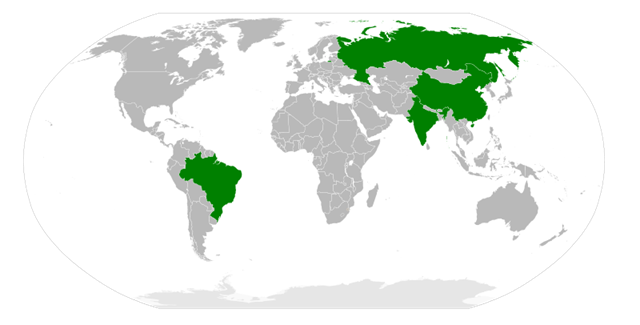
Walt calls this the end of the Atlantic Era; Mead says it is the death-throes of liberal internationalism. Increasingly, sadly to be sure, I think this is right, and increasingly my own IR thinking has drifted from optimistic liberalism to fearful realism. It makes me miss the 1990s so much. Before 9/11, the US was strong enough that we could indulge in Eurocentric intellectual flights of fancy that everyone wanted to live like us (the Washington Consensus of the indispensible nation), and that if only they followed the rules (GG), they could. But the rest of the world has been ‘rising’ (ie, modernizing, ie, it getting its act together) for several decades now, and there are a lot more of them (the Rest) than of us (the West), so inevitably as the BRICs (above map) and such come on-line, they are going to change the implementation of the rules, if not the rules themselves, if only because of their sheer bulk. China and India each have 1.3+ billion people. How can they not impact just about everything? I once heard the president of the World Bank say there would be 20 billion more people born by 2050, and 90% of them would be born outside the West. There is your one-liner for the future, not some academic tinkering about NGO access to UN specialized agencies.

Compounding these structural de-westernization trends, is the massive sinkhole of western power and strategy that the GWoT has become. The US would be declining relatively to the new risers anyway, but the $3 trillion spent on Iraq vastly accelerated this process. Does anyone remember predictions just a decade ago that China would rise so fast? Of course not, because no expected the US to shoot itself in the foot (if not the head) so badly since 9/11.

So my question then is how do we put together rules for the new post-western era. The UN, built to fail by sovereignty-obsessed nation-states, has therefore failed. It reflects a simpler world, where much of the world’s population was unsocialized, unmobilized peasantry under imperial or semi-feudal rule. So, as Schweller notes, GG was easier. There were fewer players, and they were all pretty culturally close. Today it is running the other way as previous marginalized peoples around the globe get richer, get to TVs and the Internet, complain more (especially about the US), vote their grievances, and otherwise make the liberal rules harder to enforce.

Finally, this doesn’t mean the US will be poorer or weaker, but it does mean the US will have less room to maneuver and that it will be harder to bully others into doing what we think is right for them (even if it is good for them). It’s not the decline of the US or the West, unless you equate unipolarity and Western cultural hegemony with the ‘normal’ status of the world.

Post-Unification De-population of North Korea?

north-korea-map

PNU’s Institute of Social Science Research had a good speaker this week, demographer Berhard Koppen of Landau-Koblenz University in Germany. His talk, “Demographic Change and Immigration in Germany since Unification,” focused on the population impacts of German unification. As you can imagine, the Koreans study the German model (although not as much as you’d think), because they wonder what unification will look like – how much, how long, how disruptive, etc.

Koppen laid out a lot of good demographic data on just how extreme the population shifts from east to west inside Germany have been. I don’t have all the numbers in front of me, but it was pretty striking. In the most underdeveloped parts of the old German Democratic Republic (GDR), the population drop was more than 40% in two decades! In toto, the old GDR is 20% below its old population, despite the move of the capital to Berlin. So bad is it, that many east German communities have had to bulldoze housing, because it has simply sat unused for more than a decade (this, in country with one of the highest population densities in the world).

I have written about the geopolitics of Korean unification before. In short, they are not good, because China is much stronger than the USSR was in the German case. SK is weaker than was the Federal Republic of Germany (FRG). The US is also relatively weaker. And NK is far worse off than the GDR, which was regularly touted as the most advanced socialist state. All this forebodes that China’s role in unification will be much greater than the Soviet Union’s. As Koppen put it, the wealthy FRG could effectively ‘buy’ unification from the bankrupt USSR. China today though is ‘rising,’ and given the NK borders China, its interest and influence in the issue are correspondingly greater. As I wrote a year, China will structure any final status Korean deal much more than most people think right now (and the Chinese were sure to tell me that in Beijing earlier this year).

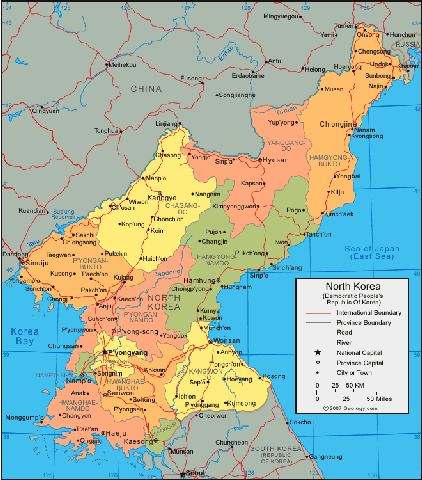
If this doesn’t scare South Koreans enough, Koppen’s data quieted the room. When I asked about the comparison with Korea, and what Koreans should expect, he could only foresee that a sudden border opening would lead to a huge southward flow – maybe 6 million people in the first few years. The differences between east and west Germany were much smaller than NK-SK, yet look at how much population flight has been happened there. One can only imagine how bad it would be here – a 40% depopulation of NK (9 out of 23 million), perhaps? Where would they be housed, how would they be supported, what would they do all day? The questions are endless.

Koppen closed by arguing that a slow federation of North and South would be better than the lightning unification of a sudden border opening as in the German case. Koppen used the EU as a model for Korean unification (an interesting parallel I never considered). As the EU is gradually federating in stages, so might Korea. I have heard this line of reasoning before using a more Asian model – Hong Kong and mainland China. Like that arrangement, perhaps Korea can go through a ‘one country, two systems’ stage. So North Koreans would get temporary work and living permits in the South, while Southern business would be encouraged to go North, with the North reconceived as something like a massive enterprise zone.

I am skeptical for a number of reasons:

1. North Koreans are vastly poorer than not only east Germans, but any of the eastern EU members. The moral pressure to do more faster would be enormous. Paced unification would look like Southern niggardliness in the face of desperation and poverty. Note also, that Hong Kong is quite wealthy, as is surrounding Guangdong province. This helps mitigates the border pressure; the opposite would be the case in a united Korea.

2. The nationalism factor would make holding the North at arms length difficult and distasteful. If the Koreans are one minjoek, as they never cease to tell us expats here, then how can you justify, save unashamed selfishness, keeping Northerners out? It looks bad, and it would certainly encourage populist North Korean politicians to complain about Southern cheapness, etc.

3. Keeping the North in some kind of semi-national limbo would encourage Chinese meddling. Indeed, the slower the unification process goes, the more likely China and others are to stick their noses into it. Conversely, if unification speeds along as a chaotic mess, then even China will likely say, we want nothing to do with the catastrophe-in-the-making; you South Koreans figure it out. This sounds unfortunate – the more anarchic the reunification, the more likely it will be a Korean-only affair, but I think it is so.

4. And in fact, Korean unification is almost certainly going to be messy, rapid, and chaotic if not downright anarchic. If one looks at Germany, once the communist lid was removed, the desire for unification on the part of the east especially, but also the west, exploded and became like a freight train accelerating downhill. It was just unstoppable. Yes, there were all sorts of GDR intellectuals who wanted east Germany to become a unique space, neither capitalist nor communist, but somehow ‘more humane,’ and all that. But the huge bulk of the population wanted nothing to do with such academic airiness, a luxury for elites. Average east Germans wanted nationalism, unity, wholeness, an end to an awful, artificial historical division, and an immediate improvement in living standards. They just pushed aside all those both internally and externally (Thatcher and Mitterand especially) who wanted a paced process. Helmut Kohl led reunification as much as he was led by it. And even though the GDR was supposedly ‘advanced’,’ it turned out not to be at all. The state collapsed almost immediately, and realistically, there was no one to pick up the many, many pieces expect West Germany. I think this is by far the most likely scenario here too. Once North Korea slips, it will go lightning fast. It will be chaotic, unpredictable, with huge national emotions at play and populations on the move, and near anarchy in the North, given how thoroughly illegitimate the state there is. The only realistic way to get control over this nation-wide meltdown will be the immediate extension of SK constitutional authority across the whole peninsula. It will be messy, hugely expensive, and involve the dramatic depopulation of the North, but realistically, I don’t see serious alternatives given how much worse off NK is than Hong Kong, the GDR, or eastern Europe.

It’s the 1930s All Over Again…

currency

The increasing drift toward a ‘currency war’ should worry just about everyone. And it is remarkable given that we already went through this in the 1930s – a collective disaster for all involved, and which everyone realized afterwards was a huge error. Yet here are on the cusp of another round of beggar-thy-neighbor devaluation rounds as everyone seeks to export their way out of the recession.

In case you don’t know the history, start here. Just about everyone learns this story in Econ 101, but here is the quick version: The Great Depression struck in 1929, and everyone panicked. In that sort of adverse environment, everyone starts to save. This is individually rational, as savings represent a hedge against suddenly increased uncertainty about the future. You see that same thing today in the US as Americans are suddenly saving again to pay off their housing and credit card debt in order to get financially sounder. Unfortunately, as people save, they are not spending, and their spending ultimately creates jobs. When you buy stuff at Walmart, a whole slew of people got their jobs to bring you whatever it is that you just bought. This is the well-known paradox of thrift: while it is rational for you the individual to save ask a hedge against the future, if everyone does that, then our collective future gets that much worse because all that missing consumer spending (demand) eventually creates unemployment (less need for supply). Again, this is what is happening today in the US. As Americans retrench on their spending very suddenly and sharply (household savings rates have jumped something like 5% in 24 months), you get a consequent drop in the need for supply. That in turn means you don’t need so many workers to make that supply anymore, so people get fired. US unemployment has therefore suddenly spiked as savings rates spiked.

One good way out of this recessionary trap (high savings –> high unemployment –> worsening economy –> even more fear about the future –> more savings) is to export to others. If others buy your stuff, then you keep all the employment (to supply the foreigners’ demand), but your own consumer can still continue to save. It is a tempting way out that squares the mathematical circle in which, in a closed economy, savings must equal unemployment. But with exports, you can have your cake and eat it too; ie, the economists’ expression ‘export your way out of a recession.’ Now, a good way to make your exports cheaper is for your currency to be cheap against other currencies. Then your stuff is cheaper for foreigners to buy. It is therefore tempting for governments in recession to intervene artificially in currency markets to keep their currencies cheap, indeed maybe even undervalued (China today). Because a cheaper currency means cheaper exports means a quicker route out of recession. And in the 1930s, everybody tried to do this. But just like the paradox of thrift, if everyone tries to cheapen their currency, then no one’s currency becomes cheaper, and very quickly you can get a cycle of government-forced exchange rate devaluations across the board as everyone tries to get a price advantage over everyone else. We call this ‘beggar-thy-neighbor.’

It is now universally acknowledged by just about everyone (except Marxists I suppose) that this was a disaster that lengthened the Great Depression considerably. This intellectual consensus lies behind the creation of the IMF, and the IMF museum (next to the lobby in the Fund building) walks the visitor through this in excellent detail.

And now we are doing it all over again.

So much for learning from history and all that…

This time it is mostly Asians to blame. China, SK, and Japan all intervene regularly (‘fine-tuning’ they call it in SK) to keep their currencies lower than the market would otherwise say. China of course is the worst, and it is leading to some genuinely desperate policy ideas on what to do.

This leads me to two conclusions. First, it is evidence that global governance (GG) continues to fail. The G-20 squabbling over exchange rates so perfectly fits what we know states shouldn’t do, yet they are doing it anyway. This – along with the astonishing, ‘I-don’t-give-a-damn-what-the-world-thinks’ Bush unilateralism – tells me that GG was a dream of the 1990s that is fading fast. Second it tells me that the only answer is cultural change in Asian attitudes toward imports. For decades, a trade surplus (and if necessary, an undervalued currency) were not just natural outcomes of market processes, but an explicit statist-developmental goal wrapped in nationalism. A trade surplus is a mark of national pride and success in the world, and if Asian consumers must be punished with high prices and higher savings to get it, then so be it. In Korea, I see this ‘imports-are-bad’ everyday; contrast that with the American love of cheap Chinese stuff at Walmart. Given that barrier to Asian rebalancing is a cultural one – getting Asians to accept imports without mercantilist-nationalist distaste – that rebalancing is likely to take a long time. Culture changes slowly.

On the Kim Family Succession in North Korea

3highres_00000402386223

Kim Jong-Un (right), the now annointed successor to Jong Il (left)

As usual, Scott Snyder and Ruediger Frank have the best commentary on the succession and it importance for all Korea. Start with them before me.

I would just add a few points.

1. Much of the discussion about NK focuses on its supposed irrationality and unpredictability. I remember reading somewhere that Paul Wolfowitz was once asked which country on earth he feared the most, and he answered NK, because it operated so far outside international norms on just about everything – besides its regular asymmetric strikes against SK (like the Cheonan sinking, KAL 1987 bombing, or the bombing of the SK cabinet in 1983), it also engages in proliferation, drug-trafficking, insurance fraud (as a gimmick to raise money), and dollar counterfeiting. And of course, George Bush put NK on the Axis of Evil, even though it has no connection to Islamic radicalism at all, precisely because of the fear of irrationality linked to WMD. Increasingly though, I don’t buy this, and I think the succession demonstrates that NK is in fact somewhat predictable. I argued this a few weeks ago in Seoul, and the recent family succession, I believe, reinforces this.

While it is true that NK is nasty and does seem to cheat on all sorts of norms, they do this so regularly now, that its cheating is in fact predictable. This feels rather strange of course. Cheating is supposed to indicate unpredictability; but what if you cheat all the time? That too is regularity, right? As I argued in the link above, the Cheonan sinking does actually fit a pattern of asymmetric outbursts from NK in past, so it shouldn’t be a huge surprise, however awful it was. Similarly, the succession happened much as the last one did – from father to son – and lots of analysts, both Asian and Western predicted it, both then and again this time. And then those predications came true. So while it is unfortunate for the long-suffering North Koreans, and its does not bode well for better NK behavior in future, it was not unexpected. I am not fully convinced by this position myself; erratic and weird still seem to be the best words to describe NK. But its also not the case that we can’t make fairly educated guesses about NK’s future.

2. In line with point 1 is the likelihood that Kim III probably won’t change much. Indeed, he sent a huge signal to the whole world by his dress in last week’s coming out party-parade that he is not a Gorbachev. Just about everyone noticed that he looks strikingly like Kim Il Sung (Kim I). Note the hair style, NK lapel pin, Mao outfit, and, quite honestly, the obesity (presumably to signal stolidity and robustness, although it is a good bet too that he is party-boy like his dad). The speculation is endless that he might actually change stuff, but if NK is more predictable than we think (point 1 above), and if he is consciously cloning himself on Kim I, then it is a good bet that business as usual will roll on. In fact, given his youth and, hence, possible longevity, he could give the NK system a new lease on life, just as Bashar al Assad did when he took over Syria. Like NK, Syria is corrupt, isolated and broke, but the sheer energy of a younger dictator has helped hold Syria together and forestall the endless speculation, endemic to any dictatorship, of palace coups and such. If Kim III can hang on through the early years, which will be the toughest, as factions maneuver for influence in the nouveau regime, then we might be looking at a semi-stable NK for another few decades.

3. Finally, I can’t pass up noting the sheer ideological ridiculousness of a communist monarchy. Nothing demonstrates the ideological bankruptcy of NK as much as a family succession. That is a feudal practice, of course, which is exactly the type of thing communism was supposed to eliminate as backward and repressive. Marx and Lenin, we all know, were bitingly harsh in their critiques of feudalism. One of Marx’ most mean-spirited comments was his famous complaint of the ‘idiocy of the peasantry,’ meaning that they stood outside of history as passive, uninformed spectators mired in ignorance. And of course, the primary historical claim of just about every Marxist theorist and leader was that history moved in stages and the communism was the next one after capitalism. When Khrushchev said ‘we will bury you’,’ he meant exactly that these large Marxist-metaphysical forces of History were working against capitalism, no matter what it did to stop, and that communism was the inevitable future. This is why leaders like Stlin and Pol Pot were so harsh on their feudal-agricultural communities; they were ‘behind’ in the marxist historical mechanic. Even Mao had the sense to avoid the ‘familiazation’ of the CCP (his wife didn’t last too long) and famously criticized Confucius as a feudal reactionary. Yet here we have a communist regime openly going back to a pre-capitalist mode, not moving forward into the post-capitalist era as its own ideology says it should. One wonders how in god’s name NK ideologues must work to square this blatant neo-feudalism with regime ideology. It just baffles the mind.

Nobel: Occasionally Reminding China about Human Rights is still Good

Nobel

By now everyone one knows that Liu Xaibao won the Nobel Peace Prize. He is a human rights and democracy activist rotting in a Chinese prison, along with so many others, for laughable, ‘only-in-a-dictatorship’ crimes like ‘insulting the state and national dignity.’ He is most famous in the West for starting the ‘Charter 08,’ probably the most important liberal outburst from Chinese civil society in this decade (and a nice counterpoint to the ‘national humiliation’ nationalism otherwise showcased by the Chinese Internet). Predictably China was acerbic; it threatened Norway (!), because, of course, we all fear Norway rising and its rogue unilateralism. It is worth noting that the Norwegian government does not assign the prize; the independent Nobel Foundation does.

The flap tells us a few things:

1. I am not sure if we should laugh about the Norwegian threat (threatening the Green Nordics who give lots of development aid, have a globally envied living standard, and no military – lol) or lament (Chinese bullying now extends to NATO – yikes). But the Chinese overresponse fits its recent behavior in the South China Sea and toward Japan (as well as NK, I bet; it’s just behind the scenes, so we don’t see it), as well as its now system-threatening monetary interventions and downright bizarre head-in-the-sand denials about the Cheonan sinking. Now it is ok for rising powers to be tvetchy. We expect that. But if the Chinese keep up the bullying, then lots of westerners (think the Kagans) who can’t wait to label China a threat (in part because so many have predicted it) will claim that Chinese foreign policy has taken a major, and nasty, turn. For a long time, China’s claim to a ‘peaceful rise’ rested on its ‘Good Neighbors Policy.’ As Dave Kang has pointed out for years to the ‘China threat’ school, China has generally sought good relations with its neighbors. It has (previously at least) tried to settle border disputes peacefully (most importantly with Vietnam) and has generally sought to be a good institutional player in all those various East Asian semi-organizations like the EAS, ARF or the Six-Party Talks. US business lobby has generally used this to defend engagement with China, in an important pushback against the US military, especially the navy, which is both nervous (a possible peer competitor to break the Pacific-as-American-lake) and secretly hopeful (at last a symmetrical contestant we can understand! unlike all these noxious terrorists against whom our super-cool aircraft carriers are useless). In short, if the Chinese aren’t careful and step back here a bit in the next few months, they could find themselves seriously ringed in. Quick Prediction: the Chinese aren’t stupid. Unlike OBL, they don’t want to take on the whole world. They will pull back, and in six months we will be talking once again about the ‘unpredictable swings in Chinese foreign policy.’

2. I am pleased to see this issue back in discussion, after a decade of quiet. Everyone recalls what a big issue this was in the 1990s. I remember Jay Leno even once had a Chinese-American who had been arrested there on his show. And human rights (and labor) was the big stumbling block behind permanent most favored nation status for China under Clinton. Of course no one wants a war or another cold war, but it is also clear that western engagement can’t just be all flattering and desperate (please keep buying US bonds). Sometimes we need to push them hard on political change too. This is an obvious danger of mixed or contradictory signals – we want to work with you, but we will antagonize you too. But in fact, we do want both. When western governments push for change, it sends the Chinese off the deep end; hence neither Hillary nor Timothy Geithner challenge China on liberalization much anymore. In the end, Google too gave-in (rather disappointing that actually). But western NGOs like Nobel or Amnesty International can also send the other message – that our values are important, that we are genuinely uncomfortable dealing with dictatorships even if we don’t want a cold war, etc. So I think flaps like this, of the earlier Google one, are useful. They tell China that they are limits and expectations – mild, to be sure – that it will lighten up a little on the nationalism and repression. In short, after one experience with a superpower that stepped all over its people and bullied the neighborhood, no one wants to go through that all over again. And the Nobel reminds the CCP leadership of this.

3. Finally, after last year’s ridiculous Nobel choice, this year’s was smart and helps restore the Peace Prize’ good name. In fact, I bet the Foundation figured that after such a light, gauzy choice for Obama, credibility demanded a really tough choice this year. And few human rights cases are harder than China. Like most observers, I applaud the choice, but I am also glad, because I think the prize is a useful weapon in the struggle for human rights and liberalism. It shows up the glaring failures of places like Burma, apartheid South Africa, and China, and tells their elites that the West isn’t always looking the other way for business contracts. So here, here to the Foundation for such a strong choice. My quick choice for next year: Morgan Tsvangirai.

China, Japan, and these Fights over Islands

diaoyut


There has been lots of good commentary recently over the China-Japan flap about the fishing captain. (Start here and here.) I tend to agree that China is setting itself back 5 to 10 years with the neighbors, and that this is the somewhat predictable behavior of a ‘rising’ state. Just about everyone expects China’s appetites to grow as its power grows. It is reasonable to expect China to get pushier in its backyard as it grows, just as the US did in Latin America in the late 19th century. I have just a few extra thoughts:

1. All these left over island disputes leave China (and Japan, Korea, Russia, and ASEAN) with lots of friction points. Just last week, the Japanese told the Russians not to visit their disputed islands either. The standard liberal internationalist answer would be to create some joint committee (indeed, boundary demarcation is one of the few things the World Court does well) to iron out the details. But this has never really happened out here, as it has in other places, like South America, where geography also created confusion. (In SA, it was the highest peaks of the Andes that made the lines unclear.) But in Asia, I have the sneaking suspicion that these island/sea disputes never get resolved in part, because domestic elites don’t really care that much; indeed they may like having them around once in awhile for patriotic rallying purposes. They serve an unremarked domestic utility: These disputes are low cost. They can simply be ignored when necessary. A few rocks here or there have no real economic value; according to UNCLOS, if the rocks are uninhabitable without external provision (ie, food and potable water must be transported in), then possession of the islands has no impact on the claims to the surrounding water either. That is why fishermen so frequently seem to spark these flaps; the seas are wide open to everyone. But because these conflicts-in-waiting are always still hanging around, they can be turned on and off at will – whenever domestic leaders need a rally-round-the-flag effect. This is probably especially useful for deeply illegitimate regimes like China or Russia, or in Japan with its endless rotation of governments in search of credibility. In this, I am reminded of the oft-made accusation that Israel’s Arab neighbors don’t really want the Palestinian-Israeli conflict resolved, because it is a nice deflector of public unhappiness at home.

2. One unremarked deep cause of these flaps is Japan’s slow erosion. Most of the excitement focuses on rising China. But just as important is the steady decline of Japan. If Japan were still rising, as it was until the 1990s, the competition here would be quite different – two rising powers side by side (like India and China). But in the western Pacific, China is walking away with the game because both the US and Japan are in decline, and ASEAN remains in its perpetual disorganized dither. This would create space for China, even if it weren’t booming. But it is, hence doubling the power shift. In fact, this is the weakest Japan has been vis China since the Opium War upended China-Japan relations 170 years ago. This is the most important Asian balance of power shift since the West arrived in East Asia. We are moving back toward the 18th C (not the 19th), when China was dominant in the neighborhood.

3. The Chinese leadership is increasingly boxed in by nationalized opinion. 20 years of patriotic reeducation on the national humiliation has created an unhappy nationalistic youth in China with prestige grudges against Japan and the US. As China gets wealthier and more connected, it will become harder and harder for the CCP to avoid dealing with this, and these island fights are a useful outlet, per point 1 above.

4. China will have a harder time carving out a backyard than the US did. Latin America has been weak for centuries and the rest of the world was far way, so there was an easy vacuum for the US to fill. In Asia, China is next to India, Japan, South Korea, and, a bit further out, Australia. All of them have a much better capacity to push back than Mexico, Argentina, or Brazil ever did. (PS: The Economist says the Monroe Doctrine is dead now. I don’t buy it.)